Every field is a solar classroom.
The simple answer
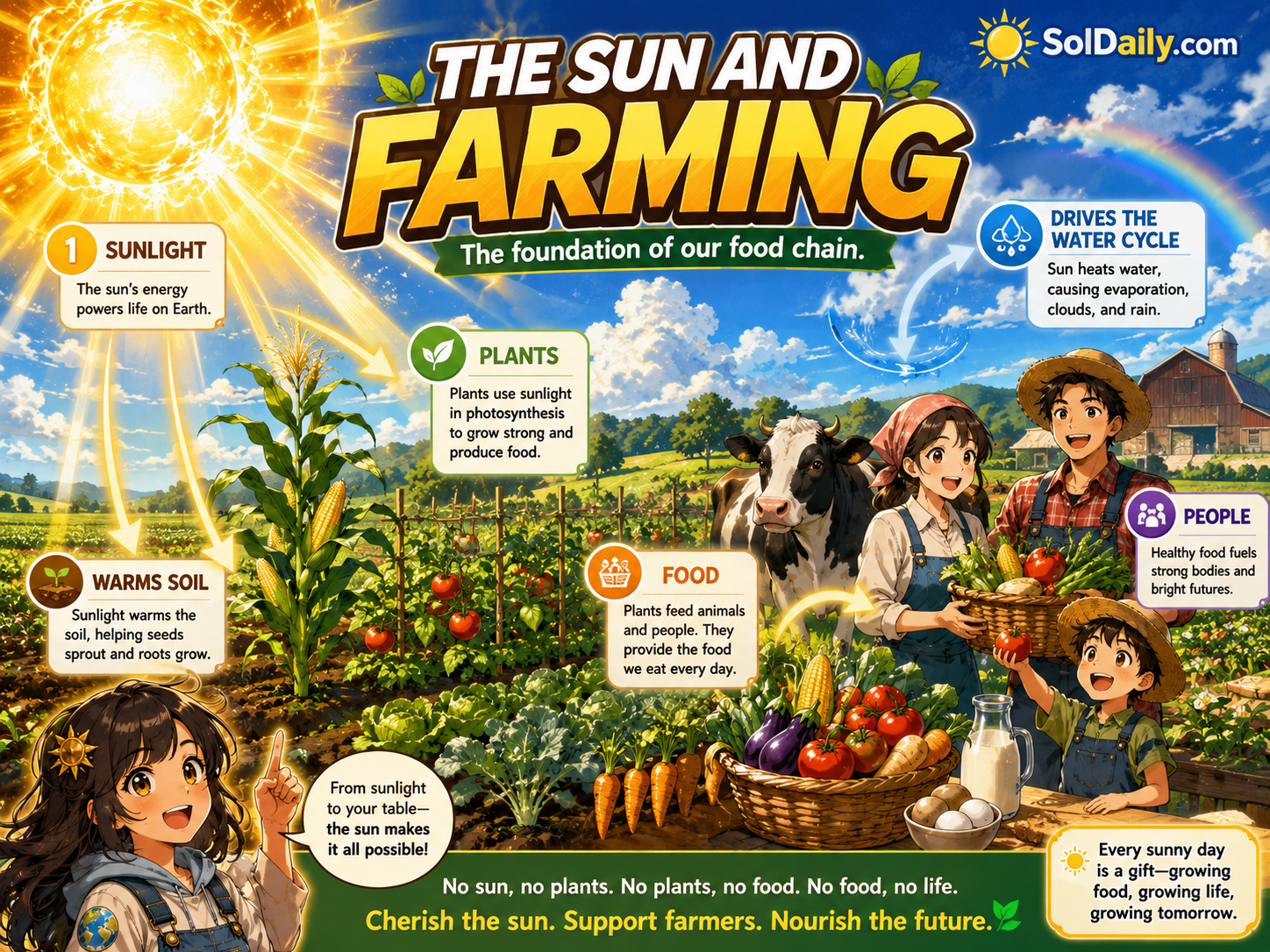
The Sun supports farming by providing the light plants use for photosynthesis, the warmth that affects soil and growing conditions, and the energy that helps drive the water cycle. Farmers plan around sunlight, season, weather, temperature, day length, and water.
Earth Girl Terra calls farming “solar science with dirt under its fingernails.” The Solar Man agrees: a crop field is sunlight made visible through leaves, roots, water, labor, and time.
Sunlight and photosynthesis
Photosynthesis is the process by which plants use sunlight to help convert carbon dioxide and water into sugars. Those sugars support plant growth, and the plant becomes the base of many food chains.
Professor Photon loves standing in a leaf. To him, a leaf is a biological solar receiver. It does not work like a photovoltaic panel, but both are part of the larger story of sunlight being captured and put to use.
Crops need the right amount of light
Different crops need different amounts and patterns of sunlight. Some plants prefer full sun. Some tolerate partial shade. Some are sensitive to day length, while others are less affected. Farming succeeds when crop choice, location, season, and sunlight work together.
Earth Girl Terra reminds the SolDaily newsroom that “more Sun” is not always the only answer. The right light, at the right time, with the right water and temperature, is the real farming story.
| Farm connection | Plain-language meaning | SolDaily character angle |
|---|---|---|
| Photosynthesis | Plants use sunlight to help make sugars for growth. | Professor Photon enters the leaf laboratory. |
| Day length | The number of daylight hours can influence growth and flowering in some crops. | Solar Sensei checks the seasonal calendar. |
| Soil temperature | Sunlight and weather affect how warm the soil becomes. | Earth Girl Terra kneels down to test the field. |
| Water cycle | Solar energy helps move water through evaporation, clouds, rain, and soil moisture. | The Solar Man points from ocean to cloud to field. |
| Farm solar power | Solar panels can help power pumps, buildings, equipment, and operations. | PV Boy brings rooftop and ground-mount lessons to the farm. |
Day length and crop timing
Day length changes through the year because Earth is tilted as it orbits the Sun. Some plants respond strongly to day length, which can influence flowering, growth stages, and seasonal timing.
Solar Sensei calls this the calendar hidden in the sky. Farmers may use planting dates, local knowledge, crop type, frost risk, heat patterns, and daylight timing to plan the season.
Soil warmth matters
Sunlight helps warm the soil, and soil temperature affects seed germination, root growth, microbial activity, and plant development. A field can look ready from a distance, but the soil may still be too cold, too wet, or too dry for a crop.
Earth Girl Terra says farming teaches humility: the Sun shines from above, but the answer is often under your boots.
The Sun and the water cycle
Solar energy helps evaporate water from oceans, lakes, rivers, soils, and plants. Water vapor can form clouds and later return as rain or snow. This cycle is central to farming, irrigation, drought, reservoirs, groundwater, and soil moisture.
The Solar Man sees rain as sunlight’s long route back to the field. Professor Photon says that sounds poetic but technically acceptable.
The Sun feeds the field twice.
First through light that powers photosynthesis. Again through energy that helps move water through sky, cloud, rain, river, soil, and root.
Too little Sun, too much Sun
Too little sunlight can limit plant growth. Too much heat, intense sunlight, or drought stress can also damage crops or reduce yield. Plants need energy, but they also need water balance, suitable temperatures, soil health, and protection from extreme conditions.
Earth Girl Terra keeps the lesson balanced: the Sun is essential, but farming is about managing conditions, not worshiping extremes.
Shade can be helpful or harmful
Shade can reduce photosynthesis for sun-loving crops, but it can also protect some crops from heat stress or reduce water loss in certain conditions. Shade cloth, orchards, greenhouses, and crop spacing all show that farmers actively manage light.
Solar Sensei likes this nuance. In solar panels, shade is usually a production problem. In farming, shade can be problem, tool, or strategy depending on the crop and climate.
Agrivoltaics
Agrivoltaics is the practice of combining solar panels and agriculture on the same land. In some designs, panels provide partial shade while crops, grazing, pollinator habitat, or other agricultural uses continue beneath or around the array.
PV Boy is fascinated by agrivoltaics because it combines two solar stories: plants catching sunlight biologically and panels catching sunlight electrically.
Solar power for farms
Farms can use solar energy to help power buildings, pumps, refrigeration, processing, workshops, electric equipment, water systems, and other loads. The right design depends on farm energy use, utility rules, land, roof space, electrical service, and operations.
The Permit Goblin appears here with a stack of interconnection forms. PV Boy rolls his eyes, but Solar Sensei admits that real farm solar needs proper design, permitting, utility coordination, and safe installation.
Greenhouses and controlled environments
Greenhouses use sunlight while modifying temperature, moisture, wind exposure, and growing conditions. Some operations may also use supplemental lighting, shading systems, ventilation, heating, cooling, or solar power.
Earth Girl Terra calls a greenhouse a sunlight negotiation: let the light in, control the conditions, protect the crop.
Farming and climate patterns
Farming depends heavily on climate and weather. Temperature, frost dates, rainfall, drought, storms, heat waves, humidity, and seasonal sunlight all influence what can be grown and how reliably it can be harvested.
The Solar Man reminds readers that climate is Earth answering sunlight over time, but farming is where those answers become very real.
Why this lesson matters
The Sun and farming matter because food is one of the most direct human connections to solar energy. A meal can be traced back to sunlight, soil, water, seed, labor, biology, and time.
Earth Girl Terra closes the lesson with this: when you understand the Sun, you understand more of the field, the harvest, the roof, and the table.
The Sun and Water Cycle
Follow sunlight into evaporation, clouds, rain, rivers, groundwater, drought, and the movement of water through Earth systems.
Follow the waterThe Sun and Satellites
Return to orbit and learn how sunlight powers satellites while space weather tests their systems.
Back to satellites