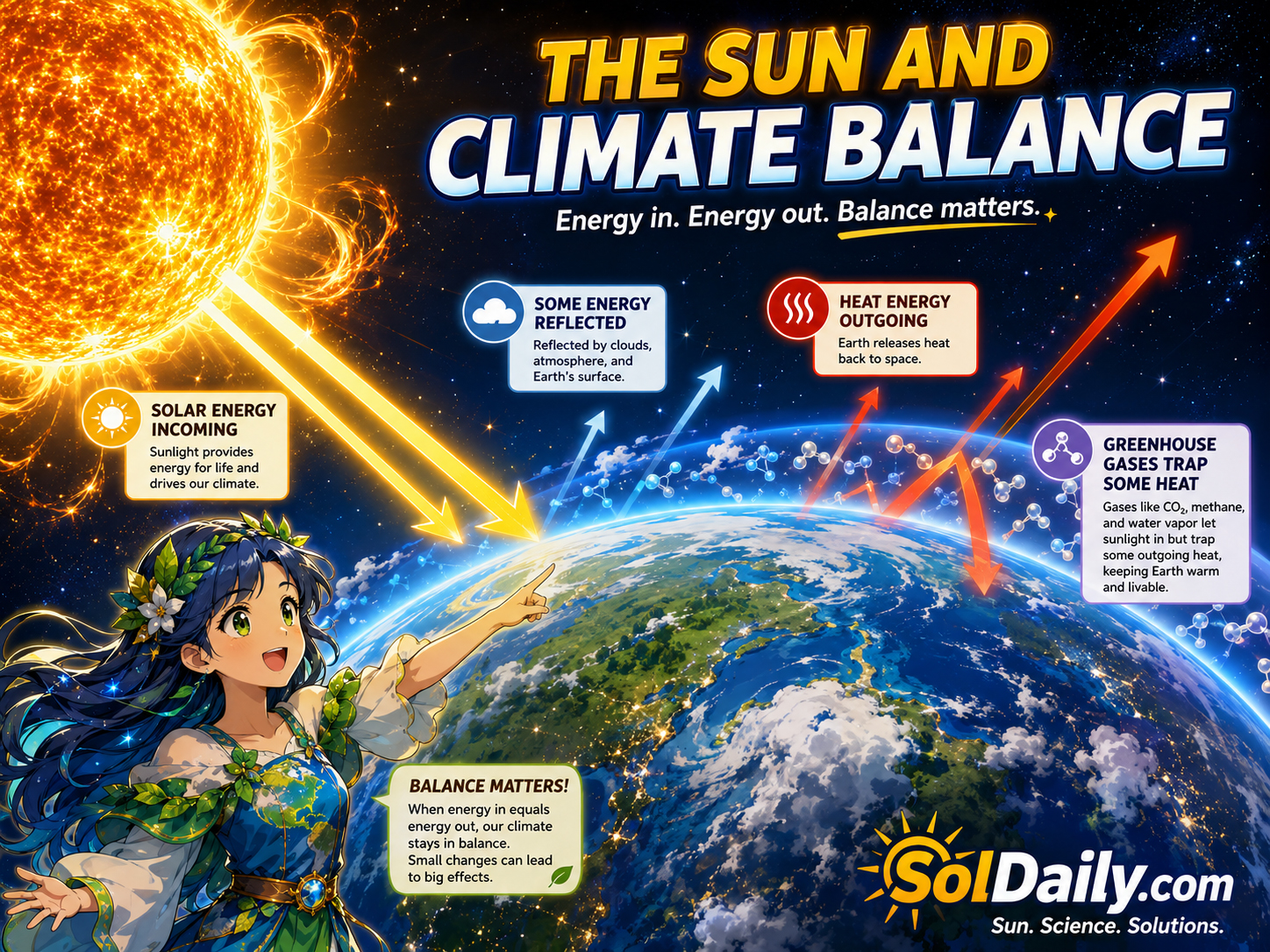
Climate begins with sunlight, but it is shaped by the whole Earth system.
The simple answer
The Sun is the main external energy source for Earth’s climate system. Sunlight warms Earth’s surface, drives winds and ocean circulation, powers evaporation, and helps create weather patterns. But climate depends on how Earth receives, reflects, absorbs, stores, and re-radiates that solar energy.
Earth Girl Terra asks the careful question: if the Sun powers the system, does the Sun explain everything about climate? Solar Sensei answers: no. The Sun is essential, but Earth’s atmosphere, greenhouse gases, oceans, ice, land, clouds, and human activity all affect the final climate story.
Weather versus climate
Weather is what is happening in the atmosphere over short time periods: today’s heat, tomorrow’s rain, this week’s wind, or a specific storm. Climate is the long-term pattern of weather conditions over years, decades, and longer.
Captain Flare loves weather because it is dramatic. Solar Sensei studies climate because patterns matter more than single moments.
| Climate concept | Plain-language meaning | SolDaily character angle |
|---|---|---|
| Solar input | Energy arriving from the Sun. | The Solar Man points to the source of the system. |
| Albedo | How much sunlight a surface reflects. | Earth Girl Terra compares ice, ocean, roofs, deserts, and forests. |
| Greenhouse effect | Atmospheric gases absorb and re-radiate heat energy. | Solar Sensei draws the atmosphere as a thermal blanket. |
| Oceans | Huge heat reservoirs that store and move energy around Earth. | The Solar Wind Riders are jealous of ocean currents. |
| Climate feedbacks | Processes that can amplify or reduce climate changes. | Professor Photon warns that systems can answer back. |
Earth’s energy balance
Earth receives energy from the Sun and sends energy back to space. Climate depends on the balance between incoming solar energy and outgoing infrared energy. If Earth keeps more energy than it releases, the system warms. If it releases more than it receives, the system cools.
The Solar Man sees this as the grand scale version of a budget: energy in, energy out, and many processes deciding what happens in between.
Reflection: albedo
Albedo describes how reflective a surface is. Bright surfaces such as ice, snow, and some clouds reflect more sunlight. Darker surfaces such as oceans, forests, and asphalt absorb more sunlight.
Earth Girl Terra makes this practical: what Earth looks like matters. Ice sheets, cloud cover, land use, oceans, rooftops, deserts, and vegetation all affect how sunlight is reflected or absorbed.
Earth does not receive sunlight as one flat surface.
Ice reflects differently from ocean. Forests absorb differently from deserts. Clouds change the story. Earth’s surface and atmosphere decide what happens to incoming light.
Absorption and heat
When sunlight is absorbed by land, water, buildings, vegetation, or the atmosphere, that energy can become heat. Different materials absorb and store heat differently. Water warms and cools differently from land, and cities behave differently from forests or fields.
Solar Sensei uses this to connect climate science to everyday experience: a blacktop parking lot, a shaded garden, a beach, and a forest do not feel the same under the same Sun.
The greenhouse effect
The greenhouse effect is a natural process that helps keep Earth warmer than it would be without an atmosphere. Certain gases in the atmosphere absorb and re-radiate infrared energy, influencing how heat leaves Earth.
The important distinction is balance. The natural greenhouse effect helps make Earth habitable. Changes in greenhouse gas concentrations can change the energy balance and affect climate.
The Sun and climate change
Solar variation can influence climate, and scientists study changes in solar output, orbital patterns, volcanic activity, aerosols, greenhouse gases, land use, oceans, and other factors. However, modern climate change cannot be explained by simply saying “the Sun did it.” Climate analysis requires comparing all major drivers.
Solar Sensei handles this carefully: the Sun is fundamental, but explanations must match measurements, timing, physics, and multiple lines of evidence. The Solar Man does not accept lazy answers, even when they flatter the Sun.
Oceans store and move heat
Oceans are enormous heat reservoirs. They absorb, store, and move energy through currents and interactions with the atmosphere. Ocean temperatures affect weather patterns, storms, humidity, regional climate, and long-term climate behavior.
Earth Girl Terra calls the oceans Earth’s slow-moving memory of heat.
Clouds complicate the picture
Clouds can reflect incoming sunlight back to space, which can cool the surface below. They can also trap outgoing infrared energy, which can have a warming influence. The effect depends on cloud type, height, thickness, location, timing, and surrounding conditions.
Professor Photon says clouds are not simple villains or heroes. They are complicated atmospheric characters with more than one role.
Ice, snow, and feedbacks
Ice and snow reflect sunlight. When reflective ice decreases, darker ocean or land may absorb more solar energy. That can reinforce warming in some regions. This is an example of a climate feedback.
The Solar Man treats feedbacks with respect because they show that Earth systems can respond to change in ways that strengthen or weaken the original push.
Volcanoes, aerosols, and particles
Particles in the atmosphere can affect climate by scattering or absorbing sunlight and by influencing clouds. Large volcanic eruptions can inject particles high into the atmosphere and temporarily affect the amount of sunlight reaching the surface.
Captain Flare complains that volcanoes are Earth’s attempt at solar drama. Earth Girl Terra reminds him that terrestrial systems have their own power.
Climate and solar panels
Solar panels respond to local sunlight, weather, shade, temperature, and system design. Climate affects the long-term patterns a solar system operates within: sunny seasons, cloudy seasons, heat, snow, dust, smoke, storm exposure, and roof conditions.
PV Boy keeps it practical: a solar production estimate is not just “the Sun exists.” It depends on location, climate, equipment, roof geometry, shade, and real-world operation.
Solar energy and climate responsibility
Solar energy is one tool for producing electricity from current sunlight rather than burning stored fuels. It is not the only energy solution and it does not erase every climate challenge, but it is an important practical technology in the larger energy story.
The Solar Man frames solar power as a direct relationship with the present Sun: photons arriving now, converted by equipment now, used by people now.
Why this lesson matters
The Sun and climate matter because the Sun provides the energy, but Earth decides the outcome through atmosphere, oceans, land, ice, clouds, gases, and living systems. Understanding climate means understanding both the source and the system.
Earth Girl Terra closes the lesson this way: climate is not just sky. Climate is Earth answering sunlight over time.
The Sun and Satellites
Learn how sunlight, solar panels, radiation, solar wind, and space weather affect satellites and space technology.
Enter orbitThe Sun and Life on Earth
Return to the living systems page and see how sunlight supports plants, food chains, water cycles, warmth, and daily rhythms.
Back to life under Sol