Before there was a bill, there was a star. Before there was a wire, there was light.
The simple answer
The Sun is a star: a massive sphere of extremely hot gas and plasma held together by gravity. Deep inside its core, nuclear fusion releases enormous energy. That energy slowly moves outward, eventually leaving the Sun as light, heat, and other forms of radiation.
To Earth, the Sun feels familiar because we see it every day. But Solar Sensei would say: do not mistake familiar for simple. The Sun is a giant natural power plant, weather driver, clock, calendar, and life-support system.
The Solar Man’s view
The Solar Man sees the Sun as the first chapter in every energy story. Coal, oil, natural gas, food, wind, water cycles, and solar panels all trace back to sunlight in one way or another. The Sun is not merely a ball of fire in the sky. It is the original energy economy.
When a rooftop solar panel makes electricity, it is not creating energy from nowhere. It is catching a tiny part of the sunlight that began as nuclear fusion in the Sun’s core.
The Sun is mostly hydrogen and helium
The Sun is made mostly of hydrogen, with helium as the second major ingredient. In the core, hydrogen nuclei are squeezed under extreme pressure and temperature until fusion occurs. Fusion converts hydrogen into helium and releases energy.
Professor Photon loves this part because it is where the story of light begins. A photon born from solar energy does not simply fly straight out of the Sun. It can bounce and scatter through the dense solar interior before energy finally reaches the surface and escapes into space.
The Sun has layers
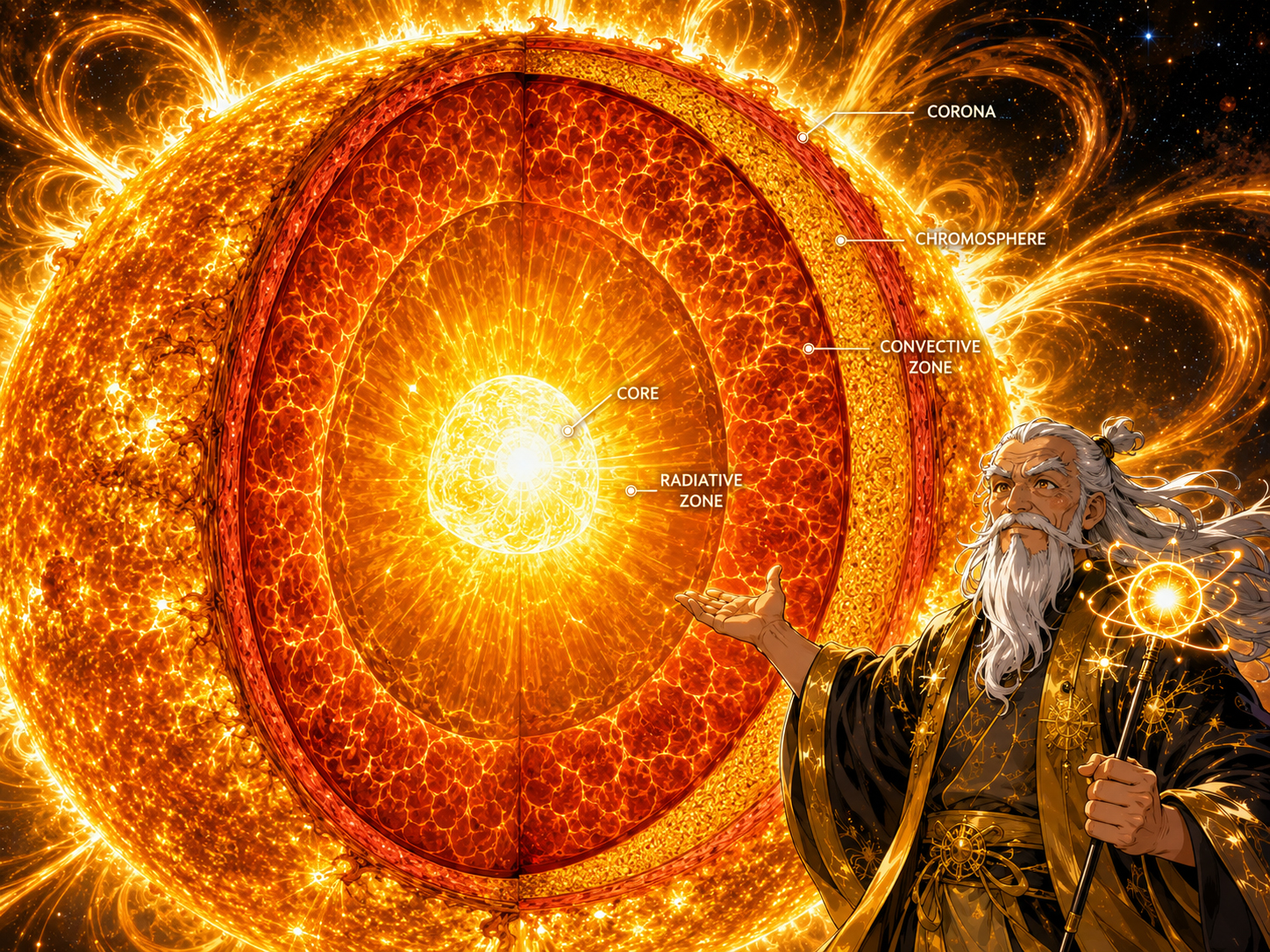
A useful way to understand the Sun is to think of it as a layered star.
| Layer | What it does | SolDaily character angle |
|---|---|---|
| Core | The central region where nuclear fusion releases energy. | Solar Sensei explains the engine room. |
| Radiative Zone | Energy moves outward through radiation and repeated interactions. | Professor Photon begins the long escape story. |
| Convective Zone | Hot plasma rises and cooler plasma sinks, carrying energy toward the surface. | The Sun becomes a boiling manga ocean of motion. |
| Photosphere | The visible “surface” of the Sun, where most sunlight we see comes from. | The Solar Man points to the light humans recognize. |
| Chromosphere | A thin layer above the photosphere with dramatic solar activity. | Captain Flare starts getting loud. |
| Corona | The outer atmosphere of the Sun, visible during total solar eclipses. | Madame Corona reveals her crown. |
The Sun’s gravity holds the solar system together
The Sun is by far the dominant mass in our solar system. Its gravity holds planets, dwarf planets, asteroids, comets, and countless smaller objects in orbit.
Earth does not simply float near the Sun. Earth is in a gravitational relationship with the Sun. That relationship creates the year, anchors the orbit, and gives our planet its place in the solar system.
The Sun gives Earth daylight and heat
Daylight is sunlight reaching the side of Earth facing the Sun. Night happens because Earth rotates away from direct sunlight. Seasons happen because Earth’s axis is tilted, changing the angle and duration of sunlight through the year.
This is where Earth Girl Terra steps in. She asks the practical question: what does the Sun mean for people on the ground? It means warm afternoons, plant growth, weather patterns, solar production, seasonal behavior, and the daily rhythm of life.
The Sun is active, not static
The Sun looks steady from Earth, but it is constantly moving, churning, and changing. Magnetic fields twist through solar plasma. Sunspots appear. Flares erupt. Coronal mass ejections can send charged material into space.
The Sunspot Twins teach that dark-looking areas on the Sun can still be powerful. Captain Flare teaches that magnetic energy can be released suddenly. The Solar Wind Riders show that charged particles can stream outward through the solar system.
The Sun is not quiet.
From Earth, it may look like a steady disk of light. Up close, the Sun is a living ocean of plasma, magnetism, motion, eruptions, particles, and radiant power.
The Sun and solar panels
Solar panels work because sunlight carries energy. When photons strike a photovoltaic cell, they can help move electrons and produce electric current. That is the practical bridge between the solar science of SolDaily.com and the real-world work of solar energy.
PV Boy would put it this way: a photon enters, an electron gets ideas, and the system begins turning sunlight into electricity.
Why the Sun matters
The Sun matters because it is not just an astronomy subject. It is connected to energy, food, water, weather, climate, time, construction, farming, technology, satellites, and solar power. Every solar panel is a small practical reminder that the Sun is not only beautiful. It is useful.
That is why SolDaily.com treats the Sun as a character, a force, a classroom, and a story worth telling.
Nuclear Fusion
Go deeper into the core and learn how hydrogen becomes helium, releasing the energy that eventually reaches Earth as sunlight.
Enter the coreEpisode 1: The Day He Became Sol
The opening manga story where The Solar Man transforms and begins the SolDaily mission.
Read episode 1