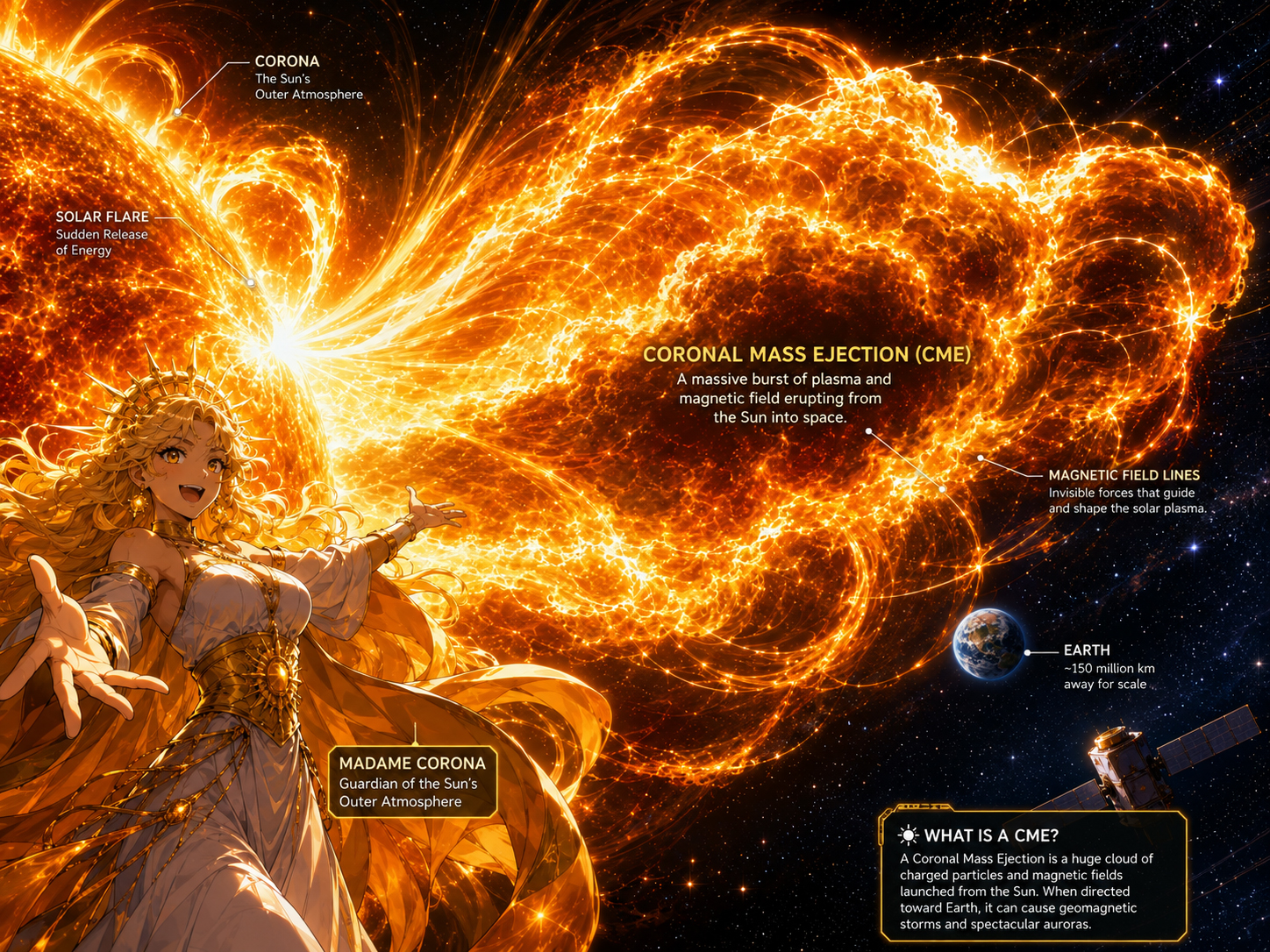
“Beauty, in solar physics, is often violent.” — Madame Corona
The simple answer
A coronal mass ejection is a massive eruption from the Sun’s outer atmosphere. It can send billions of tons of charged solar material and embedded magnetic field outward into space. Unlike a solar flare, which is a burst of radiation, a CME is a large moving cloud of plasma and magnetism.
Madame Corona calls a CME “the crown casting off a storm.” Solar Sensei calls it a magnetized plasma eruption. Captain Flare calls it “not my explosion, but respect.”
What does “coronal mass ejection” mean?
The word “coronal” points to the corona, the Sun’s outer atmosphere. “Mass” means physical solar material, mostly plasma. “Ejection” means that material is launched outward into space.
In SolDaily manga terms, Madame Corona opens her radiant crown, magnetic field lines stretch and reorganize, and a huge solar cloud is released into the solar system.
The corona is not calm
The corona may look delicate during a total solar eclipse, but it is a powerful region shaped by hot plasma and magnetic fields. Loops, streamers, and eruptions can form there. A CME is one of the most dramatic ways the corona shows its strength.
The Solar Man reminds readers not to confuse elegance with weakness. The corona can be beautiful, mysterious, and capable of launching space weather across millions of miles.
| CME concept | Plain-language meaning | SolDaily character angle |
|---|---|---|
| Corona | The Sun’s outer atmosphere, where many dramatic structures are visible. | Madame Corona wears it as her crown. |
| Plasma | Hot charged solar material launched outward during the eruption. | The Solar Wind Riders call it storm fuel. |
| Magnetic field | Embedded magnetism travels with the ejected material. | The magnetic dragon lines leave the Sun. |
| Direction | A CME matters more to Earth if it is aimed toward Earth. | Earth Girl Terra asks, “Is it coming here?” |
| Geomagnetic storm | Earth’s magnetic environment can be disturbed if a CME interacts strongly with it. | The Aurora Sisters may begin dancing. |
CMEs and solar flares
CMEs and solar flares are often discussed together because both involve solar magnetic activity. But they are different. A solar flare is a sudden release of electromagnetic radiation. A CME is a large eruption of solar plasma and magnetic field.
Sometimes a strong solar event includes both a flare and a CME. In that case, Captain Flare provides the flash and Madame Corona sends the massive cloud outward.
Flash versus cloud.
A flare is the flash of released radiation. A CME is the moving solar storm cloud. One travels as light. The other travels as magnetized material through space.
How fast do CMEs travel?
CMEs can travel through space at very different speeds. Some move relatively slowly by solar standards, while others race outward extremely fast. Unlike light from a flare, a CME usually takes much longer to reach Earth because it is physical material moving through space, not radiation traveling at light speed.
Professor Photon is proud of this distinction. Light gets the speed crown. The Solar Wind Riders get the road trip.
What happens if a CME reaches Earth?
If a CME is directed toward Earth and its magnetic field couples strongly with Earth’s magnetic environment, it can produce a geomagnetic storm. This can energize auroras and may affect satellites, radio communication, navigation systems, aviation operations, and electric power infrastructure.
Earth Girl Terra makes the page practical: most people on the ground are not personally struck by a CME like a lightning bolt. Earth’s atmosphere and magnetic field provide major protection. The concern is the modern technology connected to near-Earth space and long electrical systems.
CMEs and auroras
Auroras can become stronger and appear farther from the poles during geomagnetic storms. When charged particles and magnetic disturbances interact with Earth’s upper atmosphere, atoms and molecules can emit colorful light.
In SolDaily lore, the Aurora Sisters dance when solar disturbances reach Earth’s magnetic stage. Madame Corona may have sent the storm, but Earth’s magnetic field choreographs the performance.
How scientists watch CMEs
Scientists use solar observatories, spacecraft, coronagraphs, and space weather instruments to observe CMEs. A coronagraph can block the bright disk of the Sun so faint structures in the corona become easier to see.
Solar Sensei loves this tool because it is like putting a hand in front of a bright lamp so you can finally see the glow around it. Madame Corona calls it “proper stage lighting.”
CMEs and the solar wind
The solar wind is the steady outflow of charged particles from the Sun. A CME is different: it is a major eruption traveling through that solar wind environment. When a CME moves outward, it can disturb the solar wind and carry magnetic structure with it.
The Solar Wind Riders do not own every CME, but when a CME enters interplanetary space, they are the ones racing alongside the disturbance.
CMEs and solar panels
A CME does not normally change a home solar panel’s power production in the same direct way that clouds or shade do. For everyday solar output, local sunlight conditions and system design matter most.
However, severe space weather can be relevant to large power grids, satellites, communications, and the broader technology environment. PV Boy keeps the practical distinction clear: rooftop production is about sunlight at the panel; space weather is about the Sun’s effect on technological systems around and above Earth.
Why CMEs matter
Coronal mass ejections matter because they show the Sun as an active star connected to the rest of the solar system. The Sun does not merely shine. It releases material, shapes space, drives storms, and interacts with Earth’s magnetic shield.
The Solar Man respects Madame Corona because she teaches the grand scale of Sol. A CME is not just a solar event. It is the Sun reaching outward.
Solar Wind
Ride with the Solar Wind Riders and learn how charged particles stream from the Sun through the solar system.
Ride the solar windSolar Flares
Return to Captain Flare and learn how sudden magnetic energy releases create intense bursts of radiation.
Back to flares