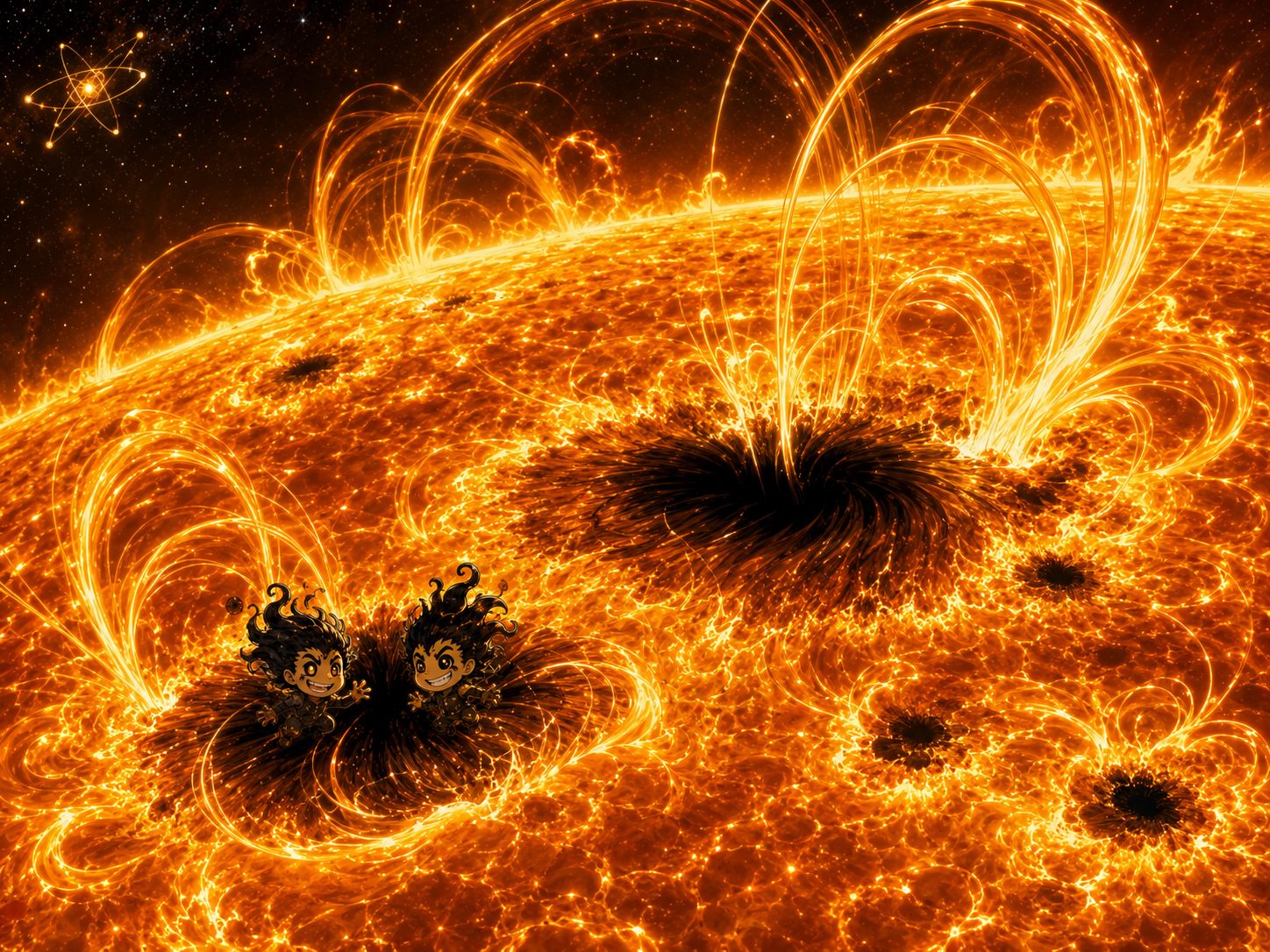
“Dark? Yes. Weak? Hardly.” — The Sunspot Twins
The simple answer
Sunspots are areas on the Sun’s photosphere that appear darker than their surroundings. They are darker because they are cooler than the nearby solar surface. But “cooler” does not mean cold, and “dark” does not mean powerless.
The Sunspot Twins love this misunderstanding. They wait for someone to say, “That spot looks quiet,” and then they start twisting magnetic field lines into trouble.
Why sunspots look dark
Sunspots appear dark by contrast. The surrounding photosphere is so bright that a cooler region looks like a dark mark. If you could somehow view a sunspot by itself away from the Sun’s glare, it would still be intensely bright.
Professor Photon considers this a lesson in comparison. Brightness is not just about an object by itself. It is also about what surrounds it.
Sunspots are magnetic
Sunspots form where intense magnetic fields interfere with the normal motion of hot plasma. The Sun is made of plasma, which means charged particles are moving in powerful, complicated ways. Magnetic fields can shape and constrain that motion.
The Sunspot Twins personify this perfectly. They are not random ink stains on the Sun. They are signs that magnetism is doing something important beneath and around the surface.
| Sunspot feature | What it means | SolDaily character angle |
|---|---|---|
| Dark appearance | Sunspots look dark because they are cooler than the surrounding photosphere. | The Twins grin whenever someone mistakes dark for weak. |
| Magnetic field | Strong magnetic fields shape and suppress normal plasma motion. | General Magneto Sol would call this magnetic discipline. |
| Umbra | The darker central part of a sunspot. | The Twins call it their shadow throne. |
| Penumbra | The lighter surrounding region around the umbra. | Solar Sensei draws the ring on the chalkboard. |
| Active region | A magnetically complex area that may be associated with flares or eruptions. | Captain Flare starts watching from the doorway. |
Umbra and penumbra
Many sunspots have a darker central region called the umbra and a lighter surrounding region called the penumbra. These parts show that a sunspot is not just a simple dot. It can have structure, texture, and magnetic complexity.
In manga language, the umbra is the Twins’ secret base and the penumbra is the swirling border where their magnetic tricks begin to show.
Sunspots and the solar cycle
Sunspots are connected to the Sun’s activity cycle. Over roughly an eleven-year rhythm, the number of visible sunspots tends to rise and fall. More sunspots usually mean the Sun is in a more active part of its cycle.
Earth Girl Terra cares about this because solar activity can matter beyond astronomy. A more active Sun can be associated with more flares, eruptions, and space weather concerns.
The solar cycle is our schedule of mischief.
Sunspots rise and fall with the Sun’s magnetic rhythm. When the Sun becomes more active, the surface can become a louder, stranger, more dramatic place.
Sunspots and solar flares
Sunspots themselves are not solar flares, but magnetically complex sunspot regions can be associated with flares. Solar flares happen when magnetic energy is suddenly released in the Sun’s atmosphere.
Captain Flare loves hanging around active regions. When magnetic fields become twisted, stressed, or rearranged, he waits for his explosive entrance.
Sunspots and coronal mass ejections
Some active regions can also be connected to coronal mass ejections, or CMEs. A CME is a large eruption of solar material and magnetic field into space. Not every sunspot creates a CME, but sunspot groups are important markers of solar activity.
Madame Corona does not blame the Twins for everything, but she watches them carefully. Magnetic complexity near the surface can connect upward into the corona, where dramatic structures and eruptions can form.
Why astronomers track sunspots
Scientists track sunspots because they are visible clues to the Sun’s magnetic behavior. Counting and mapping sunspots helps researchers understand solar activity and compare activity across time.
Solar Sensei calls sunspots “surface punctuation marks.” They help reveal the mood and rhythm of the star.
Can sunspots affect Earth?
Sunspots do not usually affect Earth directly just by existing. The bigger concern is the solar activity that can come from magnetically active regions, such as flares and coronal mass ejections. These can contribute to space weather that affects satellites, radio communications, navigation systems, and power infrastructure.
The Solar Wind Riders enter here. If charged particles and magnetic disturbances move through space toward Earth, they may interact with Earth’s magnetic field and atmosphere. That is where auroras and space weather effects become part of the story.
Sunspots and solar panels
For everyday rooftop solar production, local conditions like shade, clouds, angle, roof orientation, panel condition, and system design are usually much more immediate concerns than individual sunspots.
PV Boy keeps this practical. Sunspots are fascinating solar science, but your solar production on a given day is more likely to be shaped by weather, time of day, season, shade, and equipment behavior.
Why sunspots matter
Sunspots matter because they prove the Sun is not a simple glowing ball. It is active, magnetic, layered, and changing. Sunspots reveal the hidden force lines behind solar drama. They are dark marks that point to bright science.
The Sunspot Twins are mischievous because magnetism itself is mischievous. It twists, stores energy, releases energy, and makes the Sun more interesting than a plain disk of light.
Solar Flares
Captain Flare makes his entrance and explains sudden releases of magnetic energy.
Meet Captain FlareSolar Radiation
Return to the solar spectrum and learn how light, infrared, ultraviolet, and energy travel from the Sun.
Back to radiation