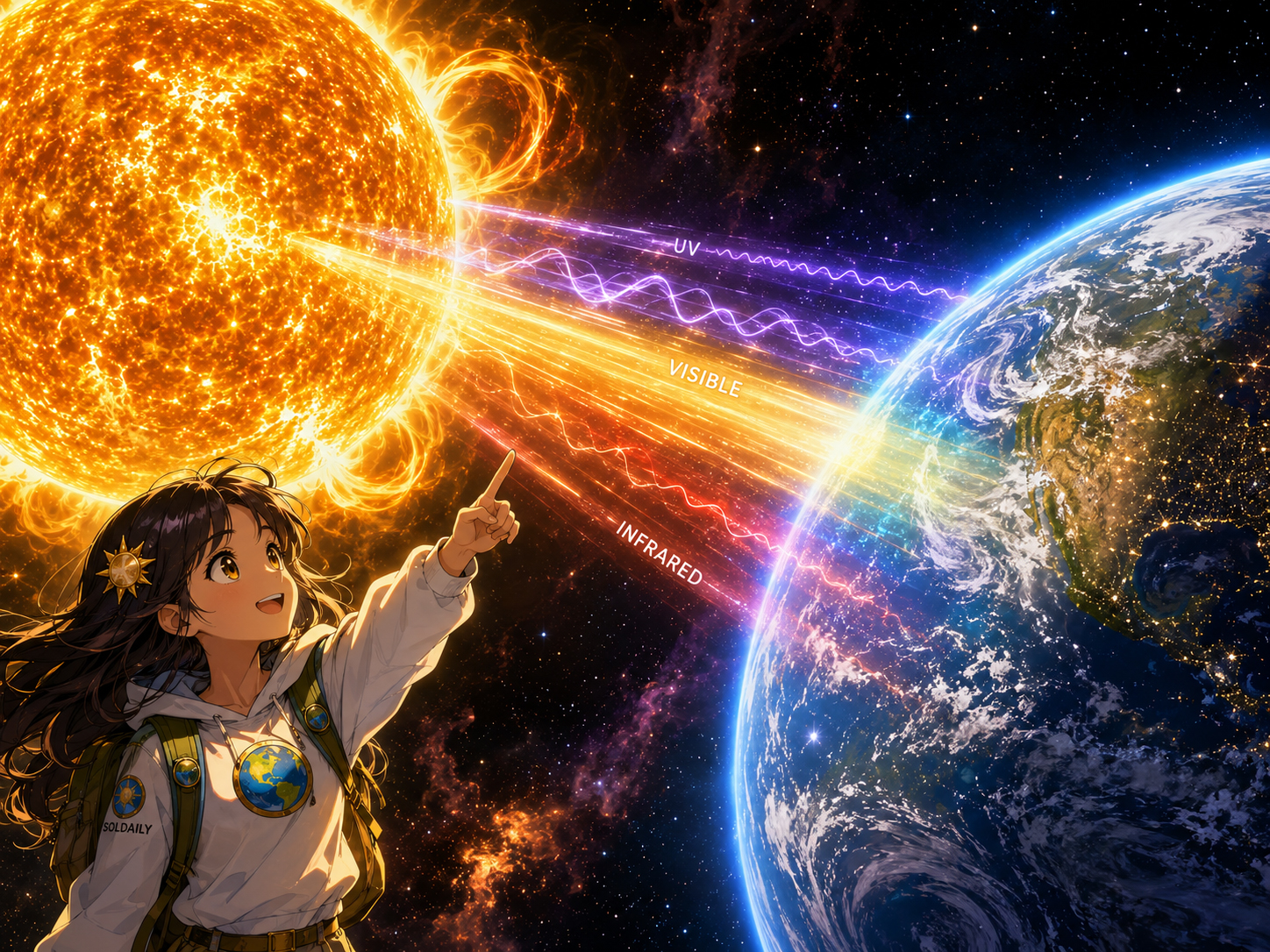
Sunlight is what we see. Solar radiation is the larger family of energy behind it.
The simple answer
Solar radiation is the energy emitted by the Sun. Some of it is visible light that human eyes can see. Some of it is infrared energy that we often experience as warmth. Some of it is ultraviolet energy, which can affect skin, eyes, materials, and the atmosphere.
Solar Sensei would say: do not let the word “radiation” frighten you by itself. Radiation simply means energy traveling outward. The key questions are what kind, how much, and how it interacts with Earth.
The solar spectrum
The solar spectrum is the range of electromagnetic energy coming from the Sun. Human eyes only see a narrow slice of that range. That visible slice is the rainbow of colors we call visible light.
Professor Photon likes to describe the spectrum as a manga lineup: low-energy characters on one side, high-energy characters on the other, and visible light in the middle where human eyes can recognize the cast.
| Type of solar energy | What it means | SolDaily character angle |
|---|---|---|
| Visible light | The part of sunlight humans can see; it creates brightness and color. | Professor Photon rides the beam everyone notices. |
| Infrared | Longer-wavelength energy often felt as heat. | The Solar Man reminds us that sunlight warms Earth. |
| Ultraviolet | Shorter-wavelength energy beyond violet; important for safety and atmospheric effects. | Solar Sensei brings out the safety rules. |
| X-rays and extreme ultraviolet | Higher-energy radiation connected to solar activity and space weather. | Captain Flare gets dramatic during eruptions. |
| Radio energy | Lower-energy electromagnetic radiation that can be produced by solar processes. | The Solar Wind Riders tune into the cosmic broadcast. |
Wavelength and energy
One way to understand solar radiation is by wavelength. Longer wavelengths generally carry lower photon energy. Shorter wavelengths generally carry higher photon energy. This is why ultraviolet radiation is treated differently from visible light or infrared.
Professor Photon insists on this point because not all photons behave the same way. A photon’s energy matters. Different materials absorb, reflect, transmit, or convert different parts of sunlight in different ways.
What reaches Earth?
Not all solar radiation that leaves the Sun reaches the ground. Earth’s atmosphere reflects, absorbs, scatters, and filters sunlight. Clouds reflect a lot of light. Ozone absorbs much of the most harmful ultraviolet radiation. Air molecules scatter sunlight, helping make the sky appear blue.
Earth Girl Terra asks the practical question: what actually reaches people, plants, rooftops, roads, oceans, and solar panels? That depends on the Sun’s angle, the atmosphere, weather, season, haze, clouds, and local shade.
The atmosphere is part shield, part filter, part stage.
The sunlight that arrives at the top of the atmosphere is not exactly the same sunlight that reaches a sidewalk, garden, or solar panel.
Solar radiation and heat
Infrared radiation is strongly connected with heat. When sunlight is absorbed by land, water, buildings, pavement, or skin, that absorbed energy can become thermal energy. This is one reason sunny surfaces warm up.
The Solar Man sees heat as one of the Sun’s obvious signatures on Earth. A cold morning changes when sunlight reaches the ground. A roof warms. A wall warms. A blacktop surface warms. The energy came from Sol.
Solar radiation and safety
Solar radiation is essential, but it also deserves respect. Ultraviolet radiation can damage skin and eyes. Looking directly at the Sun can injure vision. Eclipse viewing requires proper solar viewing protection. SolDaily.com treats solar science as exciting, but never careless.
Solar radiation and solar panels
Solar panels convert part of sunlight into electricity. The photovoltaic effect depends on photons interacting with solar cell material. Different solar technologies respond differently across the solar spectrum, which is why panel design and real-world conditions matter.
PV Boy would say: the panel is a translator. Sunlight arrives as electromagnetic energy, and the solar cell helps translate part of that light into electrical current.
Irradiance: how much solar power arrives
In practical solar energy, people often talk about irradiance. Irradiance means the amount of solar power arriving on a surface per unit area. A panel receiving strong, direct sunlight has more available solar energy than a panel in shade or under heavy clouds.
This is why a solar system’s production changes through the day and through the seasons. The amount of radiation reaching the panel is not fixed. It changes with angle, weather, shading, air clarity, and the position of the Sun.
Direct, diffuse, and reflected sunlight
Sunlight can reach a surface in different ways. Direct sunlight travels from the Sun to the surface in a straight path. Diffuse sunlight has been scattered by the atmosphere or clouds. Reflected sunlight bounces from nearby surfaces.
Solar Sensei likes this lesson because it prevents sloppy thinking. A cloudy day is not the same as night. A shaded panel is not the same as a clear panel. Light can scatter, reflect, and still matter, but direct bright sunlight is usually strongest for production.
Why solar radiation matters
Solar radiation matters because it connects the Sun’s physics to Earth’s reality. It explains daylight, warmth, weather, atmospheric filtering, UV safety, plant growth, and solar panel performance.
The Solar Man treats solar radiation as the language of Sol. The Sun speaks in light, heat, particles, waves, and energy. SolDaily.com is here to translate.
Sunspots
Meet the Sunspot Twins and learn why dark magnetic regions on the Sun are not weak, quiet, or unimportant.
Meet the Sunspot TwinsPhotons and Sunlight
Return to Professor Photon’s first lesson on light packets, sunlight, and the trip from the Sun to Earth.
Back to photons