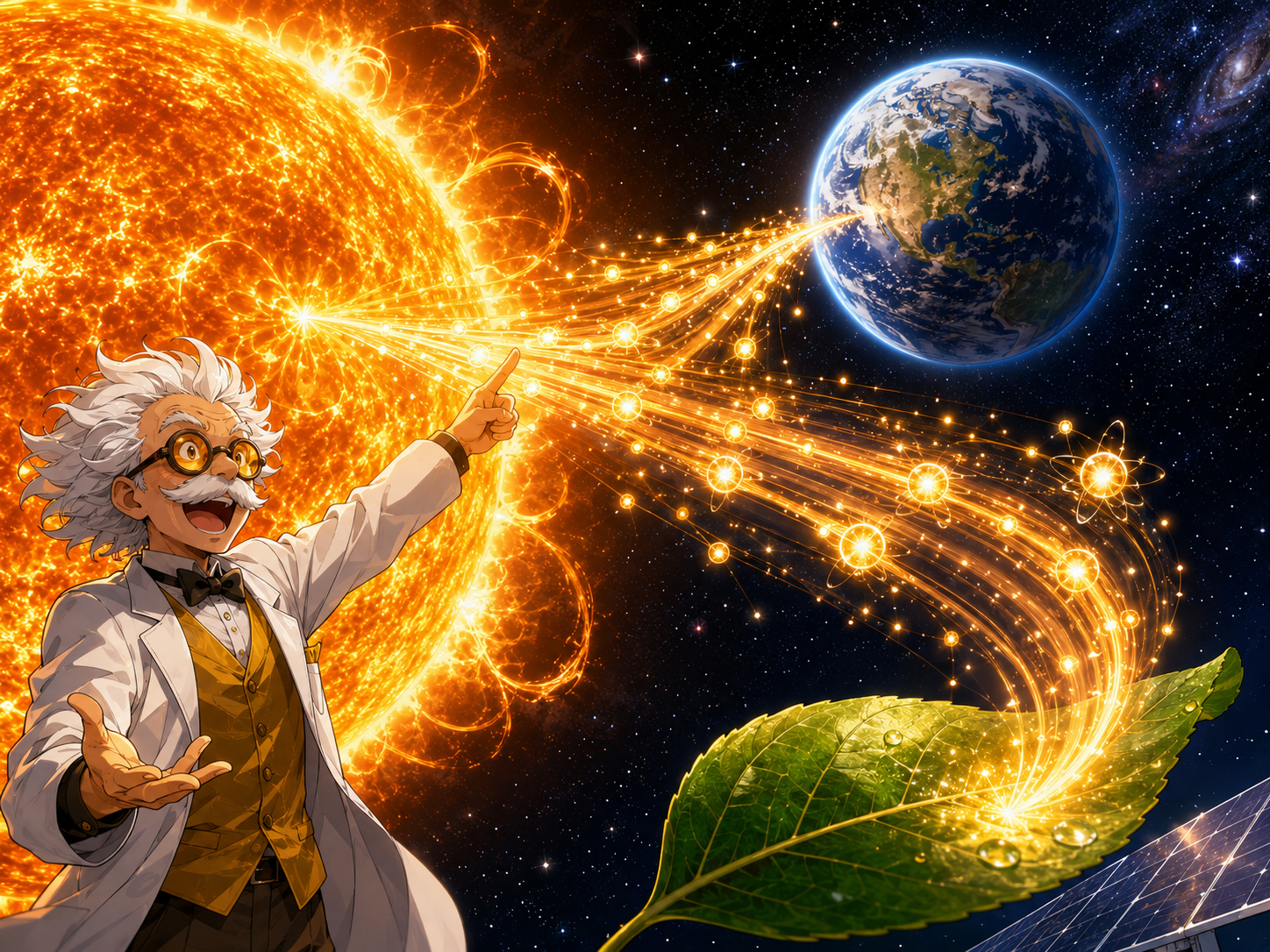
“Do not call me tiny. I carry civilization.” — Professor Photon
The simple answer
A photon is a tiny packet of electromagnetic energy. Sunlight is made of photons. When sunlight leaves the Sun and travels through space, photons carry energy toward Earth. Some of that energy warms the planet, drives weather, supports plant life, and can be captured by solar panels.
Solar Sensei would say it plainly: photons are how the Sun delivers energy across empty space without needing a wire, pipe, truck, fuel tank, or delivery invoice.
Where sunlight begins
The sunlight story begins with nuclear fusion in the Sun’s core. Fusion releases energy. That energy moves through the dense solar interior, changes form along the way, and eventually escapes from the visible surface of the Sun.
Once light escapes into space, it travels outward at the speed of light. A tiny fraction of that sunlight reaches Earth. To us, that fraction is everything: daylight, warmth, photosynthesis, weather motion, and the raw energy used by photovoltaic panels.
Sunlight is electromagnetic radiation
The word “radiation” can sound frightening, but in solar science it simply means energy traveling as waves or particles through space. Visible light is one form of electromagnetic radiation. Sunlight also includes infrared and ultraviolet energy.
| Part of sunlight | Plain-language meaning | SolDaily character angle |
|---|---|---|
| Visible light | The part human eyes can see. | Professor Photon waves from the beam of light. |
| Infrared | Energy we often experience as heat. | The Solar Man reminds Earth that warmth matters. |
| Ultraviolet | Higher-energy light beyond violet, important for safety and atmosphere lessons. | Solar Sensei brings out the safety chalkboard. |
| Photons | Packets of light energy. | Professor Photon insists on proper respect. |
| Solar spectrum | The range of sunlight energy reaching Earth. | Earth Girl Terra asks what reaches the ground. |
Photons do not need air to travel
Sound needs a medium like air or water to travel. Sunlight does not. Photons can travel through the vacuum of space. That is why energy from the Sun can cross the distance to Earth even though space between the Sun and Earth is mostly empty.
Captain Flare finds this unfair because he prefers dramatic entrances. Professor Photon does not need drama. He crosses space with mathematical confidence.
The trip to Earth
After sunlight leaves the Sun, it travels across space and reaches Earth in minutes. When it arrives, different things can happen. Some sunlight is reflected by clouds, ice, water, land, and buildings. Some is absorbed and becomes heat. Some drives photosynthesis. Some strikes solar panels.
Earth Girl Terra sees sunlight as the daily connection between the star and the ground: morning, noon, afternoon, shadows, weather, plants, rooftops, and electric bills.
Sunlight is the bridge.
Fusion happens in the Sun’s core. Electricity happens in the solar system on Earth. Sunlight is the bridge between the star and the panel.
Photons and solar panels
A solar panel uses photovoltaic cells to convert sunlight into electricity. When photons strike the right material inside a solar cell, they can transfer energy to electrons. That energy can help electrons move, creating electric current.
PV Boy makes the manga version simple: a photon arrives, an electron wakes up, and the circuit gets a job.
Not every photon does the same job
Solar panels respond differently to different wavelengths of light. Some photons carry enough energy to help produce electricity. Others may not be useful for a given solar cell. Some energy can also be lost as heat.
That is why real solar design cares about more than “sunny or not sunny.” Angle, shade, temperature, panel type, inverter design, roof layout, and time of day all affect how much usable electricity a solar system produces.
Sunlight changes through the day
Morning sunlight arrives at a lower angle. Midday sunlight is usually stronger because the Sun is higher in the sky. Afternoon sunlight changes again. Clouds, smoke, haze, shade, roof orientation, and season all influence how much light reaches a panel.
Solar Sensei would call this the difference between the myth of “the Sun is out” and the practical reality of solar production. The Sun may be shining, but the amount of useful light at the panel depends on conditions.
Photons, heat, and confusion
People often mix up light and heat. Sunlight can warm things, but photovoltaic solar panels primarily convert light into electricity. Hotter is not automatically better for solar panels. In fact, high heat can reduce electrical performance.
This is one of Professor Photon’s favorite corrections. Solar power is not simply “hot equals good.” It is light, materials, voltage, current, temperature, and system design working together.
Why photons matter to SolDaily
Photons matter because they connect the Sun’s deepest physics to everyday life. They are the carriers of the sunlight story. Without photons, the Sun’s energy would not arrive as daylight. Without daylight, plants would not grow the way they do. Without photons reaching solar cells, photovoltaic panels would have nothing to catch.
The Solar Man treats every photon as a messenger from Sol. Tiny, fast, and silent — but powerful enough to change the world when billions upon billions arrive together.
Solar Radiation
Learn how sunlight fits into the larger family of electromagnetic radiation and why different wavelengths matter.
Study solar radiationNuclear Fusion
Return to the Sun’s core and see how fusion releases the energy that begins the sunlight journey.
Back to fusion