“That was not an interruption. That was a demonstration.” — Captain Flare
The simple answer
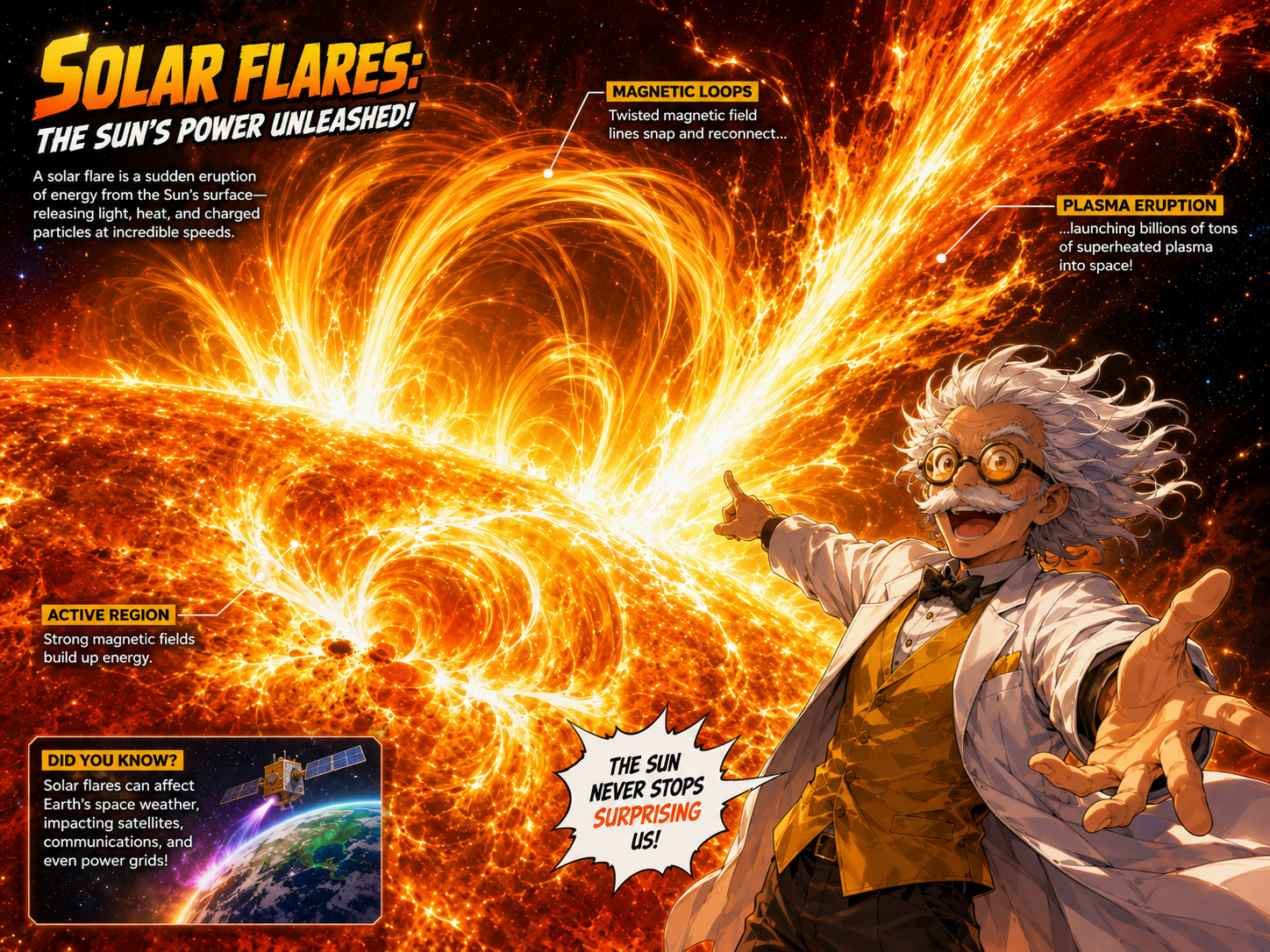
Solar flares are explosive releases of energy from the Sun. They happen when magnetic energy stored in the solar atmosphere is suddenly released. That release can produce intense radiation, bright flashes, energetic particles, and dramatic activity near the Sun’s surface and atmosphere.
Captain Flare loves to make this lesson loud, but Solar Sensei keeps the definition clear: a flare is not ordinary sunlight becoming brighter everywhere. It is a sudden, localized release of magnetic energy.
Where solar flares happen
Flares often occur in active regions, especially around complex sunspot groups. These regions can contain tangled magnetic fields. When magnetic field lines become stressed, twisted, or rearranged, stored energy can be released suddenly.
The Sunspot Twins are usually nearby, grinning from the magnetic shadows. They do not create every flare, but their active regions are often the kind of places where Captain Flare likes to make an entrance.
The magnetic trigger
The Sun is made of plasma, a hot state of matter filled with charged particles. Moving charged particles interact with magnetic fields. On the Sun, magnetic fields can become stretched, tangled, and unstable.
When the magnetic field rapidly rearranges, energy can be released. In manga terms: the magnetic dragon lines snap into a new pattern, and Captain Flare bursts through the panel yelling about “educational explosions.”
| Flare concept | Plain-language meaning | SolDaily character angle |
|---|---|---|
| Active region | A magnetically complex area on the Sun where strong activity can occur. | The Sunspot Twins set the stage. |
| Magnetic reconnection | Magnetic field lines rearrange and release stored energy. | Captain Flare calls it his grand entrance cue. |
| Radiation burst | A flare can emit energy across many wavelengths, including X-rays and ultraviolet. | Professor Photon puts on safety goggles. |
| Energetic particles | Some flare events are associated with accelerated particles. | The Solar Wind Riders get ready to move. |
| Space weather | Solar activity can affect technology and conditions near Earth. | Earth Girl Terra asks what it means for people. |
What solar flares release
A flare can release energy across the electromagnetic spectrum, including visible light, ultraviolet, and X-rays. The high-energy radiation from strong flares can reach near-Earth space quickly because electromagnetic radiation travels at the speed of light.
Professor Photon is very serious here. Not all photons are gentle classroom examples. Higher-energy radiation can matter for satellites, radio communication, astronauts, and space weather monitoring.
Solar flares and coronal mass ejections
Solar flares and coronal mass ejections are related solar activity, but they are not the same thing. A flare is a burst of radiation. A coronal mass ejection, or CME, is a large eruption of solar material and magnetic field into space.
Sometimes flares and CMEs happen together. Sometimes they do not. Captain Flare is the flash. Madame Corona may be involved when the outer atmosphere throws a much larger mass of plasma into space.
A flare is not the same as a CME.
A solar flare is a burst of radiation. A coronal mass ejection is a large eruption of solar material and magnetic field. They can occur together, but they are different events.
Can solar flares affect Earth?
Strong solar flares can affect Earth’s upper atmosphere and near-Earth space environment. They can contribute to radio blackouts, affect satellite operations, and increase radiation concerns for astronauts and high-altitude aviation routes in some cases.
Earth Girl Terra asks the practical question: should ordinary people panic? Solar Sensei’s answer is no. Most people on the ground are protected by Earth’s atmosphere and magnetic environment. But modern technology can be sensitive to space weather, so monitoring matters.
How flares are classified
Solar flares are commonly classified by their X-ray brightness. The familiar classes are A, B, C, M, and X, with X-class flares being the strongest category in that system. Within a class, numbers give more detail.
Captain Flare thinks “X-class” sounds like a tournament ranking. Solar Sensei allows the joke because it helps readers remember that flare strength matters.
Solar flares and auroras
Flares themselves are not simply aurora machines. Auroras are usually connected to charged particles interacting with Earth’s magnetic field and atmosphere. CMEs and solar wind disturbances often play a major role in geomagnetic storms and aurora displays.
The Solar Wind Riders take over when the story moves from a burst at the Sun to charged particles and magnetic disturbances traveling through space toward Earth.
Solar flares and solar panels
For everyday rooftop solar production, local sunlight conditions are usually more important than individual solar flare events. Clouds, shade, season, panel angle, inverter behavior, and system design are the normal production drivers.
PV Boy keeps the lesson grounded: a flare is fascinating solar physics and important for space weather, but your solar panel’s daily output is usually about the sunlight reaching your roof and how your system converts it.
Why solar flares matter
Solar flares matter because they show that the Sun is active, magnetic, and capable of sudden change. They connect invisible magnetic stress to visible drama and practical technology concerns.
The Solar Man respects Captain Flare because chaos can still teach. A flare is a reminder that the Sun is not just a lamp in the sky. It is a dynamic star.
Coronal Mass Ejections
Madame Corona reveals what happens when the Sun throws a huge cloud of plasma and magnetic field into space.
Meet the CMESunspots
Return to the Sunspot Twins and learn how magnetic active regions set the stage for solar drama.
Back to sunspots