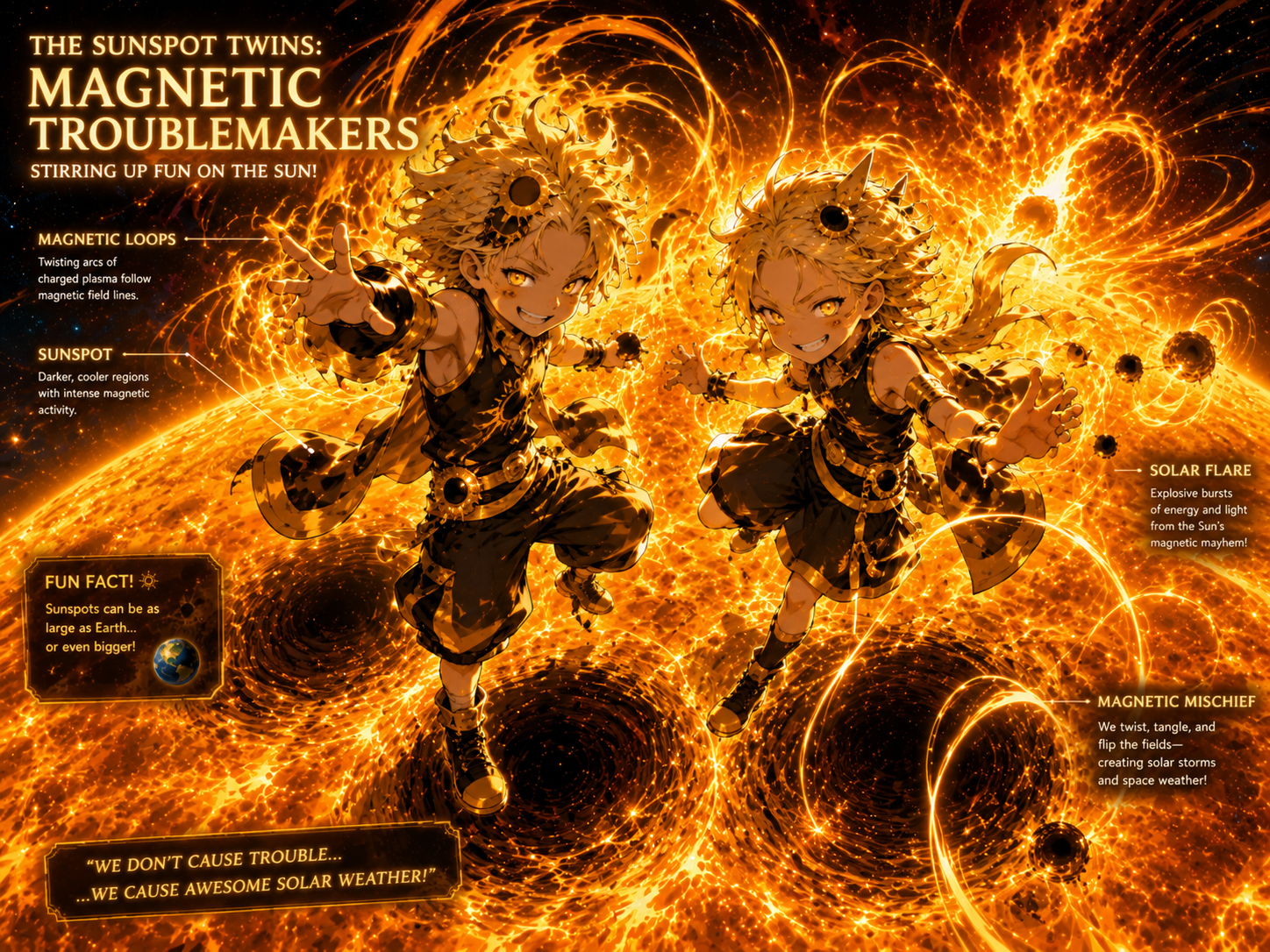
“Dark? Yes. Weak? Hardly.”
Who are the Sunspot Twins?
The Sunspot Twins are recurring foils in the SolDaily universe. They represent sunspots: darker-looking regions on the Sun’s visible surface that are cooler than their surroundings and strongly connected to magnetic activity.
They are not true villains. They are mischief-makers. They enjoy confusing beginners, bending magnetic field lines into trouble, and letting people assume that “dark” means “unimportant.”
Their role on SolDaily.com
The Sunspot Twins create teachable conflict. They interrupt clean explanations with misunderstandings, traps, magnetic riddles, and sarcastic remarks. Then Solar Sensei corrects the misconception and turns their mischief into a lesson.
They are especially important because sunspots connect multiple solar topics: magnetic fields, active regions, solar cycles, flare buildup, and space weather.
| Sunspot Twins trait | Meaning | Best page use |
|---|---|---|
| Dark solar markings | They represent cooler-looking sunspot regions. | Sunspot diagrams and character closeups. |
| Magnetic swirls | They show that sunspots are tied to strong magnetic fields. | The Sun’s magnetic field and active region pages. |
| Twin dynamic | One can be sly and one can be chaotic. | Comedy panels and myth corrections. |
| Shadow throne | The darker umbra becomes their central base. | Umbra and penumbra explanations. |
| Solar-cycle calendar | They appear more often when solar activity rises. | Solar cycle and space weather pages. |
Visual identity
The Sunspot Twins should look mischievous, magnetic, and instantly connected to dark solar regions. They can wear matching black-and-gold outfits, swirling magnetic accessories, solar spot symbols, and animated shadow halos.
One Twin can be sly, clever, and calculating. The other can be louder, goofier, and more impulsive. Together, they should feel like a magnetic comedy duo.
Dark solar marks + gold edges + magnetic swirls.
The Sunspot Twins should look like trouble, but their trouble should always lead to a better explanation.
Personality
The Twins are smug, funny, competitive, and clever. They enjoy being underestimated. They like asking trick questions and setting up beginner mistakes.
They should be mischievous rather than evil. Their role is to create tension and humor while helping readers understand that the Sun is magnetic and active.
Signature lines
- “Dark? Yes. Weak? Hardly.”
- “You saw a spot. We saw a strategy.”
- “Magnetism is never innocent.”
- “Cooler does not mean cold, class.”
- “Active region? We prefer ‘dramatic neighborhood.’”
What the Sunspot Twins teach
The Sunspot Twins own the lessons about sunspots, magnetic activity, and the buildup to dramatic solar behavior.
Dark does not mean cold
One of the Twins’ favorite tricks is letting readers assume sunspots are cold because they look dark. Solar Sensei corrects this every time. Sunspots look dark because they are cooler than the surrounding photosphere, but they are still extremely hot.
Professor Photon calls this a contrast lesson. The Sunspot Twins call it “excellent branding.”
Umbra and penumbra
Many sunspots have a dark central region called the umbra and a lighter surrounding region called the penumbra. In SolDaily language, the umbra is the Twins’ shadow throne, and the penumbra is the magnetic border where the trouble spreads.
This gives the Twins a natural way to make sunspot structure memorable without turning the page into a dry vocabulary list.
The Twins and magnetism
Sunspots are connected to strong magnetic fields. Magnetic activity can affect the movement of plasma near the solar surface, helping create the darker-looking regions we observe.
The Twins are not simply “dark spots with faces.” They are visual shorthand for magnetic structure, field complexity, and the Sun’s active behavior.
The Twins and the solar cycle
Sunspot numbers rise and fall with the Sun’s activity cycle. During more active periods, more sunspots are often visible. During quieter periods, fewer appear.
The Twins call the solar cycle their festival schedule. Solar Sensei calls it a major clue to the Sun’s magnetic rhythm.
The Twins and Captain Flare
Captain Flare often appears around the Twins because active sunspot regions can be linked to solar flare activity. The Twins twist the magnetic mood. Captain Flare makes the loud entrance.
This relationship gives SolDaily a strong action pattern: magnetic mischief builds, Solar Sensei gets suspicious, Professor Photon checks the emissions, and Captain Flare explodes into the panel.
The Twins and Madame Corona
Magnetic activity near the Sun’s surface can connect upward into the corona. Madame Corona watches the Twins carefully because their active regions can help set the stage for coronal loops and larger solar eruptions.
The Twins think this makes them royalty. Madame Corona strongly disagrees.
The Twins and Solar Sensei
Solar Sensei is the Twins’ main classroom opponent. They introduce a misconception. He corrects it. They create a magnetic puzzle. He draws the field lines. They hide in the umbra. He labels the penumbra.
Their tension makes science pages livelier and easier to remember.
Educational powers
The Sunspot Twins’ powers should always make sunspot science and magnetism clearer.
| Power | Educational meaning | Best use |
|---|---|---|
| Shadow Contrast | Shows why sunspots look dark compared to the surrounding photosphere. | Sunspot basics. |
| Magnetic Twist | Illustrates strong, tangled magnetic fields. | Magnetic field and active region pages. |
| Umbra Hideout | Explains the darker central region of a sunspot. | Sunspot structure diagrams. |
| Penumbra Ring | Explains the lighter outer region around a sunspot. | Sunspot structure diagrams. |
| Cycle Surge | Shows how sunspot numbers change with solar activity. | Solar cycle explanations. |
How to write them
The Sunspot Twins should speak in short, smug, playful lines. They should sound like they know a secret and enjoy watching the class almost get it wrong.
They should sound like this:
“Everyone notices the dark part. Almost nobody asks what the magnetism is doing.”
How not to write them
Do not make the Twins true villains. Sunspots are not evil. They are natural solar features. The Twins should create mischief, not moral danger.
Also do not make them only comic relief. They carry real science: contrast, magnetic fields, sunspot structure, active regions, and the solar cycle.
Best pages for the Sunspot Twins
The Sunspot Twins should appear heavily on:
- Sunspots
- The Sun’s Magnetic Field
- Solar Flares
- Space Weather
- Episode 3: The Sunspot Twins Cause Trouble
Why the Sunspot Twins matter
The Sunspot Twins matter because they make solar magnetism visible. A reader might ignore an abstract discussion of magnetic fields, but they will remember two mischievous dark characters bragging that “dark does not mean weak.”
They turn a spot on the Sun into a story.
Sunspots
Learn the real science behind the Twins: dark-looking regions, magnetic activity, umbra, penumbra, and the solar cycle.
Study sunspotsEpisode 3: The Sunspot Twins Cause Trouble
Read the episode where the Twins turn a simple lesson into magnetic mischief.
Read episode 3