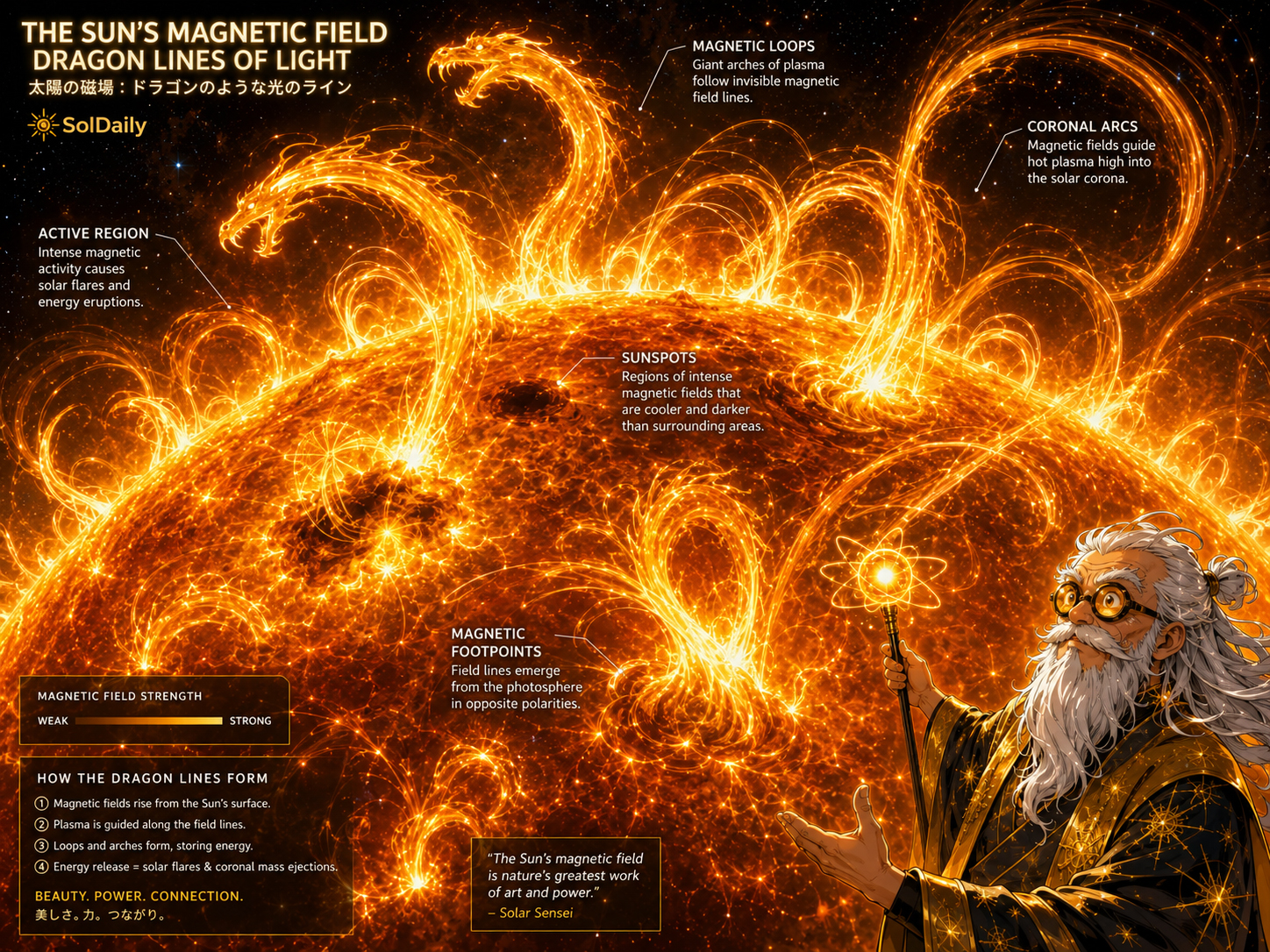
Magnetism is the Sun’s invisible choreography.
The simple answer
The Sun has a magnetic field created by moving charged plasma inside it. Because the Sun is hot, ionized, rotating, and constantly in motion, its magnetic field becomes complex. That magnetism helps shape many of the features we see: sunspots, coronal loops, solar flares, coronal mass ejections, and the solar wind.
Solar Sensei calls the magnetic field the Sun’s hidden lesson plan. The Solar Man calls it the invisible script of Sol. The Sunspot Twins call it “where the fun begins.”
Why the Sun has magnetism
The Sun is not solid. It is a giant sphere of hot plasma. Plasma is made of charged particles, and charged particles in motion can generate and interact with magnetic fields. The Sun’s rotation and internal motion help create a powerful and changing magnetic system.
Professor Photon keeps this distinction clean: photons carry light, but moving charged particles help create magnetic behavior. Both matter to the Sun, but they are different parts of the story.
The Sun does not rotate like a solid ball
Because the Sun is plasma instead of solid rock, different parts of it rotate at different rates. The equator can rotate faster than the polar regions. This differential rotation can help twist and stretch magnetic field lines over time.
In SolDaily manga language, the magnetic dragon lines get pulled, wrapped, and tangled as the star turns. When they become stressed enough, the Sun can become more active.
| Magnetic feature | What it means | SolDaily character angle |
|---|---|---|
| Magnetic field lines | Invisible paths showing magnetic direction and structure. | The magnetic dragon lines coil around Sol. |
| Differential rotation | Different parts of the Sun rotate at different speeds. | Solar Sensei explains why the field gets twisted. |
| Sunspots | Dark-looking regions where strong magnetism affects surface plasma. | The Sunspot Twins claim the magnetic stage. |
| Coronal loops | Arches of hot plasma guided by magnetic fields in the corona. | Madame Corona wears them like radiant jewelry. |
| Magnetic reconnection | Field lines rearrange and release stored energy. | Captain Flare bursts through the panel. |
Magnetic fields and sunspots
Sunspots are one of the most visible clues that the Sun has a magnetic personality. Strong magnetic fields can interfere with normal plasma motion near the visible surface. This can make regions cooler than their surroundings, causing them to appear dark.
The Sunspot Twins love this lesson because it proves their favorite motto: dark does not mean weak. Sunspots are dark-looking magnetic clues.
Magnetic fields and solar flares
Solar flares are powered by sudden releases of magnetic energy. When magnetic fields become twisted, stressed, or unstable, they can rearrange rapidly. That process can release energy as radiation and energetic particles.
Captain Flare lives for these moments. He is not random noise. He is the loud result of magnetic energy being released in dramatic fashion.
When magnetic fields snap into a new pattern, the Sun can shout.
Solar flares are one of the ways the Sun releases stored magnetic energy. The flash is dramatic, but the hidden story is magnetism.
Magnetic fields and CMEs
Coronal mass ejections can carry magnetic field along with plasma as they move outward into space. This is why CMEs can be important for space weather. The magnetic structure of the CME can interact with Earth’s magnetic environment if the eruption is directed toward our planet.
Madame Corona treats this as royal power: the corona does not merely glow. It can release magnetic storms into the solar system.
Magnetic fields and the corona
Magnetic fields shape the corona into loops, streamers, and other structures. Since the corona is made of charged plasma, magnetic fields can guide and organize the motion of that plasma.
This is why solar images often show beautiful arcs above the Sun’s surface. Those arcs are not decoration. They are magnetic architecture.
Magnetic fields and the solar wind
The solar wind carries charged particles outward from the Sun. The Sun’s magnetic field also extends outward through the solar wind, helping shape the heliosphere. The solar wind and magnetic field together create a vast solar influence throughout the solar system.
The Solar Wind Riders ride this structure. They do not just travel through empty space. They travel through a magnetic environment shaped by Sol.
The solar cycle
The Sun’s magnetic activity rises and falls in a cycle of roughly eleven years. Sunspot counts increase and decrease with this activity cycle. Around the peak of the cycle, the Sun is usually more magnetically active.
Solar Sensei frames the solar cycle as the Sun’s magnetic rhythm. The Sunspot Twins call it their festival calendar.
Earth’s magnetic connection
Earth has its own magnetic field. When solar wind, CMEs, and magnetic disturbances reach near-Earth space, Earth’s magnetosphere responds. This interaction is central to space weather and auroras.
Earth Girl Terra asks the practical question: what happens when the Sun’s magnetic story reaches Earth’s magnetic shield? That is where space weather begins to matter for satellites, radio signals, navigation, aviation, and power infrastructure.
Magnetism and solar panels
Solar panels use photons from sunlight to make electricity. The Sun’s magnetic field does not directly power a rooftop panel. However, magnetism matters to the larger solar story because it shapes the Sun’s activity and space weather environment.
PV Boy keeps the practical lesson simple: photovoltaic power is about light at the panel; solar magnetism is about the star’s behavior.
Why the Sun’s magnetic field matters
The Sun’s magnetic field matters because it explains why the Sun is active. Without magnetism, the Sun would be much harder to understand. Magnetism connects dark sunspots, brilliant flares, huge CMEs, glowing coronal loops, the solar wind, auroras, and space weather into one larger story.
The Solar Man respects the magnetic dragon lines because they reveal the hidden order behind solar drama. The Sun shines because of fusion, but it performs because of magnetism.
Space Weather
Learn how solar wind, flares, CMEs, and magnetic disturbances can affect conditions around Earth.
Enter space weatherSolar Wind
Ride with the Solar Wind Riders and learn how charged particles stream from the Sun through the solar system.
Back to solar wind