“A photon enters. An electron gets ideas.” — PV Boy
The simple answer
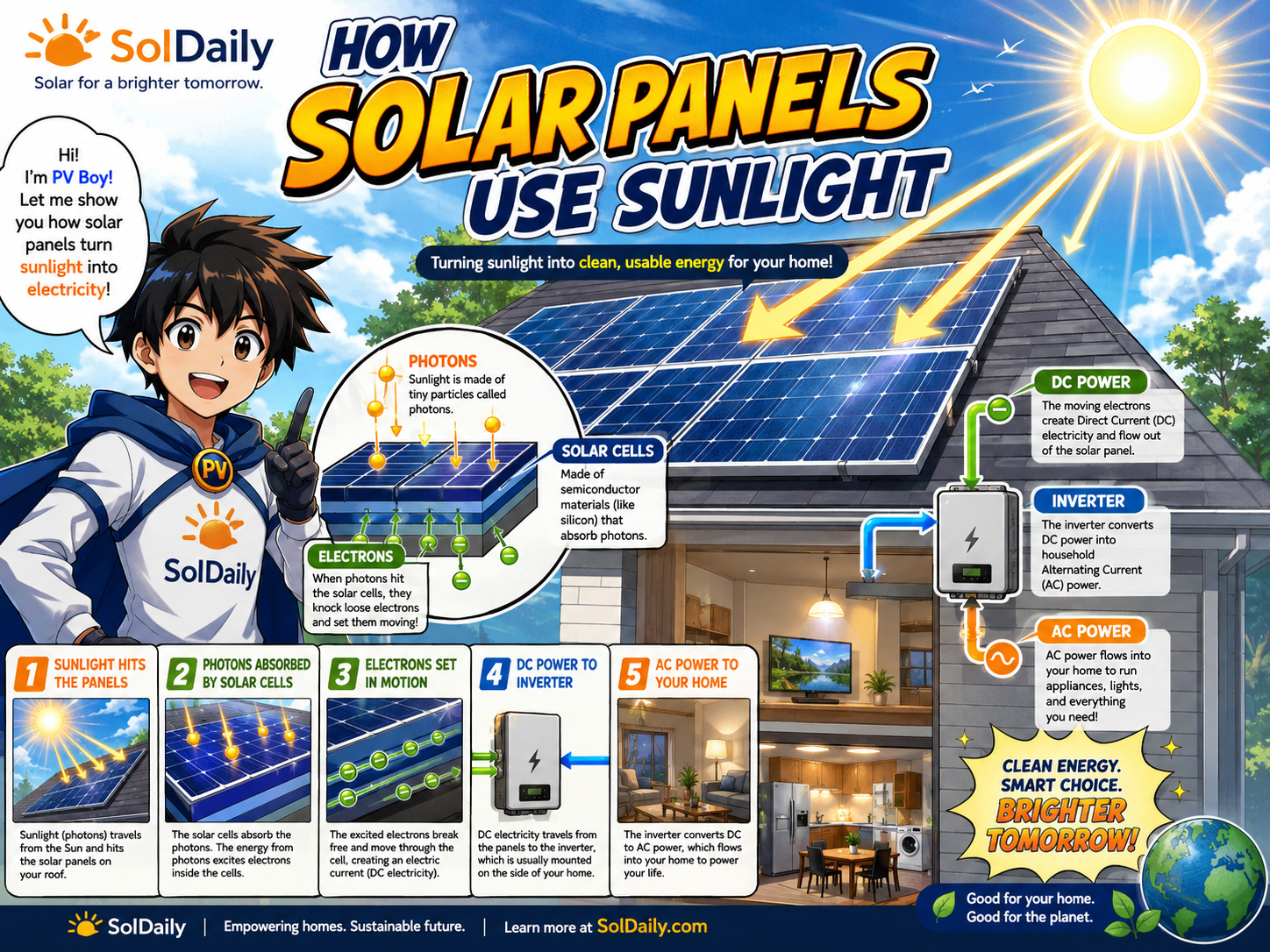
Solar panels use photovoltaic cells to convert sunlight into electricity. Sunlight is made of photons. When photons hit the right material inside a solar cell, they can transfer energy to electrons. Those energized electrons can move through an electrical circuit.
Professor Photon starts the lesson in the Sun. PV Boy finishes it on the roof. The Solar Man connects the whole path: fusion makes sunlight, sunlight carries photons, panels catch photons, and the system turns part of that light into usable power.
Step 1: sunlight reaches the panel
Before anything electrical happens, sunlight must reach the panel. Shade, clouds, roof angle, dirt, smoke, nearby buildings, trees, and time of day can all change how much usable sunlight arrives at the solar cells.
Solar Sensei calls this the first practical rule of solar: a panel can only use the light that actually reaches it.
Step 2: photons hit solar cells
A solar panel is made of photovoltaic cells. These cells are designed so that incoming photons can transfer energy to electrons inside the cell material. When enough electrons move in the right way, an electrical current can be produced.
Professor Photon is very proud of this moment. He leaves the Sun, crosses space, survives the atmosphere, reaches a rooftop, and finally gets to wake up an electron.
Step 3: electrons move
Electricity involves the movement of electric charge. In a photovoltaic cell, the structure of the cell helps separate and direct energized electrons so current can flow through an external circuit.
PV Boy calls this the “electron parade.” Solar Sensei calls it current. Captain Flare calls it not explosive enough, which is why he is not in charge of wiring.
| Solar panel part | Plain-language job | SolDaily character angle |
|---|---|---|
| Photons | Packets of light energy arriving from the Sun. | Professor Photon arrives at the panel. |
| PV cells | Materials that convert part of sunlight into electric current. | PV Boy’s main workshop. |
| Electrons | Charged particles that move through the circuit. | The electron parade begins. |
| DC electricity | The direct-current electricity produced by the solar array. | Solar Sensei labels the first electrical output. |
| Inverter | Equipment that converts DC electricity into AC electricity for building use. | PV Boy calls it the translator box. |
Step 4: panels produce DC electricity
Solar panels produce direct-current electricity, usually called DC. DC electricity flows in one direction. Many homes and businesses, however, use alternating-current electricity, known as AC.
This is why a solar energy system needs more than panels. The panels are important, but they are part of a larger system.
Step 5: the inverter translates DC to AC
An inverter converts DC electricity from the solar panels into AC electricity that can be used by ordinary building electrical systems. Inverter design, placement, compatibility, and monitoring matter in a real solar installation.
PV Boy loves inverters because they are the practical bridge between rooftop production and usable building power. Professor Photon admits the inverter deserves more attention than it usually gets.
A solar system is more than panels.
Panels catch sunlight. Wiring carries power. Inverters convert electricity. Batteries can store energy. Design and installation decide how well the system works in the real world.
What about batteries?
Batteries do not make sunlight. They store electrical energy for later use. In a solar system with batteries, some energy produced during sunny periods may be stored and used when solar production is lower or unavailable.
The Solar Man sees batteries as time-shifters. They do not replace the Sun, but they can help move solar value from one part of the day to another.
Shade matters
Shade can reduce solar production. Depending on the system design, shade on one part of an array can affect more than the shaded cells. Modern system designs may use optimizers, microinverters, or other approaches to manage shade effects, but shade is still a major design concern.
Solar Sensei gives this warning often: shade is not a decoration. It is a production factor.
Heat matters too
People often assume hotter always means better for solar panels, but photovoltaic panels usually perform less efficiently as they get hotter. Strong sunlight is good. Excessive heat can reduce output.
Professor Photon celebrates this correction because it proves the system is about light, not simply heat. PV Boy adds that good design considers airflow, temperature, equipment, and local conditions.
Angle and direction matter
A solar panel’s angle and direction affect how much sunlight it receives. A panel facing the right direction with a good tilt for the location can receive more useful sunlight than a poorly oriented panel.
Earth Girl Terra brings this back to the roof: the Sun’s path changes through the day and year, so real-world layout matters.
Clouds do not mean zero
Clouds reduce direct sunlight, but they do not always eliminate all solar production. Diffuse light can still reach panels under some cloudy conditions. Production is usually lower than under clear direct sun, but cloudy does not always mean zero.
PV Boy likes this because it makes solar feel less like an on/off cartoon switch and more like a real energy system responding to real light conditions.
Panels, monitoring, and reality
A real solar system may include monitoring that shows daily, monthly, or yearly production. Monitoring helps reveal patterns: sunny days, cloudy days, shade issues, seasonal changes, and possible equipment problems.
Solar Sensei says data keeps the manga honest. A dramatic hero image is great, but real solar education also needs production numbers, careful design, and field experience.
Where ABC Solar fits
SolDaily.com is a manga science project, but the practical solar bridge connects to ABC Solar’s real-world educational mission. The science of photons becomes useful when panels, inverters, batteries, roofs, permits, utility rules, and workmanship all come together.
The Permit Goblin may complain about paperwork, but a real solar project still needs proper design, approvals, safety, and qualified installation.
Why this lesson matters
Understanding how solar panels use sunlight helps connect the cosmic scale of the Sun to everyday energy. The journey starts in the solar core, crosses space as photons, reaches Earth, strikes a panel, moves electrons, passes through an inverter, and becomes practical electricity.
The Solar Man closes the lesson with the full chain: Sol creates the light. Earth receives the light. The panel catches the light. The system gives the light a job.
Solar Energy Basics
Learn the bigger practical solar vocabulary: panels, inverters, batteries, net energy, roof design, and system production.
Learn solar basicsSeasons and Earth Tilt
Return to Earth Girl Terra’s lesson on sunlight angle, day length, solstices, equinoxes, and seasonal production.
Back to Earth tilt