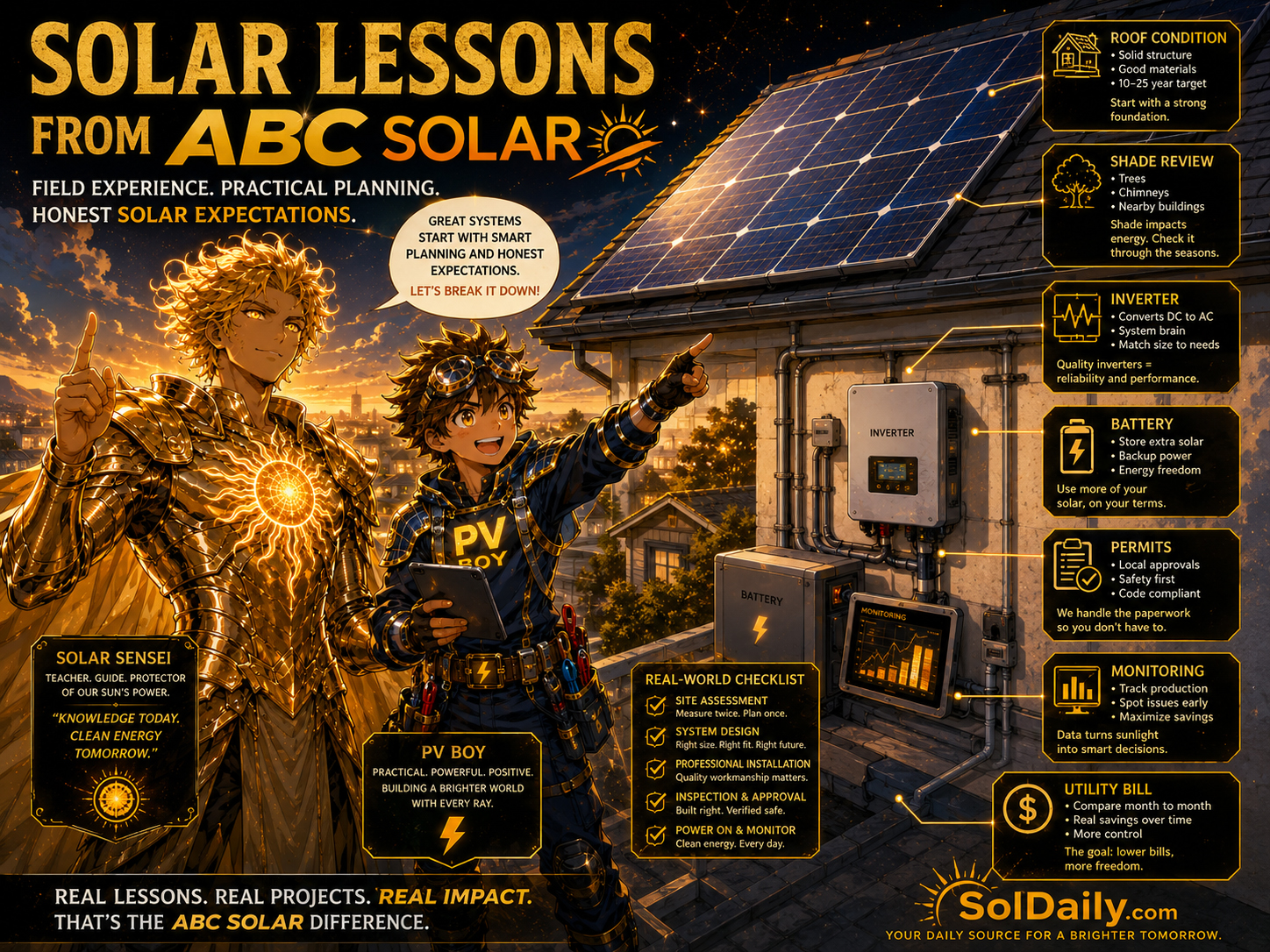
The Sun is cosmic. Solar installation is local.
The simple answer
ABC Solar’s practical lesson is that good solar is not just a panel count. A real solar project has to respect the roof, electrical system, utility rules, customer loads, equipment compatibility, safety requirements, workmanship, monitoring, and long-term service.
PV Boy can explain the solar equipment. Solar Sensei can explain the principles. ABC Solar brings the field experience that decides whether the system works safely and honestly in the real world.
Lesson 1: start with the site
Every solar project begins with the site. A home, business, farm, nonprofit, warehouse, school, or remote property has its own roof, service panel, shade, usage pattern, utility rate, and project goal.
The Solar Man may begin with Sol, but ABC Solar begins the field conversation with the actual building.
| Field lesson | Why it matters | SolDaily character angle |
|---|---|---|
| Roof review | The roof must be suitable before panels are installed. | Solar Sensei checks the roof before the hero pose. |
| Shade review | Shade can reduce solar production and change through the year. | PV Boy scans for missing photons. |
| Electrical review | Panels must connect safely to real electrical equipment. | The Permit Goblin appears, annoyingly but not entirely wrong. |
| Load review | The system should reflect how the customer actually uses energy. | Earth Girl Terra asks what must stay on. |
| Monitoring review | Production data helps verify system performance over time. | PV Boy says data keeps the manga honest. |
Lesson 2: roof condition comes before panel count
A solar system can last for many years, so the roof underneath matters. A roof near the end of its service life may need work before solar installation. Roof type, waterproofing, slope, structure, access, drainage, penetrations, and future maintenance all matter.
ABC Solar’s field lesson is blunt: do not let a beautiful solar plan ignore an ugly roof problem.
The roof is not background.
Solar panels live on the roof. The mounting, waterproofing, structure, drainage, and future service access are part of the solar project.
Lesson 3: shade is a production factor
Shade is not a small detail. Trees, chimneys, vents, parapets, neighboring buildings, roof equipment, utility poles, antennas, and seasonal Sun-path changes can all affect solar production.
PV Boy calls shade “missing photons with consequences.” ABC Solar treats shade review as part of honest production planning.
Lesson 4: the electrical panel matters
Solar power has to connect to the building’s electrical system. The main panel, service size, bus rating, breaker space, grounding, utility meter, disconnects, code requirements, and equipment location can all affect the design.
The Permit Goblin is irritating here, but he points toward a real truth: solar has to be approved, inspected, and safely interconnected.
Lesson 5: panels, inverters, and batteries are a system
Solar equipment must work together. The panels, inverter, battery, racking, wiring, disconnects, monitoring, communications, and utility interconnection should be compatible and designed as a system.
Solar Sensei says equipment is not a pile of parts. It is a coordinated electrical design.
Lesson 6: batteries need a mission
A battery should be selected and sized around a clear goal: backup loads, evening use, peak-rate strategy, self-consumption, resilience, or off-grid operation. Battery capacity, power, recharge ability, inverter behavior, load management, safety, and code compliance all matter.
Earth Girl Terra asks the battery question ABC Solar wants answered early:
“What must stay on, and for how long?”
Lesson 7: grid-tied solar is not automatically backup
Many grid-tied solar systems shut down during utility outages unless they are designed with approved backup or islanding capability. This surprises many customers and must be explained clearly.
PV Boy says this is one of the most important homeowner and business lessons: solar panels on the roof do not automatically mean power during a blackout.
Lesson 8: monitoring matters after installation
Monitoring helps confirm that the system is producing and operating as expected. It can reveal shade patterns, cloud dips, inverter issues, communication problems, battery behavior, clipping, or unexpected shutdowns.
ABC Solar’s field lesson: installation is not the end of the story. Operation matters.
Lesson 9: utility rules shape solar value
The physical system is only one part of solar economics. Utility rates, export credits, time-of-use periods, fixed charges, demand charges, interconnection rules, and metering policies can all affect value.
The Solar Man may speak in light, but the utility bill speaks in rules and timing.
Lesson 10: commercial solar needs load and demand review
Business solar often requires deeper review than simple residential solar. Demand charges, operating hours, refrigeration, HVAC, EV charging, tenant relationships, roof warranties, service size, transformers, and utility review can all matter.
Solar Sensei says commercial solar is where “kWh” and “kW” must both be respected.
Lesson 11: EV charging changes the energy picture
EV charging can add large new loads to homes, businesses, farms, and commercial properties. Solar can help offset EV charging, but charger size, charging schedule, utility rate, battery strategy, service capacity, and transformer limits matter.
PV Boy asks the simple question: when are the vehicles plugged in compared with when the Sun is producing?
Lesson 12: workmanship is part of performance
Workmanship matters. Roof sealing, mounting, wire management, conduit routing, labeling, inverter placement, battery clearances, disconnects, torque, grounding, and inspection readiness can all affect safety and long-term reliability.
ABC Solar’s field lesson is that invisible details often become visible later if done badly.
Lesson 13: permits and inspections are not optional jokes
The Permit Goblin makes paperwork funny, but real permits and inspections exist for a reason. Solar systems connect to buildings, roofs, electrical panels, batteries, utility grids, and safety equipment. Proper approvals matter.
Solar Sensei’s rule: laugh at the Goblin, but respect the inspection.
Lesson 14: serviceability matters
Equipment should be installed so it can be safely accessed, serviced, monitored, repaired, replaced, or upgraded. Inverters, batteries, disconnects, communications equipment, and roof-mounted hardware all need service planning.
PV Boy says a system that cannot be serviced is not finished. It is future trouble in a nice photograph.
Lesson 15: customer education prevents disappointment
Customers should understand what the system is designed to do and what it is not designed to do. That includes production expectations, outage behavior, battery limits, monitoring, utility bill changes, seasonal variation, shade impacts, and maintenance.
Earth Girl Terra says every solar project needs a plain-language explanation before it needs a victory lap.
Common field myths ABC Solar corrects
- “Solar panels are powered by heat.” They use light; heat can reduce performance.
- “Solar always works during outages.” Grid-tied systems usually shut down unless designed for backup.
- “A battery powers everything forever.” Batteries have capacity and power limits.
- “Any roof is fine.” Roof condition, structure, shade, drainage, and waterproofing matter.
- “The bill only depends on annual kWh.” Rates, timing, fixed charges, exports, and demand can matter.
- “More equipment always means better design.” Correct equipment for the goal matters more than equipment volume.
ABC Solar project review checklist
A serious solar review should ask:
- What does the customer want the system to accomplish?
- What is the annual and seasonal energy usage?
- When does the customer use electricity during the day?
- Is the roof ready for solar?
- Where is the shade now, and how will it change seasonally?
- What is the electrical service condition?
- Are batteries needed, and which loads matter?
- Will EV charging or new electric loads be added?
- What utility rate, export rule, or demand charge applies?
- How will monitoring and long-term service be handled?
Why ABC Solar belongs on SolDaily.com
SolDaily.com makes solar science visible and exciting. ABC Solar makes solar practical. The connection matters because the same Sun that powers the manga universe also powers real roofs, real batteries, real homes, real businesses, and real utility bills.
The Solar Man gives the mission. Solar Sensei gives the explanation. PV Boy gives the equipment path. ABC Solar gives the field reality.
Why this lesson matters
This lesson matters because solar should be inspiring without becoming careless. A strong solar project honors both the beauty of sunlight and the discipline of practical design.
The Solar Man closes the lesson:
“The Sun is generous. The work must be honest.”
Discuss a Solar Project
Talk through roof condition, shade, batteries, EV charging, business loads, utility rates, and realistic solar goals.
Contact ABC SolarSolar Energy for Business
Return to the commercial solar page for operating hours, demand charges, roof area, batteries, EV charging, and business energy strategy.
Back to business solar