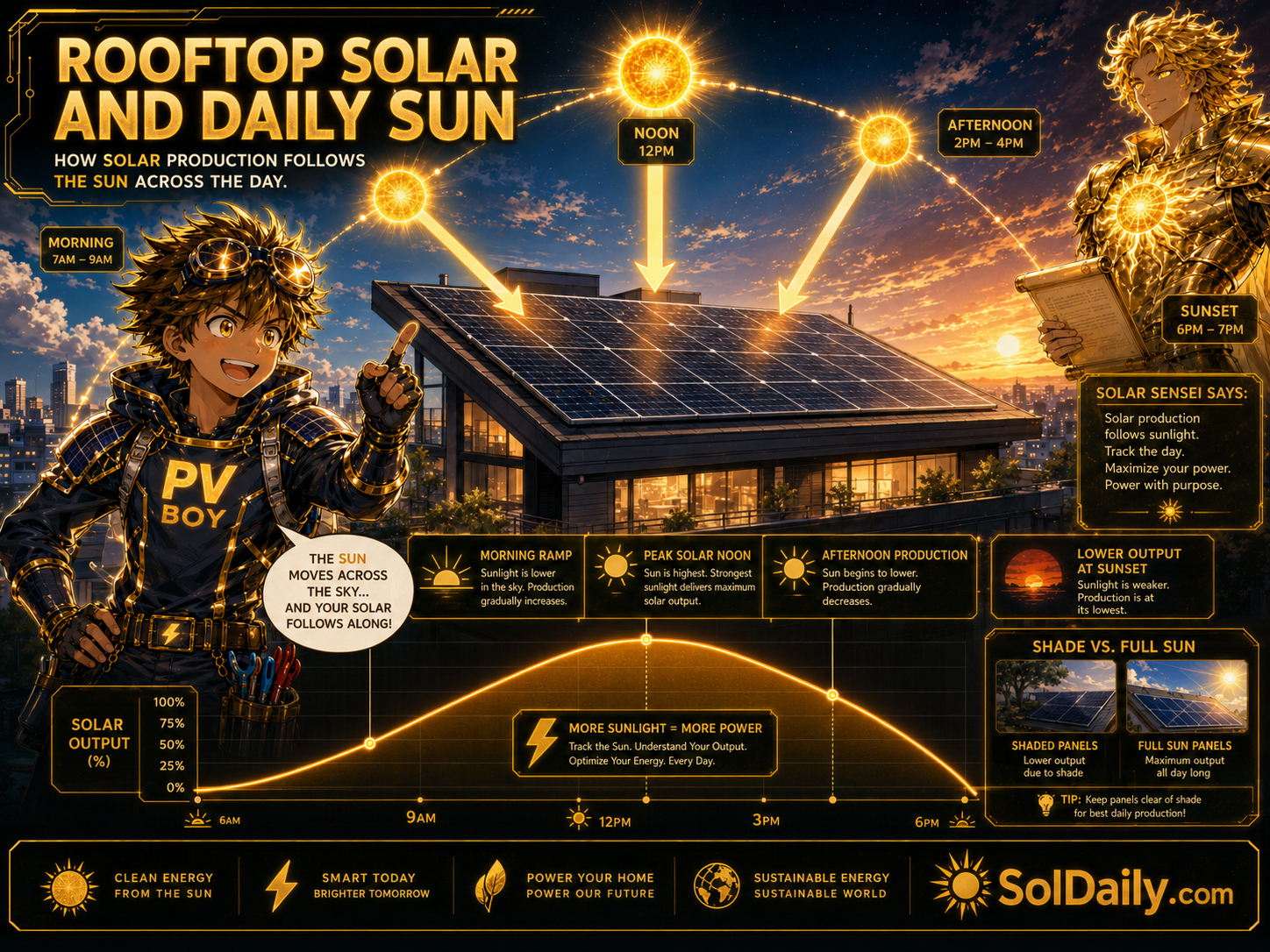
A solar day is not one moment. It is a curve.
The simple answer
Rooftop solar production changes through the day because the Sun’s angle changes. In the morning, sunlight is lower and production ramps up. Around midday, sunlight is often more direct and production may be strongest. In the afternoon, production declines as the Sun lowers, and shade or heat can change the curve.
PV Boy says the daily production graph is the solar system’s heartbeat. Earth Girl Terra says it is the roof’s diary of the Sun.
Sunrise: the ramp begins
At sunrise, sunlight arrives at a low angle. Panels may begin producing as the light becomes strong enough, but early production is usually modest. Nearby trees, chimneys, parapets, hills, buildings, or morning haze can delay or reduce the ramp.
Professor Photon likes sunrise because his workday begins. PV Boy likes sunrise because the monitoring graph starts to wake up.
Morning production
As the Sun climbs higher, sunlight often reaches panels more directly. Production usually increases if skies are clear and shade is not blocking the array.
East-facing panels may do more of their work earlier in the day. South-facing and west-facing panels follow different daily patterns. The best layout depends on the roof and project goals.
Midday: the high point
Around midday, the Sun is usually higher in the sky, and panels may receive stronger, more direct sunlight. This is often when production is strongest, though clouds, heat, inverter limits, shade, and system design can change the shape of the curve.
The Solar Man sees midday as the roof’s brightest conversation with Sol. Solar Sensei sees it as a useful data point, not a complete system evaluation.
| Daily period | What usually happens | SolDaily character angle |
|---|---|---|
| Sunrise | Production begins slowly as low-angle light reaches the panels. | Professor Photon starts the day. |
| Morning | Production rises as the Sun gets higher and stronger. | PV Boy watches the curve climb. |
| Midday | Production may peak if sunlight is strong and system limits do not cap output. | Solar Sensei checks for clipping, heat, and clouds. |
| Afternoon | Production declines as the Sun lowers, though west-facing panels may remain productive later. | Earth Girl Terra compares production to household usage. |
| Sunset | Production falls to zero when usable sunlight is gone. | The battery asks if stored daylight is needed. |
Afternoon: the curve changes
In the afternoon, the Sun lowers and production usually declines. But west-facing panels may have stronger afternoon production than morning production. This can matter where afternoon and evening utility rates are expensive or where household loads rise later in the day.
Earth Girl Terra asks the practical question: does the system produce when the building actually needs energy?
Sunset: production ends, usage continues
Solar production falls toward zero as usable sunlight disappears. But homes and businesses often keep using electricity after sunset. Lights, refrigeration, internet, cooking, heating, cooling, pumps, and entertainment may continue.
This is where batteries, grid service, load management, and rate plans become important.
Solar production and energy use are not always at the same time.
The Sun may produce strongest near midday, while a building may use more energy later. Good solar planning looks at both curves.
Load timing matters
A building’s usage curve may look very different from the solar production curve. A home may use more power in the evening. A business may use more during work hours. A farm pump or EV charger may have its own schedule.
PV Boy says solar design improves when the production curve and load curve are studied together.
Batteries and daily timing
A battery can store some daytime solar energy for later use. This can help with evening loads, backup goals, or time-of-use rate strategies depending on system design and local rules.
The Solar Man calls batteries “the memory of the solar day,” but Solar Sensei adds that batteries have capacity, power, and safety limits.
Shade windows
Shade may affect a roof at specific times. A tree might shade the array in the morning. A chimney might shade a row at midday. A neighboring building might shade the roof in the afternoon. A seasonal shadow may appear only in winter.
Solar Sensei says every shade window leaves a fingerprint on the production curve.
Clouds and passing weather
Passing clouds can create dips in production. Broken clouds can cause a jagged production curve. Heavy overcast reduces direct sunlight, but diffuse light may still allow some output.
Professor Photon calls clouds “atmospheric editors.” PV Boy calls them “graph wiggles.”
Heat through the day
Panels can get hotter as the day progresses. High panel temperature can reduce electrical performance. This means a system may not always produce its highest power at the hottest moment of the day.
Captain Flare is again reminded that heat does not automatically improve PV production.
Clipping during strong sun
If the solar array can produce more DC power than the inverter can convert at a given moment, output may be capped by the inverter. This is called clipping. Some clipping can be an intentional design choice, depending on the project.
PV Boy says clipping is not automatically bad. Solar Sensei says the question is whether the system was designed intentionally and responsibly.
Monitoring curves
Monitoring can reveal a lot. A smooth bell-shaped curve may suggest a clear day. Sudden dips may suggest clouds or shade. Repeating dips at the same time may suggest a fixed obstruction. Flat tops may suggest clipping. Zero production may indicate nighttime, outage, communication issue, or equipment issue depending on context.
Earth Girl Terra says a monitoring graph is a story with timestamps.
Roof orientation and daily shape
East-facing panels tend to favor morning production. West-facing panels tend to favor afternoon production. South-facing panels often provide strong overall production in many Northern Hemisphere locations. Flat roofs may allow different design strategies.
Solar Sensei avoids lazy rules. The best orientation depends on the site, utility rates, load timing, roof geometry, and customer goals.
Daily solar and utility rates
Some utility rates vary by time of day. If electricity is more expensive in the late afternoon or evening, the timing of solar production and battery discharge may matter more. A system should be evaluated against the actual rate schedule and usage pattern.
PV Boy says this is where solar becomes a clock, not just a panel count.
Daily solar and EV charging
EV charging can be a large load. Charging during solar production hours may use more on-site solar energy, depending on charger settings, vehicle availability, system size, and household or business loads.
Earth Girl Terra asks a practical question: is the vehicle home when the Sun is producing?
Daily solar and backup planning
During an outage, a solar-plus-battery system may behave differently depending on design. Solar may help recharge batteries during daylight if the system is built for approved backup operation. Clouds, shade, short winter days, and battery state of charge all matter.
Solar Sensei says backup planning must use realistic daily conditions, not perfect-day fantasy.
What a good daily solar review asks
A good daily solar review asks:
- When does the system produce strongest?
- When does the building use the most electricity?
- Are there morning, midday, or afternoon shade windows?
- Does the roof direction match the project goals?
- Is heat reducing output during strong-sun periods?
- Does the inverter show clipping or other limits?
- Would a battery help with timing or backup goals?
- Does monitoring show repeating patterns worth investigating?
Why this lesson matters
Rooftop solar and daily Sun matter because production is not a static number. It changes hour by hour. The best solar thinking watches the full day: light, angle, shade, weather, heat, loads, batteries, and data.
The Solar Man closes the lesson:
“A rooftop does not receive the Sun once. It receives the Sun all day.”
Solar Energy for Homes
Learn how solar production, household loads, batteries, utility rates, backup goals, and daily routines come together for homeowners.
Study home solarBatteries and Solar Energy
Return to the battery lesson on stored daylight, backup loads, capacity, power, and safety.
Back to batteries