The Sun creates the light. The solar system gives the light a job.
The simple answer
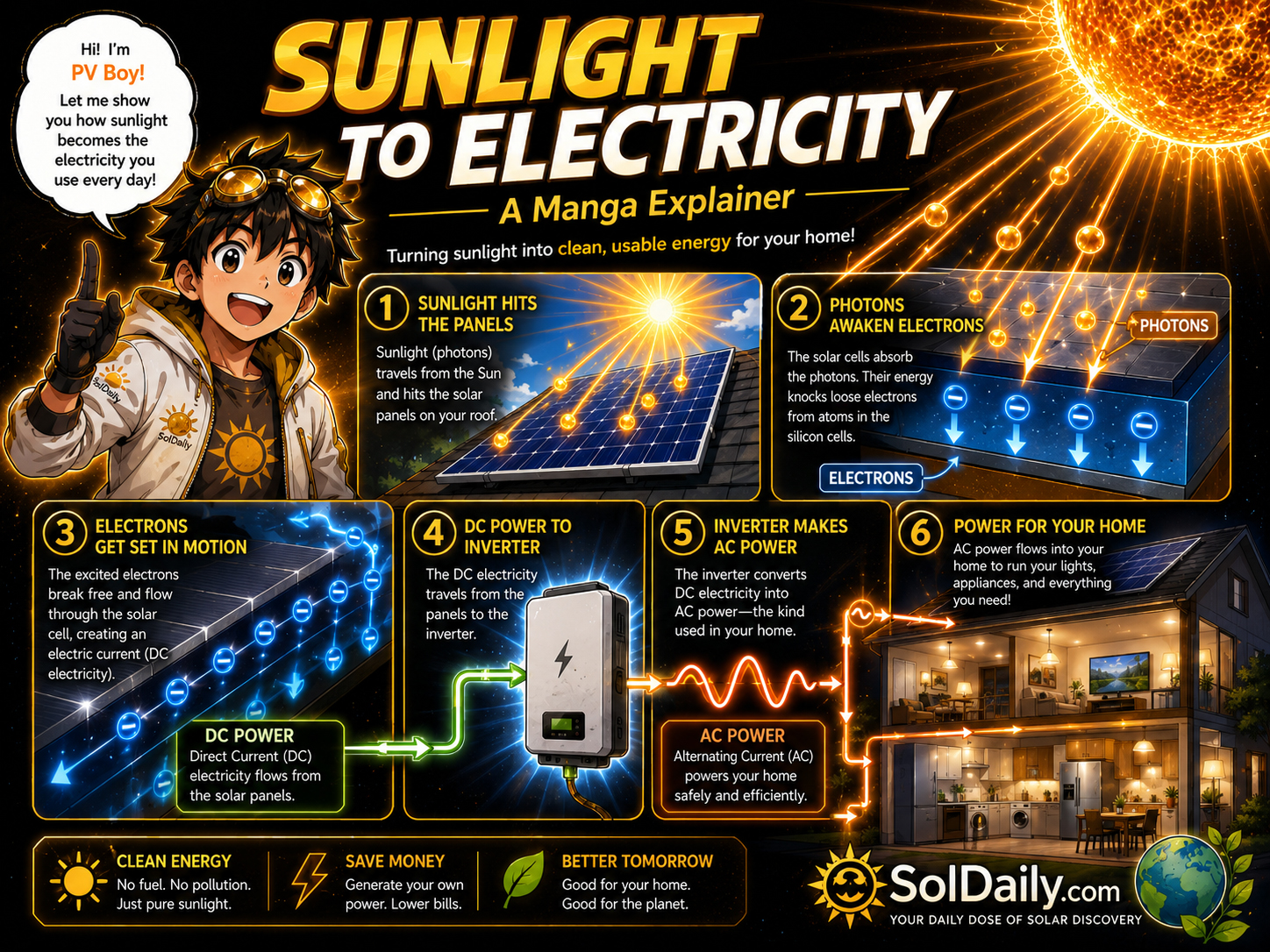
Sunlight becomes electricity when photons from the Sun strike photovoltaic solar cells and transfer energy to electrons. The solar panel produces direct-current electricity. An inverter converts that DC electricity into alternating-current electricity used by most buildings. From there, the power can serve loads, charge batteries, or interact with the grid depending on system design.
Professor Photon brings the light. PV Boy brings the equipment. Solar Sensei keeps the chain clear.
The full chain
The SolDaily version of sunlight-to-electricity follows a clean path:
- The Sun releases energy through nuclear fusion.
- Energy eventually escapes as sunlight.
- Photons travel from the Sun to Earth.
- Some photons reach a solar panel.
- Photovoltaic cells convert part of that light into electrical current.
- The array produces DC electricity.
- The inverter converts DC into AC electricity.
- The building uses the electricity, stores some in batteries, or interacts with the grid.
- Monitoring shows production and performance over time.
Step 1: the Sun makes the light
The story starts in the Sun’s core, where nuclear fusion releases energy. That energy moves outward through the Sun and eventually escapes as sunlight. Solar panels do not create the original energy. They capture a small portion of sunlight arriving at Earth.
The Solar Man puts it this way: before the panel, before the wire, before the inverter, there was Sol.
Step 2: photons carry energy
Sunlight is made of photons, which carry electromagnetic energy. A photon can travel from the Sun through space, pass through Earth’s atmosphere, and reach a solar panel.
Professor Photon is very proud of this job. He insists that a photon is not decoration. It is the messenger that makes photovoltaic power possible.
| Chain step | Plain-language job | SolDaily character angle |
|---|---|---|
| Sunlight | Energy from the Sun reaches Earth as light. | The Solar Man points back to Sol. |
| Photon | A packet of light energy arrives at the panel. | Professor Photon rides the beam. |
| PV cell | The solar cell converts part of the light into electrical current. | PV Boy opens the panel diagram. |
| DC electricity | The solar array produces direct-current electricity. | The electron parade starts moving. |
| Inverter | DC is converted into AC electricity for building use. | PV Boy calls it the translator box. |
| Battery | Optional storage holds energy for later use. | The Solar Man calls it stored daylight with a schedule. |
Step 3: the solar cell responds
A photovoltaic cell is designed so that incoming light can help move electrons. When photons strike the cell material, they can transfer energy to electrons. The cell’s structure helps direct that movement into an electrical current.
PV Boy describes this as the moment when “the light gets a job.” Solar Sensei calls that memorable, then reminds everyone that the real process depends on materials, cell structure, wiring, and system design.
A photon does not become an electron.
The photon transfers energy. The electron moves. The solar cell and circuit turn that movement into useful electrical current.
Step 4: DC electricity leaves the array
Solar panels produce direct-current electricity, usually called DC. In DC, electrical current flows in one direction. Strings of panels or module-level devices are arranged so the system can send DC power toward the inverter equipment.
Professor Photon likes the elegance of this step. PV Boy likes the wiring diagram.
Step 5: the inverter translates
Most buildings use alternating-current electricity, or AC. The inverter converts the DC electricity from the solar array into AC electricity that can serve building loads and interact with the electrical system according to the design.
The inverter may also provide monitoring, safety functions, grid interaction, and control features. It is not glamorous, but it is essential.
Step 6: electricity serves the building
Once converted into usable AC power, solar electricity can serve loads such as lights, refrigerators, computers, pumps, air conditioning, tools, appliances, and business equipment. How much of the solar production is used directly depends on timing, load behavior, and system design.
Earth Girl Terra asks the practical question: what is running when the Sun is producing? That question matters for self-consumption, battery strategy, and energy planning.
Step 7: batteries can store energy
A battery stores electrical energy for later use. Batteries can support backup goals, evening use, peak-rate management, or other design objectives depending on the system, rules, equipment, and operating mode.
Batteries are not magic, and they do not make energy. They move energy in time.
“Panels make. Batteries store. Inverters translate.” — PV Boy
Step 8: monitoring tells the truth
Monitoring helps show what the system produced and when. It can reveal daily patterns, cloud effects, shade dips, seasonal changes, equipment problems, and performance trends.
Solar Sensei says monitoring keeps the story honest. A solar system should not be understood only by a sales promise or a sunny photograph. Production data matters.
Common misunderstanding: solar panels are not heat machines
Solar panels use light. They do not simply use heat. Strong sunlight helps production, but hotter panel temperatures can reduce performance. This is why a clear, cool day can be a very good solar day.
Captain Flare finds this personally insulting. Professor Photon finds it educationally necessary.
Shade breaks the chain
A solar panel can only use light that reaches it. Shade from trees, chimneys, vents, parapets, nearby buildings, dirt, debris, smoke, or clouds can reduce production. The impact depends on system design and where the shade falls.
PV Boy calls shade “missing photons with consequences.”
Angle and season change the chain
The amount of sunlight reaching a panel changes through the day and year. Sun angle, day length, weather, and seasonal shade all affect production. A serious solar design considers the roof and the sky together.
Earth Girl Terra connects this to the seasons: Earth’s tilt changes how sunlight arrives, and the roof must live with that geometry.
Grid-tied, battery, and off-grid systems
The sunlight-to-electricity chain can be used in different system types. A grid-tied system works with the utility grid. A solar-plus-battery system stores some energy for later use. An off-grid system must be designed to serve loads without normal utility service, usually requiring careful battery and backup planning.
Solar Sensei warns that these are different design problems. The same Sun shines on all of them, but the equipment strategy changes.
Where ABC Solar fits
SolDaily.com uses manga to make solar science readable, but practical solar work still requires real design, field review, proper equipment, permits, inspections, utility coordination, and qualified installation.
The Permit Goblin may make the paperwork ridiculous, but safety and compliance are real.
Why this lesson matters
Sunlight-to-electricity matters because it connects the star to the socket. It shows how a photon that began in the Sun’s story can land on a panel, move an electron, pass through an inverter, and become useful power.
The Solar Man closes the lesson with this:
“The light was always powerful. Solar technology gives it a path.”
Photons to Electrons
Zoom deeper into the photovoltaic moment when incoming light transfers energy and electrons begin to move.
Follow the electronHow Solar Panels Use Sunlight
Return to the broader PV Boy lesson on panels, inverters, batteries, shade, heat, and practical solar design.
Back to solar panels