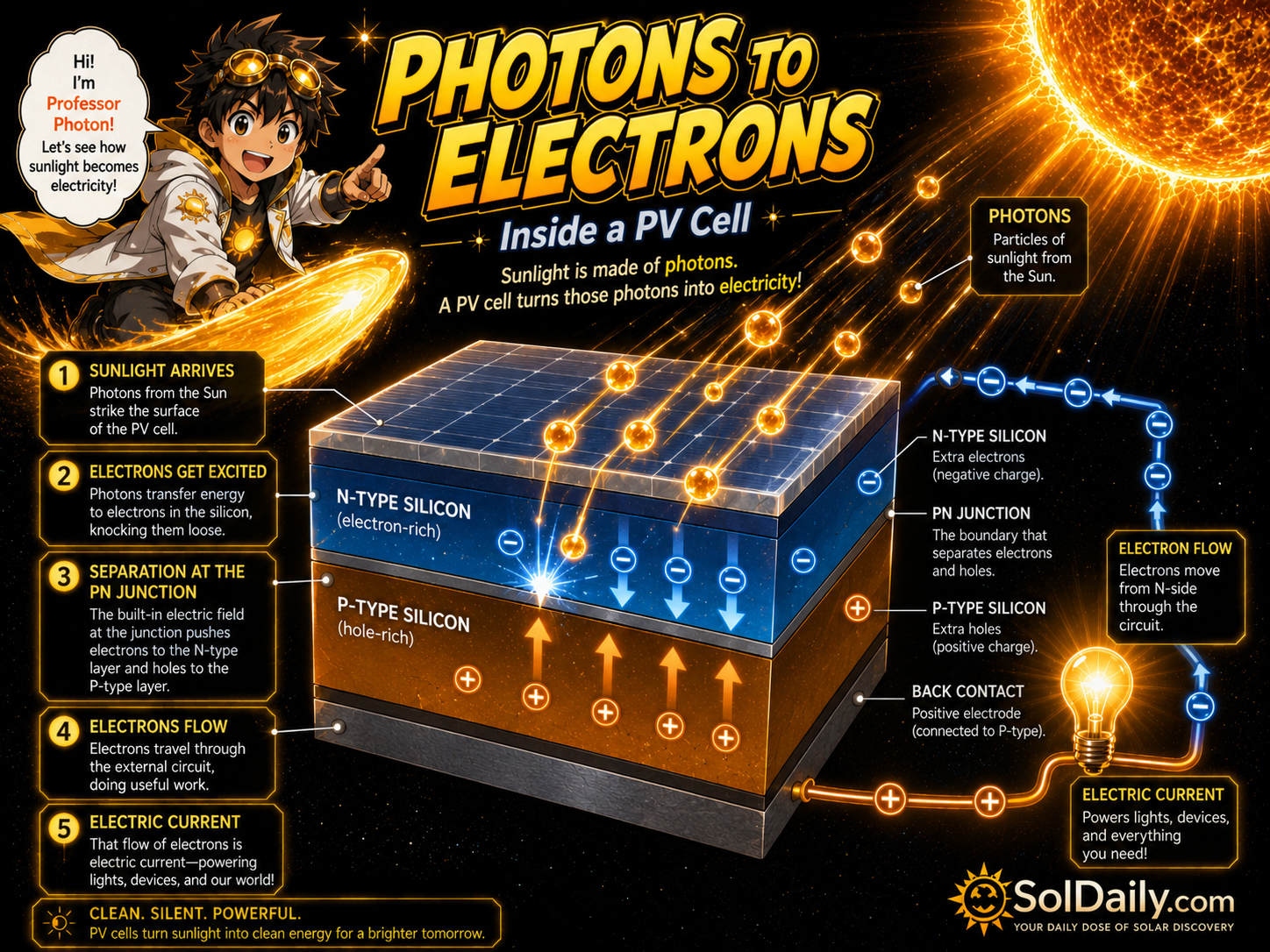
A photon does not become an electron. It gives an electron a reason to move.
The simple answer
In a photovoltaic solar cell, photons from sunlight can transfer energy to electrons in the cell material. When the cell is designed correctly, those energized electrons can be separated and guided into an electrical circuit. That movement of charge is the beginning of solar electricity.
Professor Photon brings the energy. PV Boy shows where the energy goes. Solar Sensei makes sure nobody says “the photon turns into electricity” without explaining the steps.
Photon first: the light arrives
A photon is a packet of light energy. When sunlight reaches a solar panel, many photons strike the surface. Some photons are reflected. Some are lost as heat. Some have the right conditions to help produce electrical current inside the solar cell.
Professor Photon insists that this is not a popularity contest. Not every photon does the same job in the panel.
Electron next: the charge moves
Electrons are charged particles inside atoms and materials. Electricity involves the movement of electric charge. In a solar cell, photon energy can help electrons move in a way that contributes to current through an external circuit.
PV Boy calls this the electron wake-up moment:
“Light arrives. Charge moves. The circuit gets serious.”
The photovoltaic material matters
A solar cell is not just any flat surface in sunlight. It is made from photovoltaic material, commonly semiconductor material, designed to respond to light and help direct electrical charge.
Solar Sensei uses a classroom comparison: sunlight on a rock may warm the rock, but sunlight on a photovoltaic cell can help create usable electrical current because the material and structure are designed for that purpose.
| PV cell idea | Plain-language meaning | SolDaily character angle |
|---|---|---|
| Photon | A packet of light energy arriving from the Sun. | Professor Photon dives into the cell. |
| Electron | A charged particle that can move through a circuit. | PV Boy wakes the electron parade. |
| Semiconductor | A material whose electrical behavior can be engineered for PV conversion. | Solar Sensei opens the material diagram. |
| Electric field | A built-in structure helps separate and direct charges. | PV Boy calls it the traffic controller. |
| Current | Moving electric charge in the circuit. | The electron parade gets a route. |
The built-in electric field
Solar cells are designed with internal structure that helps separate charges and push them in useful directions. This is part of what makes photovoltaic conversion possible.
PV Boy uses a traffic metaphor: if electrons are the moving vehicles, the solar cell’s structure helps create lanes and direction instead of random motion.
Random movement is not enough.
A useful solar cell does more than let light hit material. It helps separate and guide charge so current can flow through a circuit.
Current and voltage
Current is the movement of electric charge. Voltage is electrical pressure or potential difference that helps push charge through a circuit. A solar cell produces a small amount of voltage and current; many cells are connected together to make a useful solar panel.
Solar Sensei warns that this is where beginners often blur words. Current, voltage, power, and energy are related but not identical.
Cells become panels
One photovoltaic cell is small. A solar panel contains many cells connected together. The panel is designed to produce useful electrical output under sunlight.
PV Boy says this is the difference between one awakened electron moment and a working team. Solar electricity becomes useful when many cells work together as part of a complete system.
Panels produce DC electricity
Photovoltaic panels produce direct-current electricity, or DC. That DC electricity travels through system wiring toward inverters or other power electronics, depending on the design.
Professor Photon likes the elegance of the chain: light energy becomes charge movement, charge movement becomes current, and current becomes useful only when the system gives it a safe path.
The inverter comes later
The photons-to-electrons step happens in the solar cell, but most buildings need AC power. That means an inverter is usually needed to convert the panel’s DC electricity into AC electricity for building use.
PV Boy calls this the next room in the factory. The solar cell starts the current. The inverter makes the power useful for ordinary building systems.
Heat is not the main trick
A major misunderstanding is that solar panels are mainly powered by heat. They are not. Photovoltaic panels respond to light. Heat can affect performance, and excessive panel temperature can reduce output.
Captain Flare objects from the corner, but Solar Sensei overrules him.
Photon energy matters
Not every photon has the right energy to contribute usefully in a given solar cell. Some photons may not have enough energy to free an electron. Some may carry extra energy that becomes heat. Solar cell design is partly about using as much of the sunlight spectrum as practical.
Professor Photon says this is why he refuses to be treated as a generic sparkle. Photon energy matters.
Losses are real
Not all incoming sunlight becomes electricity. Some light is reflected. Some energy becomes heat. Some is lost in electrical resistance. Some losses occur in wiring, inverters, and other system components. Real systems have real efficiency limits.
PV Boy likes this part because it keeps the lesson honest. Solar is powerful, but not magic.
Shade interrupts the electron parade
If shade blocks light from reaching the cell, fewer useful photons arrive. That can reduce current and production. Shade impacts depend on system architecture, panel layout, module electronics, string design, and where the shade falls.
The Permit Goblin calls shade “photon access denial.” PV Boy calls it a design problem.
Soiling and surface conditions
Dust, debris, bird droppings, smoke residue, pollen, or other surface conditions can reduce how much light reaches the cells. Rain may help clean panels in some locations, but site conditions vary.
Earth Girl Terra connects this to the real world: the photon’s journey does not end at the atmosphere. It still has to reach the cell surface.
Monitoring confirms the story
Monitoring data can help show how well photons-to-electrons conversion is working across the whole system. A production curve can reveal sunrise ramp-up, cloud dips, shade effects, inverter behavior, seasonal changes, and possible issues.
Solar Sensei says data is where the manga becomes accountable.
Why this lesson matters
Photons-to-electrons is the key moment that makes photovoltaic solar possible. Without photons carrying energy, electrons do not receive the push. Without the solar cell structure, charge movement does not become useful current. Without the inverter and system design, that current does not become practical building power.
The Solar Man closes the lesson:
“The photon brings the message. The electron carries the work.”
Solar Panels and the Sun
Step back from the cell and see how Sun angle, shade, heat, clouds, season, and roof layout affect whole-panel production.
Study panels and sunlightSunlight to Electricity
Return to the full chain from sunlight to panels, inverter, batteries, loads, and useful power.
Back to the chain