Solar is cosmic at the source and practical on the roof.
The simple answer
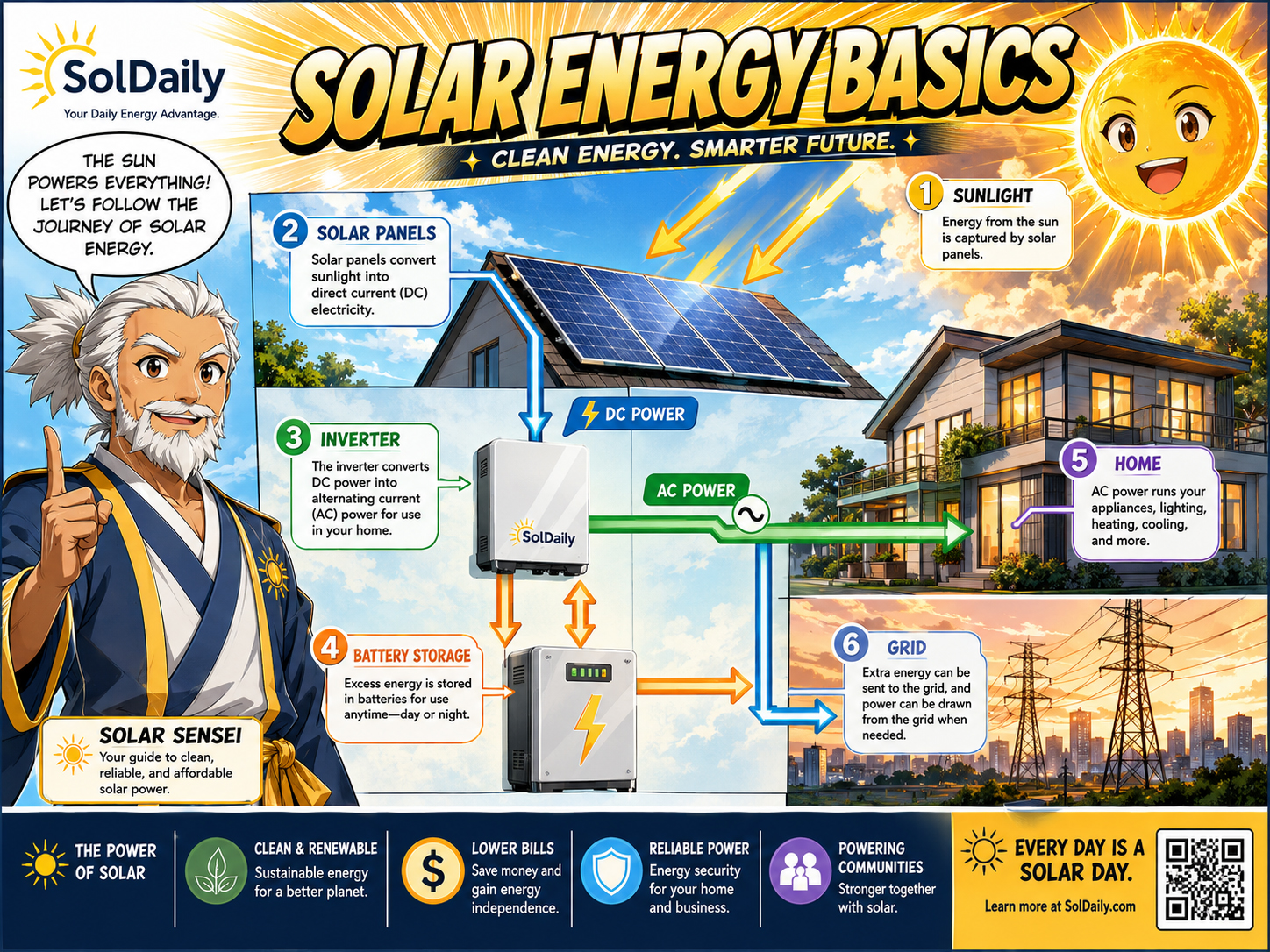
Solar energy for a home or business usually means photovoltaic solar power. Photovoltaic panels catch sunlight and produce direct-current electricity. An inverter converts that electricity into alternating-current electricity that a building can use. A battery, if included, can store some energy for later.
PV Boy calls this the rooftop chain: sunlight, panel, wire, inverter, building, battery, utility, monitoring, and maintenance. Solar Sensei adds one more word: design.
The main parts of a solar system
A practical solar energy system has several major parts. The exact equipment depends on the project, the roof, the electrical service, the utility, local rules, budget, and goals.
| Solar system part | Plain-language job | SolDaily character angle |
|---|---|---|
| Solar panels | Catch sunlight and produce DC electricity. | PV Boy catches Professor Photon. |
| Racking | Mounts the panels securely to the roof or structure. | Solar Sensei checks the foundation before the drama begins. |
| Wiring | Carries electricity safely between system components. | The electron parade needs a proper road. |
| Inverter | Converts DC electricity into AC electricity for building use. | PV Boy calls it the translator box. |
| Battery | Stores energy for later use when included in the system. | The Solar Man calls it a time-shifter. |
| Monitoring | Shows system production and helps reveal performance patterns. | Solar Sensei says data keeps the manga honest. |
Solar panels
Solar panels are the most visible part of the system. They contain photovoltaic cells that convert part of incoming sunlight into electricity. Panel output depends on sunlight, temperature, orientation, tilt, shade, equipment condition, and system design.
Professor Photon loves panels because panels give photons a practical job. The photon travels from the Sun, reaches the panel, and helps move electrons.
Inverters
Solar panels produce DC electricity. Most building electrical systems use AC electricity. The inverter converts DC to AC. Inverters can also provide monitoring, safety functions, and communication with other system components.
PV Boy says the inverter is not a side character. It is one of the main translators in the whole solar story.
Batteries
Batteries store energy for later use. A battery can help shift solar energy from daytime production to evening or backup use, depending on the system design and operating rules. Batteries add cost and complexity, so they should be matched to clear goals.
The Solar Man frames batteries as timing tools. They do not replace panels, sunlight, or good design. They help manage when stored energy is available.
Panels make. Batteries store. Inverters translate.
Good solar design understands what each part actually does. Confusing the parts leads to bad expectations.
Grid-tied solar
Many solar systems are grid-tied, meaning they are connected to the electric utility grid. The building can use solar power when it is produced, and the grid can still provide power when solar production is not enough.
Utility rules, metering programs, rates, export policies, and interconnection requirements matter. This is where the Permit Goblin enters with forms, stamps, and a dramatic clipboard.
Off-grid solar
Off-grid solar is different. It is designed to operate without normal utility grid service. Off-grid systems usually require careful load planning, batteries, charging equipment, backup power strategy, and disciplined energy use.
Solar Sensei warns that off-grid is not simply “regular solar without the utility.” It is its own design challenge.
Net energy and bills
Solar can reduce the amount of electricity a building buys from the grid, but bills depend on system size, production, usage patterns, utility rates, fixed charges, export rules, seasonal variation, and customer behavior.
The Solar Man keeps this honest: sunlight is powerful, but a bill is a contract, a meter, a rate schedule, and a usage pattern all meeting in one document.
Shade is serious
Shade from trees, chimneys, vents, parapets, nearby buildings, antennas, and roof features can reduce production. Shade also changes with time of day and season. A roof that looks clear at noon in summer may have different shade in winter.
Solar Sensei calls shade the silent villain of solar layout. Captain Flare calls it boring, which is why he is not allowed to design arrays.
Roof direction and tilt
The direction a panel faces and its tilt affect sunlight capture. The ideal design depends on the location, roof, utility plan, usage pattern, and project goals. A good design is not always just “put panels wherever they fit.”
Earth Girl Terra asks the field question: where does the Sun actually travel across this roof through the year?
Heat and production
Solar panels use light, not heat. Hotter weather does not automatically mean better production. In fact, high panel temperature can reduce performance. Strong sunlight on a cooler day can be excellent for solar output.
Maintenance
Solar systems generally have no fuel delivery and fewer moving parts than many energy systems, but they are not magic. Monitoring, occasional inspection, cleaning needs, equipment condition, vegetation growth, roof condition, and electrical safety all matter.
Solar Sensei says maintenance is not the opposite of excitement. It is how good systems remain good.
Permits and inspections
Solar projects often involve permits, utility interconnection, inspections, code compliance, and safety requirements. This process may feel slow, but it exists because solar systems connect to buildings, roofs, electrical equipment, and sometimes the utility grid.
The Permit Goblin: Space Division may be ridiculous, but proper approvals are not optional in real-world solar work.
What a good solar design considers
A good solar design considers many factors together:
- Roof condition, age, type, and available area.
- Sun exposure, shade, orientation, and seasonal path.
- Electrical service, main panel, wiring, and safety requirements.
- Energy usage patterns and future energy needs.
- Utility rules, rates, and interconnection requirements.
- Battery goals, if storage is being considered.
- Local code, permits, inspections, and workmanship.
Where ABC Solar fits
SolDaily.com tells the story of solar science in manga form, but ABC Solar connects that story to real field experience. The Sun may power the concept, but practical solar requires qualified design, installation, safety, permits, utility coordination, and long-term support.
PV Boy can explain photons. Solar Sensei can explain the system. ABC Solar brings the rooftop reality.
Why this lesson matters
Solar energy basics matter because they turn wonder into useful understanding. The Sun is grand, but a solar system is specific. It has parts, limits, design choices, rules, and performance patterns.
The Solar Man closes the lesson with this: respect the star, respect the roof, respect the wiring, respect the data, and the sunlight can go to work.
The Sun and Life on Earth
Step back from equipment and see how sunlight supports living systems, plants, food chains, and the rhythm of Earth.
Follow life under SolHow Solar Panels Use Sunlight
Return to the photon-to-electron lesson and see how solar cells begin making electricity.
Back to PV cells