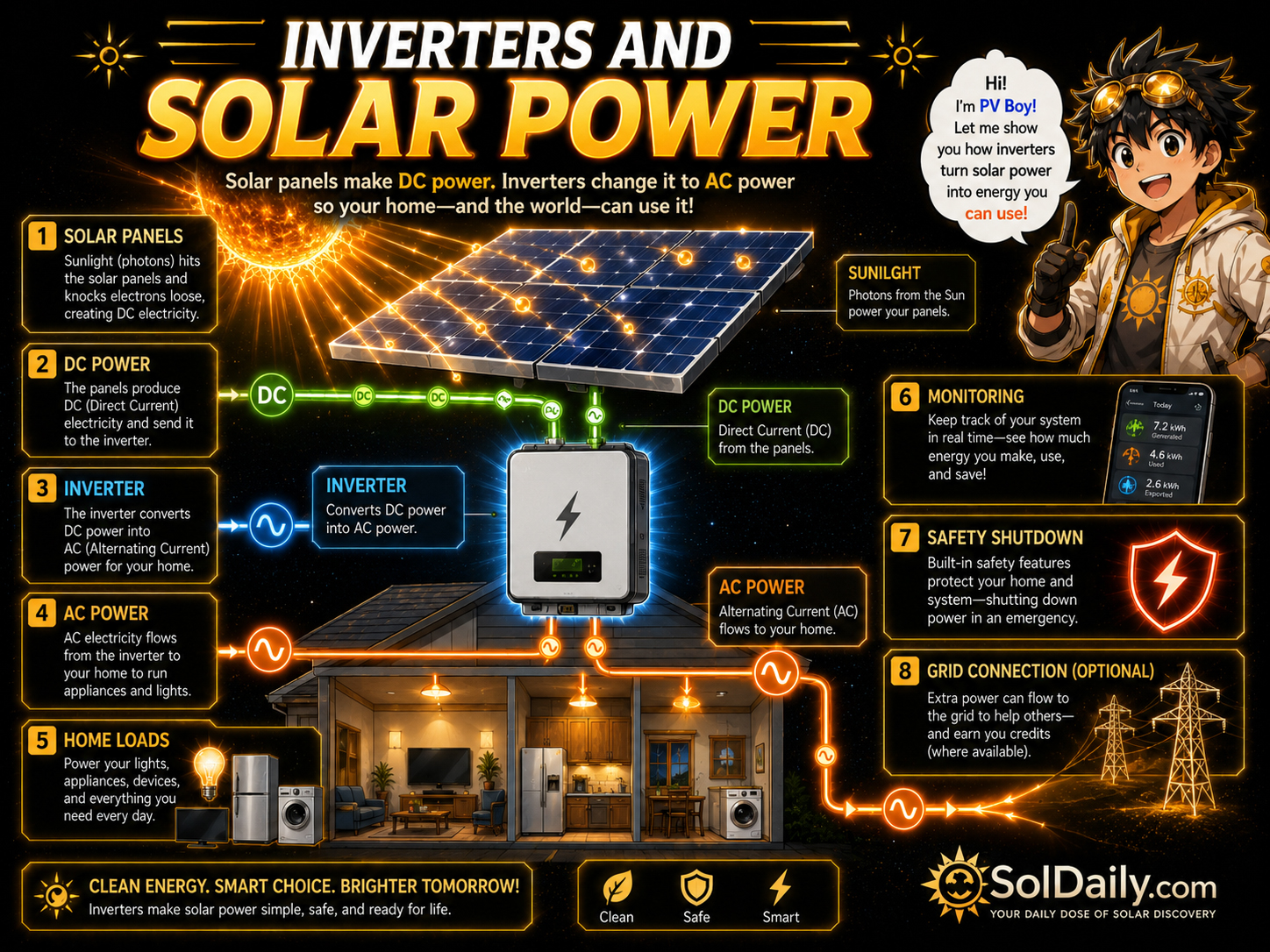
Panels catch the light. The inverter makes the power useful.
The simple answer
A solar inverter converts direct-current electricity from solar panels into alternating-current electricity that most homes and businesses can use. In modern systems, the inverter may also manage monitoring, grid communication, rapid shutdown functions, battery charging, backup operation, and other controls depending on the equipment type.
PV Boy calls the inverter the translator box. Solar Sensei calls it one of the most important pieces of the system.
DC versus AC
Solar panels produce DC electricity. DC stands for direct current, where electric charge flows in one direction. Most buildings use AC electricity. AC stands for alternating current, where the current changes direction many times per second.
The inverter converts solar DC into building-ready AC. Without that conversion, ordinary building loads cannot use most solar array output in the normal way.
| Inverter topic | Plain-language meaning | SolDaily character angle |
|---|---|---|
| DC input | Electricity from the solar panels enters the inverter. | PV Boy follows the electron parade from the roof. |
| AC output | The inverter sends usable alternating-current power to the building system. | Solar Sensei labels the translator step. |
| Monitoring | The inverter may report production and system status. | Earth Girl Terra checks the daily graph. |
| Grid interaction | The inverter synchronizes with the utility grid when grid-tied. | The Permit Goblin waves interconnection paperwork. |
| Battery control | Hybrid systems may charge, discharge, or coordinate with batteries. | The Solar Man calls it scheduling stored daylight. |
String inverters
A string inverter connects groups of solar panels, called strings, to a central inverter. This can be a clean and efficient design for many systems. Shade, roof complexity, string voltage, inverter sizing, and code requirements all matter.
Solar Sensei likes string inverters because they make the system diagram easier to teach, but he also warns that simple does not mean automatic. The design still has to fit the site.
Microinverters
Microinverters are small inverters installed at or near individual solar modules. They convert DC to AC closer to the panel and can provide module-level monitoring. They may be useful for some complex roofs or shade situations, but they are not the right answer for every project.
PV Boy says microinverters give each panel its own translator, but the whole system still needs good layout, wiring, safety, and monitoring.
Optimizers and inverter systems
Some systems use power optimizers with a central inverter. Optimizers can manage module-level behavior and monitoring while the central inverter performs the main DC-to-AC conversion. The design can help with certain shade, mismatch, and monitoring needs.
Professor Photon appreciates module-level detail. Solar Sensei appreciates not pretending one architecture solves every site condition.
Inverter architecture is a design decision.
String inverters, microinverters, optimizers, and hybrid inverters each have tradeoffs. The best choice depends on the roof, shade, electrical design, battery goals, code, utility rules, and long-term service plan.
Hybrid inverters
A hybrid inverter can coordinate solar panels and batteries in one system architecture. Hybrid designs may support battery charging, discharging, backup loads, grid interaction, and energy management depending on equipment and configuration.
The Solar Man calls hybrid inverters “the intersection where sunlight, storage, and building power negotiate.”
Battery inverters
Some battery systems have separate battery inverters. In those systems, solar production and battery storage may be handled by different pieces of equipment that must be properly coordinated.
PV Boy keeps this practical: batteries are not just boxes of energy. They need power electronics, protection, communication, and careful design.
Grid-tied operation
In a grid-tied solar system, the inverter synchronizes its AC output with the utility grid. It must follow safety rules and utility requirements. If the grid goes down, many grid-tied inverters shut down unless the system is designed with approved backup capability.
This surprises many people. Solar Sensei says it is one of the most important customer education points: ordinary grid-tied solar does not automatically mean power during a blackout.
Backup power and islanding
Some solar-plus-battery systems can create a protected backup power island during an outage. This requires equipment designed for that function, proper wiring, transfer equipment, protected loads, utility compliance, and inspection.
The Permit Goblin arrives here with three stamps and a helmet. PV Boy lets him speak because the safety point is real.
Monitoring and data
Inverters often provide production monitoring. Monitoring can show power output, daily energy, inverter status, faults, communication issues, shade patterns, clipping, and possible equipment problems.
Earth Girl Terra calls the monitoring graph the system’s diary. Solar Sensei calls it evidence.
What is clipping?
Clipping happens when the solar array could produce more DC power than the inverter can convert at that moment, so output is limited by the inverter’s AC capacity. Some clipping can be a normal design choice, depending on the project and production goals.
Captain Flare hears “clipping” and assumes something exploded. PV Boy makes him sit down.
Inverter sizing
Inverter sizing matters. An inverter must be compatible with the solar array voltage, current, power, code requirements, utility interconnection, battery strategy, temperature conditions, and expected operating behavior.
Solar Sensei says inverter sizing is where “close enough” can become expensive. The details matter.
Inverter location
Inverters need appropriate installation locations. Temperature, ventilation, clearance, accessibility, weather exposure, wall space, electrical routing, communication signal, and serviceability all matter.
PV Boy says a beautiful inverter design on paper still has to live on a wall.
Safety functions
Inverters and associated equipment may provide safety functions such as anti-islanding, rapid shutdown coordination, ground-fault detection, arc-fault detection, disconnecting means, and system monitoring depending on system type and code requirements.
Solar Sensei keeps this serious: safety functions are not decoration. They are part of why qualified design and installation matter.
Communication and updates
Modern inverters may communicate with monitoring platforms, batteries, utility equipment, or installer tools. Communication can be useful, but it also means system owners should understand support, access, cybersecurity, warranties, firmware behavior, and long-term service.
Earth Girl Terra asks the grounded question: who can see the system, who can change it, and who supports it when something goes wrong?
Inverters and batteries
In a solar-plus-battery system, the inverter or battery inverter may manage when batteries charge and discharge. The behavior depends on the system design: backup, self-consumption, time-of-use shifting, demand management, or other operating goals.
The Solar Man calls this “teaching sunlight how to arrive later.”
Why inverters matter
Inverters matter because they decide how solar panel output becomes usable power. They affect performance, safety, monitoring, grid interaction, battery behavior, outage operation, and serviceability.
PV Boy closes the lesson:
“The panel catches the photon. The inverter teaches the electricity how to speak building.”
Batteries and Solar Energy
Learn how batteries store solar energy for later use, backup goals, peak-rate strategy, and resilience planning.
Study batteriesSolar Panels and the Sun
Return to the rooftop lesson on Sun angle, shade, clouds, heat, season, and monitoring.
Back to panels