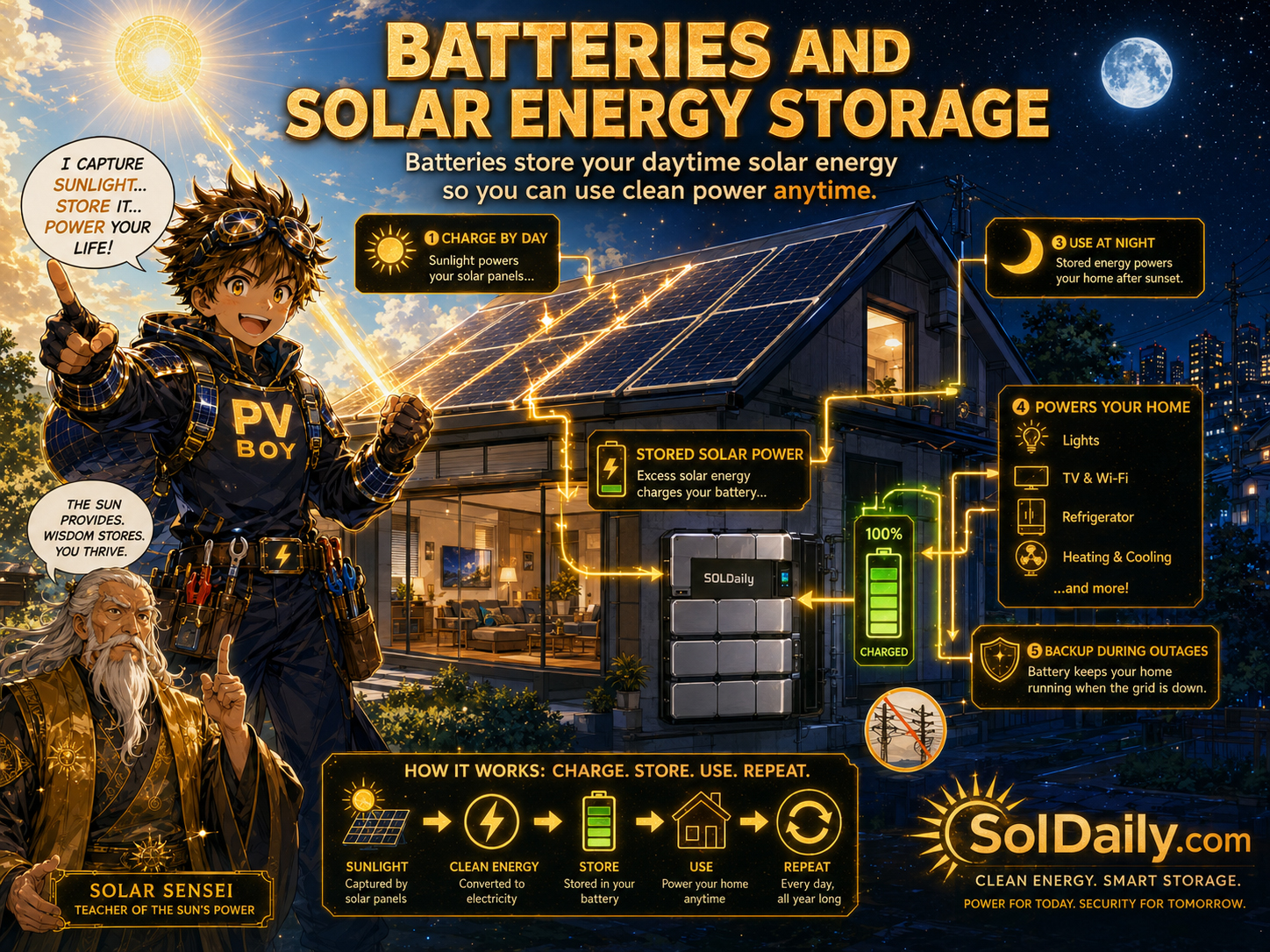
Batteries do not create the Sun’s energy. They help decide when stored solar energy can be used.
The simple answer
A solar battery stores electrical energy produced by a solar system or supplied from another allowed source, depending on the system design. Later, the battery can discharge that stored energy to serve loads, support backup operation, reduce grid purchases during certain times, or help manage energy use.
The Solar Man calls a battery “stored daylight with a schedule.” PV Boy says that is poetic, but the battery still needs proper sizing, wiring, equipment, ventilation, controls, permits, and monitoring.
Panels make, batteries store
Solar panels convert sunlight into electricity. Batteries store energy for later. That distinction matters. A battery without enough charging energy is just a waiting box. A solar array without enough storage may export or curtail energy depending on the system and utility rules.
PV Boy’s short version is clean:
“Panels make. Batteries store. Inverters translate.”
Why add a battery?
People add batteries for different reasons. The right reason should be clear before choosing equipment or size. A battery designed for brief backup is not the same as a battery designed for long outage survival, high evening use, commercial demand strategy, or off-grid operation.
| Battery goal | Plain-language meaning | SolDaily character angle |
|---|---|---|
| Backup power | Keep selected loads running during an outage. | Earth Girl Terra asks which loads really matter. |
| Time shifting | Store daytime energy for later use. | The Solar Man calls it scheduled daylight. |
| Peak-rate strategy | Use stored energy during expensive grid periods when allowed and properly configured. | PV Boy checks the rate schedule and settings. |
| Self-consumption | Use more solar energy on site instead of exporting it. | Solar Sensei compares production and load timing. |
| Off-grid support | Store energy for systems without normal utility service. | PV Boy warns that off-grid design is a serious load-planning problem. |
Capacity versus power
Battery capacity and battery power are different. Capacity is how much energy the battery can store, often discussed in kilowatt-hours. Power is how quickly the battery can deliver energy at a given moment, often discussed in kilowatts or amps.
Solar Sensei uses a water analogy carefully: capacity is how much water is in the tank, while power is how quickly it can flow. The analogy is imperfect, but useful.
A big battery is not automatically a powerful battery.
Storage capacity and discharge power are separate design questions. A system must be sized for both how long loads run and how much power they need at once.
Backup loads
A battery backup system usually does not need to power everything. Many designs use a protected loads panel or backup loads panel with the circuits that matter most: refrigeration, lights, internet, medical equipment, garage door, selected outlets, or other priority loads.
Earth Girl Terra asks the most important backup question:
“What must stay on when everything else can wait?”
Whole-home backup
Whole-home backup may be possible in some systems, but it is more demanding. Large loads like air conditioning, electric heating, ovens, dryers, pumps, EV charging, and multiple simultaneous loads can quickly overwhelm battery capacity or power limits if not planned carefully.
PV Boy warns that “whole-home backup” is not a slogan. It is a load calculation, equipment design, operating strategy, and customer expectation conversation.
Hybrid inverters and battery inverters
Batteries need power electronics. Some systems use hybrid inverters that coordinate solar and batteries. Other systems use separate battery inverters. The equipment must be compatible and configured correctly.
Solar Sensei says batteries are not just “attached” to solar. They are integrated into an electrical system.
Charging from solar
A solar battery can charge from daytime solar production when the system is designed and configured to do so. During an outage, some systems can continue using solar to recharge the battery, but only if they are designed for approved backup/islanding operation.
This is a major customer education point. Not every solar system can recharge batteries during an outage, and not every battery system behaves the same way.
Time-of-use strategy
In some utility rate structures, electricity costs more during certain times of day. A battery may be configured to discharge during expensive periods and charge during solar production or other allowed times.
PV Boy says the battery is not just hardware in this case. It is a schedule, a rate plan, and a control strategy.
Self-consumption
Self-consumption means using more of your solar energy on site instead of exporting it. A battery can help by storing excess daytime solar and discharging later when the building needs power.
Earth Girl Terra connects this to daily life: solar production peaks when the Sun is strong, but household or business usage may peak later. A battery can help bridge that timing gap.
Battery chemistry and equipment differences
Batteries differ by chemistry, capacity, power, voltage, cabinet design, thermal behavior, warranty, communication, safety certifications, installation rules, and compatible inverters. The right battery depends on the job.
Solar Sensei avoids brand worship and focuses on the design question: what must the battery safely and reliably do?
Safety matters
Battery systems require proper installation, clearances, wiring, overcurrent protection, disconnects, labeling, ventilation or thermal considerations, code compliance, and inspection. Battery energy is useful, but stored energy deserves respect.
The Permit Goblin appears here with a serious helmet. For once, nobody laughs too much.
Monitoring batteries
Battery monitoring can show state of charge, charging and discharging power, backup status, battery health, energy flows, and system alerts. Monitoring helps owners understand whether the battery is behaving as expected.
PV Boy calls battery monitoring the fuel gauge for stored daylight.
Battery limits during long outages
During a long outage, a battery can be depleted if loads exceed available stored energy and recharge opportunities. Solar recharge can help when available, but clouds, shade, smoke, storms, short winter days, or system limits can reduce charging.
Earth Girl Terra asks the honest question: how many hours or days do the chosen loads need to run under realistic conditions?
Load management
Load management can make a battery more useful. Turning off nonessential loads, scheduling heavy equipment, avoiding simultaneous large loads, and prioritizing critical circuits can extend backup duration.
Solar Sensei says the cheapest battery capacity is often the load you did not waste.
Batteries and generators
Some systems may coordinate batteries with generators or other backup sources, depending on equipment compatibility and design. This requires careful engineering and proper controls.
PV Boy warns that mixing power sources is not improvisation. It is system design.
Off-grid batteries
Off-grid systems depend heavily on batteries because there is no normal utility grid to cover gaps. Off-grid battery design must consider daily loads, surge loads, weather, winter production, reserve capacity, charging sources, maintenance, and customer behavior.
The Solar Man says off-grid power teaches respect for energy because every watt has a source.
Batteries and solar panels
A battery and solar panels can work beautifully together when sized correctly. The solar array charges the battery during available sunlight, and the battery serves loads later. But the array must be large enough and sunny enough to meet the charging goals.
PV Boy says the design question is not “Do you have a battery?” It is “Can the system refill the battery under real conditions?”
Where ABC Solar fits
Battery systems are field reality, not just product brochures. Real projects need load review, electrical design, equipment compatibility, safe placement, permits, inspections, utility coordination, customer education, and long-term service planning.
SolDaily.com explains the story. ABC Solar brings the practical installation experience.
Why this lesson matters
Batteries matter because solar energy arrives on the Sun’s schedule, while people often need power on their own schedule. A battery can help bridge that gap, but only within its real capacity, power, safety, and design limits.
The Solar Man closes the lesson:
“Stored daylight is powerful — when the system respects time, load, and safety.”
Rooftop Solar and Daily Sun
Learn how the daily Sun path, shade, roof shape, usage timing, and monitoring data shape solar production.
Study daily solarInverters and Solar Power
Return to the inverter lesson and learn how solar DC becomes usable AC power.
Back to inverters