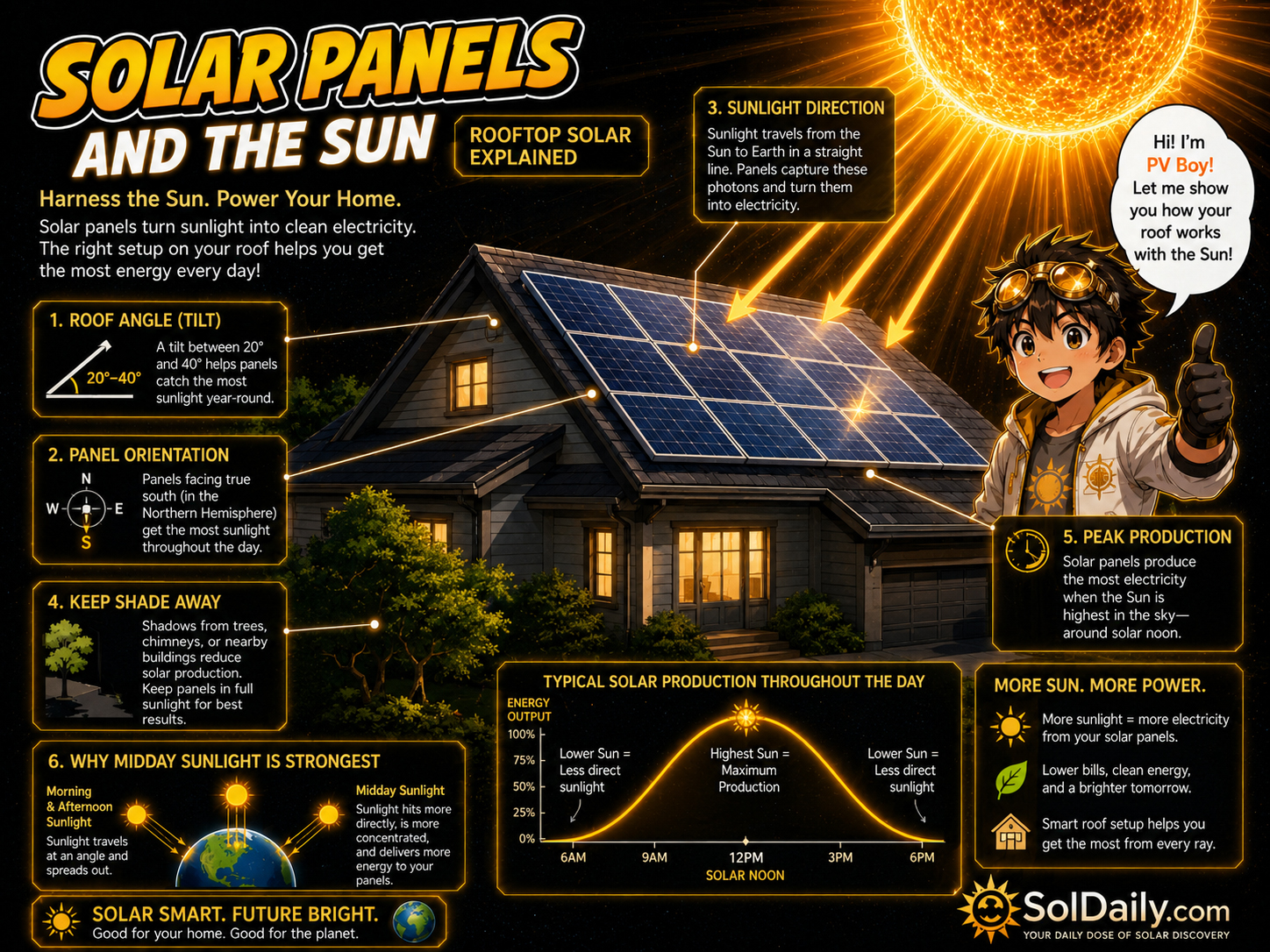
A solar panel can only use the sunlight that actually reaches it.
The simple answer
Solar panels convert part of incoming sunlight into electricity. The more useful sunlight reaches the cells, the more opportunity the panel has to produce power. But sunlight at the panel changes through the day and year, and production is affected by site conditions, equipment, temperature, shade, and design.
PV Boy says solar production is not a slogan. It is a relationship between the Sun, the roof, the equipment, the weather, and the data.
Sunlight is the source
Solar panels use light. Photons from sunlight interact with photovoltaic cells and help produce electrical current. This is the core of photovoltaic solar power.
Professor Photon insists on the first correction: panels are not mainly powered by heat. Heat can affect them, but light is the essential input.
Sun angle matters
Solar panels generally produce more when sunlight strikes them more directly. When the Sun is high and well aligned with the panel surface, more sunlight can be captured. When the Sun is low, light is spread over a larger area and passes through more atmosphere.
Earth Girl Terra calls this the roof-angle lesson: the Sun may be strong, but the panel still has to face the light well.
| Production factor | Plain-language effect | SolDaily character angle |
|---|---|---|
| Sun angle | More direct sunlight usually gives more production opportunity. | Solar Sensei draws the light beam geometry. |
| Roof direction | The direction panels face affects daily production shape. | PV Boy studies the roof compass. |
| Shade | Blocked sunlight reduces available photons. | The Permit Goblin calls it photon access denial. |
| Heat | Hotter panel temperatures can reduce performance. | Captain Flare is told to step away from the array. |
| Clouds and haze | Direct sunlight may drop, but diffuse light can still produce some power. | Professor Photon explains scattered light. |
| Monitoring | Production data reveals the real daily story. | PV Boy says data keeps the manga honest. |
Roof direction matters
The direction panels face affects when and how much sunlight they receive. In many Northern Hemisphere locations, south-facing surfaces can receive strong annual sunlight, but east- and west-facing surfaces may still be useful depending on goals, rates, load timing, roof shape, and design.
Solar Sensei warns against one-size-fits-all thinking. A solar design should consider the actual roof, actual usage, local conditions, and project goals.
Tilt matters
Panel tilt affects how directly sunlight hits the module through the year. A flat roof, steep roof, ground mount, carport, or tilted rack will each interact with the Sun differently.
PV Boy calls tilt “the handshake angle between panel and Sun.”
Season changes the Sun path
The Sun follows a higher path in summer and a lower path in winter. Days are also longer in summer and shorter in winter. This changes the amount of solar energy available and also changes shade patterns.
Earth Girl Terra connects this back to Earth’s tilt: the panel does not move through the seasons alone. The whole planet changes its solar geometry.
A good solar layout looks beyond one day.
A tree shadow, chimney shadow, nearby building, or roof obstruction may behave differently in winter than in summer because the Sun’s path changes.
Shade is serious
Shade can reduce production. Shade may come from trees, neighboring buildings, chimneys, vents, roof features, parapets, antennas, utility poles, dirt, debris, or temporary objects. The effect depends on where the shade falls and how the system is designed.
PV Boy does not treat shade as a minor cosmetic issue. Shade is a production factor and a design consideration.
Clouds do not always mean zero
Clouds can reduce direct sunlight, but some diffuse sunlight may still reach solar panels. Production under cloudy conditions is usually lower than under clear direct Sun, but it is not always zero.
Professor Photon likes this lesson because it shows light can scatter, reflect, and still matter.
Heat can reduce performance
Solar panels are tested and rated under standard conditions, but real rooftops get hot. As panel temperature rises, electrical performance can decline. This is why hot weather does not automatically mean maximum production.
Captain Flare finds this unfair. Solar Sensei finds it essential.
Dirt, dust, and soiling
Dust, ash, pollen, bird droppings, leaves, and other surface material can reduce the light reaching solar cells. Rain may help clean panels, but local conditions vary.
Earth Girl Terra calls soiling the last obstacle after a photon crosses space, survives the atmosphere, and reaches the roof.
Panel layout matters
Where panels are placed matters. A layout should consider roof structure, roof condition, fire setbacks, shade, access pathways, equipment placement, wiring routes, aesthetics, maintenance, and code requirements.
The Permit Goblin appears here with too many forms, but Solar Sensei admits the general point: real installations require proper design and approvals.
Module-level electronics and system design
Some systems use optimizers, microinverters, or string inverter designs. Each approach handles shade, monitoring, wiring, maintenance, and equipment failure differently. The right approach depends on the project.
PV Boy says equipment is not only a brand choice. It is a design strategy.
Monitoring tells the real story
Monitoring data can show how the system performs over time. Daily curves can reveal the morning ramp, midday peak, shade dips, cloud events, clipping, inverter behavior, seasonal changes, and possible maintenance issues.
Solar Sensei says monitoring helps separate guesses from evidence.
Solar production and customer usage
Production is only one side of the energy story. Customer usage also matters. A building may use power while the solar system is producing, export power when production exceeds usage, or import power when usage exceeds production.
Earth Girl Terra asks the practical question: when does the building need electricity compared with when the solar system makes electricity?
Solar panels and batteries
Batteries can store some solar energy for later use when included in the system. They can support backup goals, evening use, peak-rate strategy, or resilience planning depending on the design.
The Solar Man calls batteries “stored daylight with a schedule,” but Solar Sensei adds that storage must be sized and designed for real loads and goals.
Solar panels and the grid
Many solar systems are connected to the utility grid. Utility rules, interconnection, metering, export compensation, rates, fixed charges, and safety requirements can all shape the project. The solar panel is only part of the full energy and billing picture.
The Permit Goblin enters here because he cannot resist utility paperwork. PV Boy lets him speak for three seconds, then returns to the wiring diagram.
Why this lesson matters
Solar panels and the Sun matter because the rooftop is where cosmic light becomes practical production. Understanding how the Sun reaches the panel helps explain why design, shade, direction, tilt, temperature, monitoring, and real-world conditions matter.
The Solar Man closes the lesson:
“The Sun is generous. The roof must be honest.”
Inverters and Solar Power
Learn how the inverter translates solar DC electricity into usable AC power for buildings and grid interaction.
Study invertersPhotons to Electrons
Return inside the solar cell and study the moment light energy helps electrons move.
Back to the cell