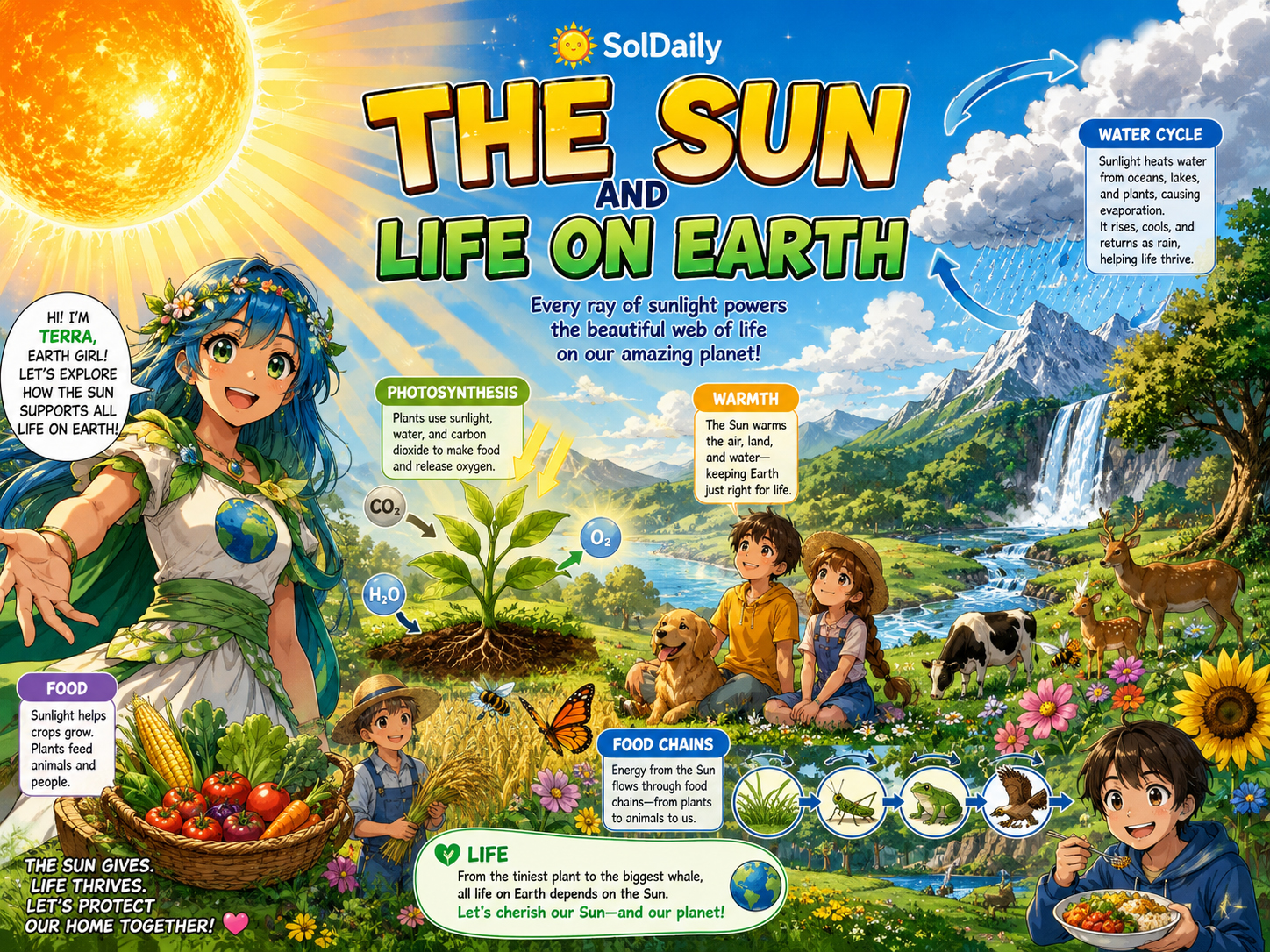
You do not live beside the Sun. You live because of it.
The simple answer
The Sun supports life on Earth by providing light and energy. Sunlight warms the planet, helps drive weather and the water cycle, supports photosynthesis in plants and algae, and sets the daily and seasonal rhythms that shape living systems.
Earth Girl Terra asks the most important question on SolDaily.com: what does all this solar science mean for life here? The Solar Man answers: it means the Sun is not distant trivia. It is part of every breath, meal, shadow, season, and sunrise.
Sunlight and photosynthesis
Photosynthesis is one of the great solar processes of life. Plants, algae, and some microorganisms use sunlight to help convert carbon dioxide and water into sugars, releasing oxygen as part of the process.
Professor Photon loves this lesson because it gives photons a biological mission. A photon does not only strike solar panels. It can also help power the green systems that feed much of the living world.
Sunlight and food chains
Many food chains begin with organisms that capture sunlight. Plants use sunlight to grow. Animals eat plants. Other animals eat those animals. Even when the chain becomes complex, much of the energy can be traced back to sunlight.
The Solar Man calls this the menu of Sol. Every orchard, field, forest, pasture, and garden is part of a larger solar story.
| Life connection | Plain-language meaning | SolDaily character angle |
|---|---|---|
| Photosynthesis | Plants and algae use sunlight to help make sugars and support growth. | Professor Photon powers the green classroom. |
| Food chains | Energy captured from sunlight moves through living systems. | The Solar Man points from leaf to table. |
| Warmth | Sunlight helps keep Earth’s surface suitable for life. | Earth Girl Terra feels the morning change. |
| Water cycle | Solar energy helps evaporate water and drive weather patterns. | Solar Sensei draws clouds, rain, and rivers. |
| Daily rhythm | Daylight and darkness help shape behavior, sleep, and activity cycles. | The SolDaily newsroom opens at sunrise. |
The Sun warms Earth
Sunlight warms land, oceans, air, buildings, and living things. Without solar energy, Earth’s surface would be radically different and far less friendly to the life we know.
The Solar Man treats warmth as one of the Sun’s gentlest powers. It is easy to overlook because it is ordinary. But ordinary warmth is one of the reasons life can flourish.
The Sun drives the water cycle
Solar energy helps water evaporate from oceans, lakes, soil, and plants. That water vapor can form clouds, move through the atmosphere, and return as rain or snow. This cycle supports rivers, groundwater, agriculture, forests, and human communities.
Solar Sensei calls the water cycle a solar-powered circulation system. Captain Flare calls rain “the Sun’s delayed punchline,” which Solar Sensei does not approve of.
The Sun does not just shine on life. It moves life’s systems.
Light grows plants. Heat moves water. Daylight organizes time. Seasons guide behavior. The Sun is woven into Earth’s living rhythm.
The Sun shapes weather
Uneven solar heating helps create differences in temperature and pressure across Earth. Those differences help drive winds, weather patterns, ocean-atmosphere interactions, and the movement of heat around the planet.
Earth Girl Terra likes this because weather brings the sky down to human experience. The solar story is not only in telescopes. It is also in clouds, breezes, storms, shade, drought, rain, and seasons.
The Sun creates daily rhythms
Day and night shape life. Many organisms respond to daily light cycles. Humans organize work, rest, travel, farming, school, and culture around daylight and darkness.
Professor Photon sees sunrise as a daily headline: “Sol returns to the front page.”
The Sun creates seasonal rhythms
Earth’s tilt changes sunlight angle and daylight length through the year. Those changes create seasons, which influence plant cycles, animal behavior, agriculture, building energy use, and solar production patterns.
Earth Girl Terra links this lesson back to tilt: the Sun gives the light, but Earth’s angle changes how that light is received.
Sunlight and human health
Sunlight affects human daily rhythms and can support vitamin D production when skin is exposed appropriately. But sunlight also requires respect because ultraviolet radiation can damage skin and eyes.
Solar Sensei gives the balanced version: sunlight is important, but safety matters. Shade, protective clothing, sunscreen, and proper eye protection all have their place.
The Sun and fossil fuels
Much of the energy stored in fossil fuels can be traced to ancient sunlight captured by living organisms long ago and transformed over geological time. That means even old fuels have a deep solar connection.
The Solar Man frames this carefully: fossil fuels are stored ancient solar energy, while photovoltaic panels capture current sunlight directly.
The Sun and solar panels
Solar panels are a modern tool for catching current sunlight and converting part of it into electricity. Instead of waiting for ancient biological and geological processes, photovoltaic systems use sunlight arriving now.
PV Boy calls this the direct route: sunlight to panel, photon to electron, system to power.
Life, energy, and responsibility
Understanding the Sun’s role in life encourages respect. The Sun is not just a symbol. It is a physical power source connected to Earth systems. Learning how it works helps us think more clearly about energy, food, water, buildings, climate, and technology.
Earth Girl Terra says this is the heart of SolDaily.com: cosmic science becomes practical when it helps people understand the world they live in.
Why this lesson matters
This lesson matters because every solar page points back to life on Earth. Fusion is not just a reaction. Photons are not just particles. Solar panels are not just hardware. All of them belong to a larger story of energy moving from the Sun into the living world.
The Solar Man closes the lesson with one sentence: Sol is not background. Sol is the beginning of the day.
The Sun and Climate
Learn how solar energy, Earth’s atmosphere, oceans, land, greenhouse gases, and climate systems interact.
Study climate connectionsSolar Energy Basics
Return to the practical solar primer on panels, inverters, batteries, shade, monitoring, and system design.
Back to solar basics