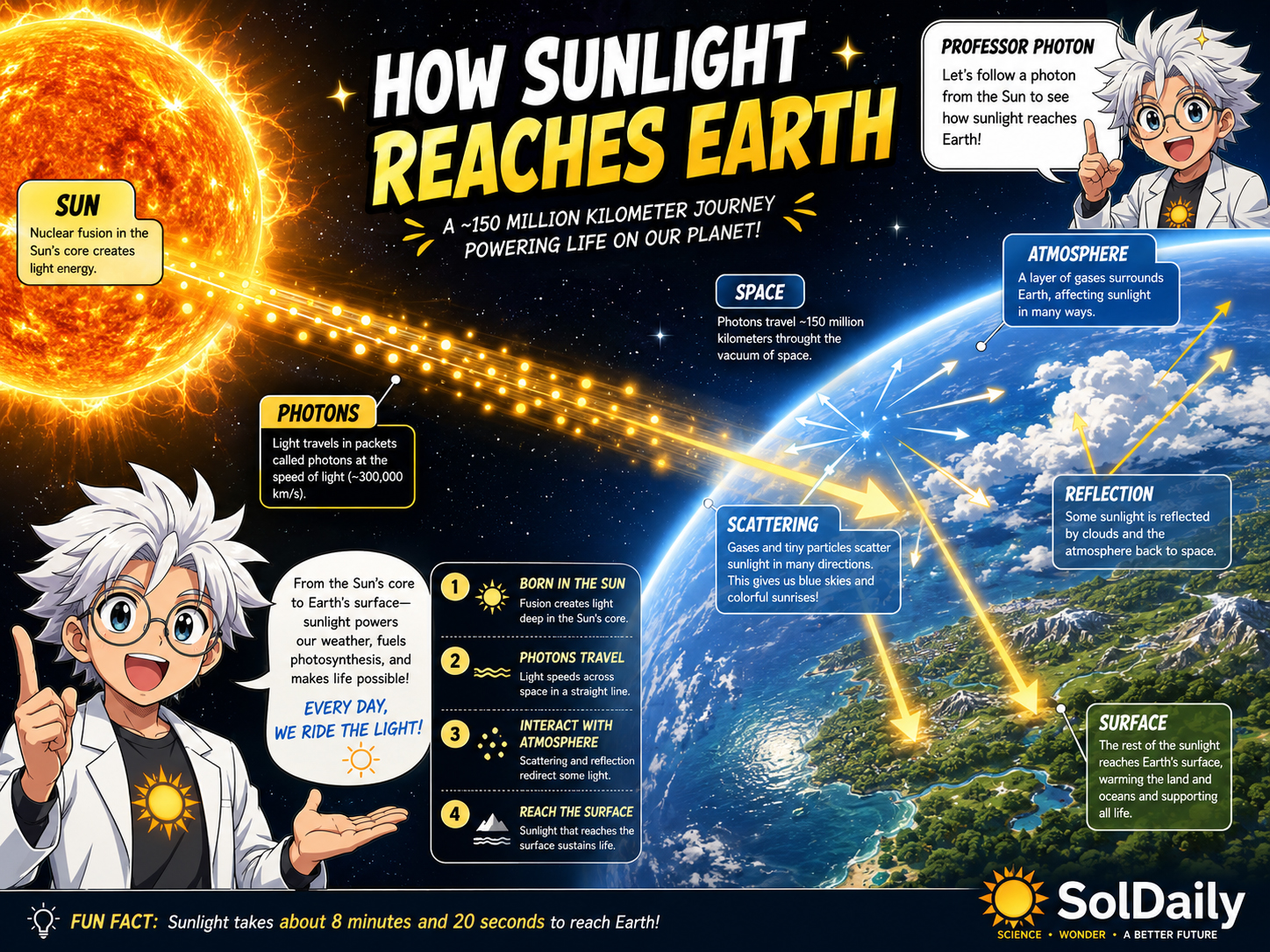
Sunlight is the bridge between the fusion engine of Sol and the living world of Earth.
The simple answer
Sunlight reaches Earth as electromagnetic radiation. After energy escapes from the Sun’s visible surface, photons travel through space. When they arrive at Earth, some sunlight is reflected, some is scattered, some is absorbed by the atmosphere, and some reaches the ground or a solar panel.
Professor Photon describes the journey as a cosmic delivery route: born from solar energy, released from the Sun, shot across space, filtered by the atmosphere, and received by Earth.
Step 1: energy begins in the Sun
The deepest origin of sunlight is nuclear fusion in the Sun’s core. Fusion releases energy. That energy moves through the Sun’s interior and eventually reaches the visible surface, called the photosphere.
Once light escapes from the photosphere, it can travel outward through space. The Solar Man calls this the moment when the Sun’s inner power becomes Earth’s daily light.
Step 2: light travels through space
Sunlight travels through the vacuum of space as electromagnetic radiation. It does not require air or any other material medium. That is why sunlight can cross the space between the Sun and Earth.
Solar Sensei uses this as a clean comparison: sound needs a medium, but light can travel through empty space. That is why we can see the Sun even though space is mostly vacuum.
Step 3: sunlight reaches Earth’s atmosphere
Before sunlight reaches the ground, it encounters Earth’s atmosphere. The atmosphere is not just empty sky. It is a mixture of gases, particles, water vapor, clouds, and aerosols that can scatter, absorb, and reflect incoming solar radiation.
Earth Girl Terra asks the practical question: what actually gets through? The answer depends on clouds, air clarity, Sun angle, season, location, altitude, and local conditions.
| What happens to sunlight? | Plain-language meaning | SolDaily character angle |
|---|---|---|
| Transmission | Some sunlight passes through the atmosphere and reaches the surface. | Professor Photon makes it through the gate. |
| Reflection | Some sunlight bounces off clouds, ice, water, land, or buildings. | Earth Girl Terra checks what Earth sends back. |
| Scattering | Air molecules and particles redirect sunlight in many directions. | Solar Sensei explains why the sky glows blue. |
| Absorption | Some sunlight is absorbed by gases, surfaces, or materials and becomes heat or other effects. | The Solar Man points to warmth on Earth. |
| Conversion | Some photons strike solar cells and help produce electricity. | PV Boy catches the photon and wakes the electron. |
Why the sky is blue
The sky appears blue because shorter wavelengths of visible sunlight scatter more strongly in Earth’s atmosphere than longer wavelengths. This scattered blue light reaches our eyes from many directions across the sky.
Professor Photon takes great pride in this effect. He calls it “atmospheric stage lighting.” Captain Flare complains that sunsets are more dramatic.
Why sunrise and sunset look red or orange
When the Sun is low in the sky, sunlight travels through more atmosphere before reaching your eyes. Much of the shorter-wavelength blue light is scattered away, leaving more red, orange, and gold colors visible.
The Solar Man approves of sunsets because they remind people that sunlight is not just brightness. It is a spectrum shaped by distance, angle, and atmosphere.
The atmosphere changes the light show.
The same Sun can look white-yellow at noon, red-gold at sunset, dim behind clouds, and sharp after a clear storm because the path through the atmosphere changes.
Day and night
Day and night happen because Earth rotates. The side of Earth facing the Sun receives daylight. The side turned away from direct sunlight experiences night.
Earth does not need the Sun to turn off at night. Earth simply turns. Earth Girl Terra calls this the daily spin lesson.
Sun angle matters
The angle of incoming sunlight affects how concentrated it is on a surface. When the Sun is high in the sky, sunlight is more direct. When it is lower, the same incoming light is spread over a larger area and travels through more atmosphere.
This matters for heat, shadows, seasons, and solar panels. PV Boy cares because panel production depends heavily on how much useful sunlight reaches the panel surface.
Clouds, haze, and shade
Clouds can reflect and scatter sunlight, reducing the amount of direct sunlight reaching the ground. Haze, smoke, dust, and pollution can also change how much light reaches a surface. Shade from trees, buildings, chimneys, and roof features can strongly affect solar panel production.
Solar Sensei warns against lazy thinking here. “Sunny” is not one fixed condition. There is direct sun, hazy sun, partial shade, broken clouds, reflected light, and many real-world variations.
Sunlight and plants
Plants use sunlight for photosynthesis, the process that helps convert light energy into chemical energy. That makes sunlight a foundation of food chains, oxygen production, and life on Earth.
The Solar Man sees every leaf as a solar panel of life. Not a photovoltaic panel, but a biological system that depends on sunlight.
Sunlight and solar panels
Solar panels use photovoltaic cells to convert part of sunlight into electricity. When photons reach a solar cell, they can transfer energy to electrons inside the material. That movement of electrons can become electric current in a properly designed system.
PV Boy keeps the lesson practical: sunlight must actually reach the panel. Angle, shade, clouds, dirt, roof layout, season, and equipment all shape the final production.
Why this lesson matters
Understanding how sunlight reaches Earth helps explain daylight, weather, seasons, photosynthesis, climate, solar energy, and everyday comfort. It also explains why solar power is both cosmic and practical.
The Solar Man closes the lesson this way: the journey from Sol to Earth is not abstract. It ends on your face, your roof, your garden, your ocean, your window, and your solar panel.
Seasons and Earth Tilt
Learn why the angle of sunlight changes through the year and how Earth’s tilt creates the seasons.
Study the seasonsPhotons and Sunlight
Return to Professor Photon’s first lesson on light, energy packets, and the solar journey from the Sun.
Back to photons