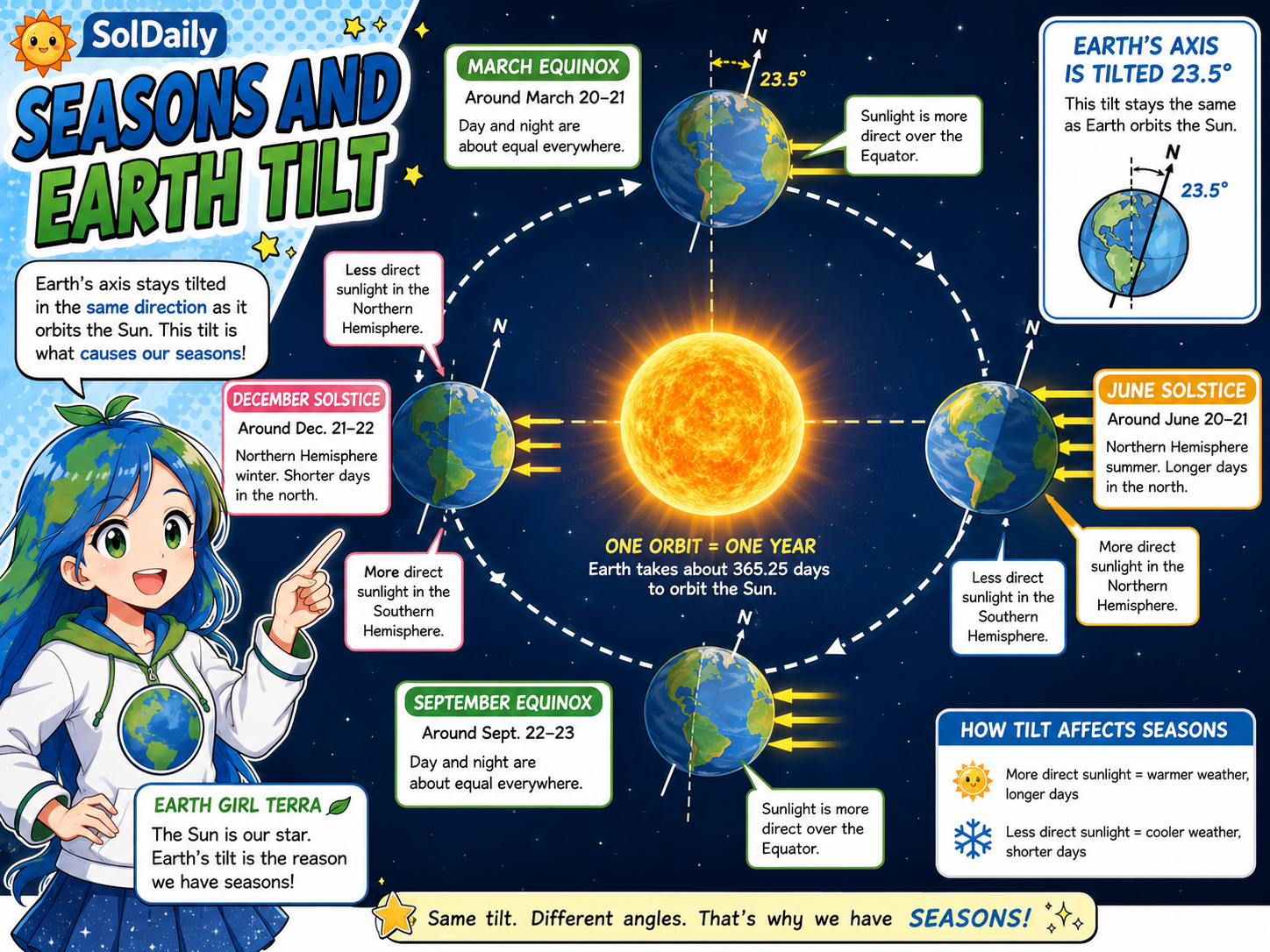
The seasons are not caused by Earth being “near” or “far.” They are caused by tilt.
The simple answer
Earth’s axis is tilted relative to its orbit around the Sun. As Earth travels around the Sun, each hemisphere tilts toward or away from the Sun at different times of year. This changes how directly sunlight hits the ground and how long the Sun stays above the horizon.
Earth Girl Terra calls this the great angle lesson. The same Sun shines all year, but Earth receives that sunlight differently as the planet moves through its orbit.
Earth is tilted
Imagine Earth’s rotation axis as an invisible line running from the North Pole to the South Pole. That axis is tilted rather than standing straight up relative to Earth’s path around the Sun. Because of that tilt, sunlight reaches different parts of Earth at different angles throughout the year.
The Solar Man sees the tilt as a cosmic design feature: one small angle changes the rhythm of calendars, harvests, holidays, shadows, energy use, and solar output.
Sunlight angle matters
When sunlight hits a surface more directly, the energy is concentrated over a smaller area. When sunlight arrives at a lower angle, the same energy spreads over a larger area. Lower-angle sunlight also travels through more atmosphere before reaching the ground.
PV Boy cares about this because solar panels generally produce more when they receive strong, direct sunlight. The seasonal path of the Sun affects the amount of usable light that reaches a panel.
| Season concept | Plain-language meaning | SolDaily character angle |
|---|---|---|
| Axial tilt | Earth’s rotation axis leans relative to its orbit around the Sun. | Earth Girl Terra draws the tilted globe. |
| Direct sunlight | Sunlight hits more straight-on and is more concentrated. | The Solar Man points to stronger illumination. |
| Low-angle sunlight | Sunlight spreads over a larger area and passes through more atmosphere. | Solar Sensei stretches the light beam across the chalkboard. |
| Day length | The number of daylight hours changes through the year. | Professor Photon checks the daylight schedule. |
| Solar production | Season, angle, weather, and shade affect how much energy panels make. | PV Boy compares summer and winter output. |
Day length changes
Seasons are also shaped by how long daylight lasts. In summer, a hemisphere tilted toward the Sun receives longer days and more direct sunlight. In winter, that hemisphere receives shorter days and lower-angle sunlight.
Professor Photon loves longer days because he gets more stage time. The Sunspot Twins claim winter shadows are better for dramatic entrances.
Summer and winter
Summer happens in a hemisphere when that hemisphere is tilted toward the Sun. Sunlight is more direct, and the days are longer. Winter happens when the hemisphere is tilted away from the Sun. Sunlight is less direct, and the days are shorter.
The important point is that opposite hemispheres have opposite seasons. When the Northern Hemisphere has summer, the Southern Hemisphere has winter, and vice versa.
Same Sun. Different angle. Different season.
The Sun does not need to change dramatically for seasons to happen. Earth’s tilt changes how sunlight arrives.
Spring and autumn
Spring and autumn happen between the stronger extremes of summer and winter. Around the equinoxes, day and night are more nearly balanced in length across much of the planet.
Solar Sensei calls spring and autumn the transition chapters. The solar angle changes, shadows shift, daylight hours move, and Earth’s surface responds.
Solstices
A solstice happens when one hemisphere is tilted most strongly toward or away from the Sun. The summer solstice brings the longest daylight period of the year for that hemisphere. The winter solstice brings the shortest daylight period.
The Solar Man treats solstices as calendar monuments: days when Earth’s tilt makes its most dramatic statement.
Equinoxes
An equinox happens around the time when neither hemisphere is strongly tilted toward or away from the Sun. Day and night are more nearly balanced, and the Sun appears to cross the celestial equator.
Earth Girl Terra calls equinoxes balance days. Madame Corona calls them elegant.
Why distance is not the main cause
Earth’s orbit is not a perfect circle, so Earth’s distance from the Sun does vary slightly. But that distance change is not the main cause of the seasons. The clearest evidence is that the Northern and Southern Hemispheres have opposite seasons at the same time.
If distance were the main cause, the whole planet would tend to have the same season at once. Instead, tilt explains why one hemisphere can have summer while the other has winter.
Seasons and solar panels
Solar panel production changes with the seasons. In many places, summer can bring longer days and a higher Sun path, which can increase solar opportunity. Winter often brings shorter days and lower Sun angles. Weather patterns, clouds, temperature, and shade also matter.
PV Boy keeps the practical lesson balanced: a solar system is not judged by one perfect noon. It produces across days, months, seasons, and years.
Temperature is not the whole story
Many people assume solar panels always produce best when it is hottest. That is not the whole story. Solar panels need light, and panel performance can be affected by high heat. A clear cool day with strong sunlight can be excellent for production.
Professor Photon claps at this correction. Photons matter. Heat alone is not the main engine of photovoltaic electricity.
Seasons, shadows, and roof design
Shadows change through the year because the Sun’s path changes. A tree, chimney, parapet, dormer, or nearby building may cast a different shadow in winter than it does in summer. This matters when evaluating solar layout.
Solar Sensei would mark this as a field lesson: seasonal shade can be just as important as roof size when thinking about real solar performance.
Why this lesson matters
Understanding Earth’s tilt helps explain seasons, day length, sunlight angle, shadows, solar production, weather rhythms, plant cycles, and human calendars.
The Solar Man closes the lesson with this: Earth is not just lit by the Sun. Earth dances with the Sun through tilt, orbit, rotation, and time.
How Solar Panels Use Sunlight
Follow PV Boy into the practical side of Sol and learn how photovoltaic panels turn sunlight into electricity.
Catch the lightHow Sunlight Reaches Earth
Return to Professor Photon’s journey through space, atmosphere, scattering, reflection, and absorption.
Back to sunlight’s journey