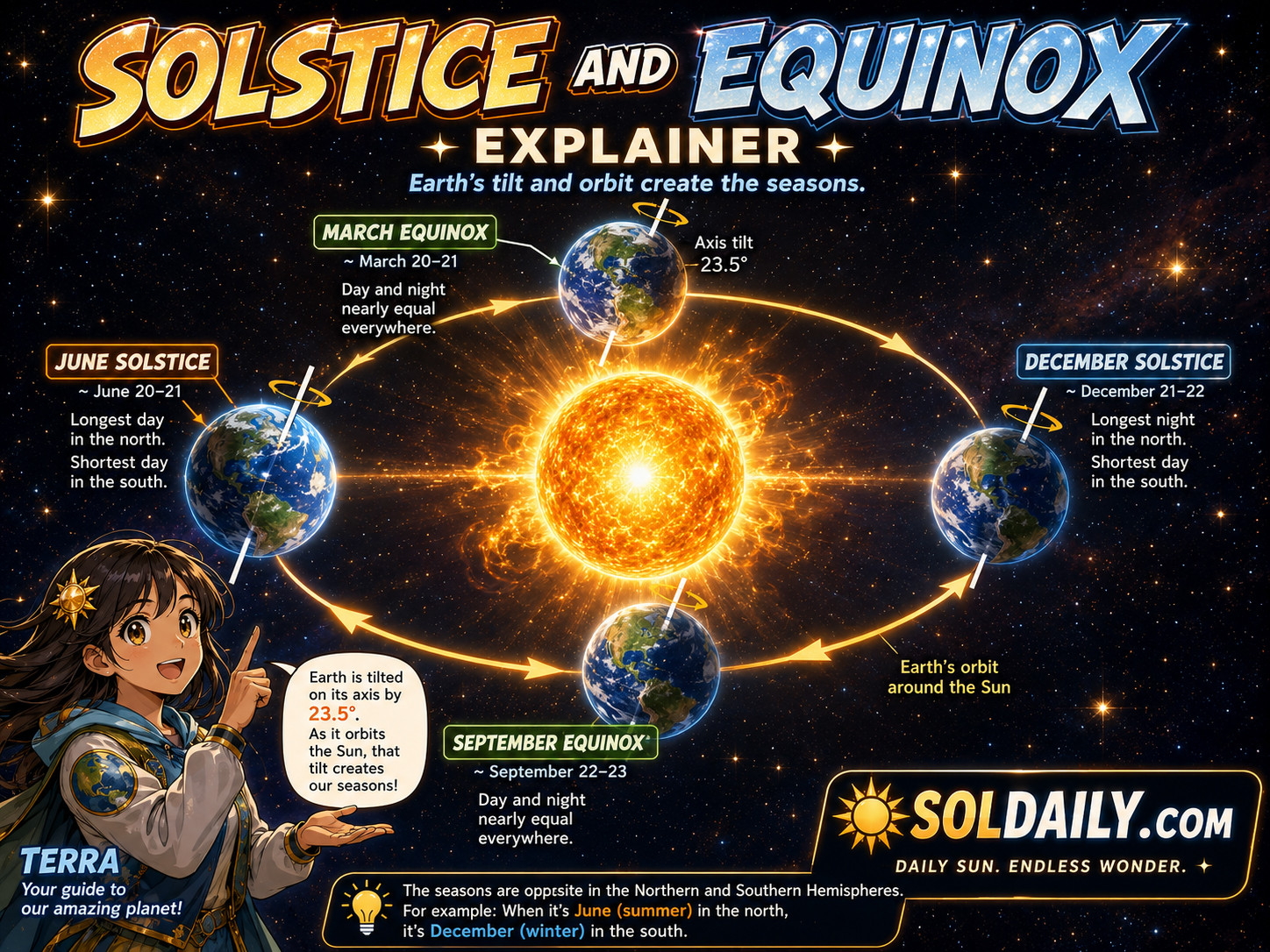
Solstices are the turning points. Equinoxes are the balance points.
The simple answer
A solstice happens when one hemisphere is tilted most strongly toward or away from the Sun. That creates the longest or shortest daylight period of the year for that hemisphere. An equinox happens when neither hemisphere is tilted strongly toward or away from the Sun, so day and night are more nearly balanced.
Earth Girl Terra calls solstices and equinoxes the four headline moments in Earth’s solar calendar. Solar Sensei calls them geometry made visible through daylight.
Why Earth’s tilt matters
Earth rotates on an axis, and that axis is tilted relative to Earth’s orbit around the Sun. As Earth travels through its orbit, this tilt changes which hemisphere receives more direct sunlight and longer days.
The Solar Man sees this as one of the great lessons of SolDaily.com: a small tilt creates huge consequences for seasons, agriculture, energy use, shadows, culture, and solar production.
What is a solstice?
A solstice occurs around the time when the Sun appears to reach its highest or lowest path in the sky for the year, depending on your hemisphere. In one hemisphere, the summer solstice brings the longest day. In the opposite hemisphere, the same moment brings the winter solstice and the shortest day.
Earth Girl Terra calls solstice a turning point because after it, daylight begins moving the other way: longer days begin shortening, or shorter days begin lengthening.
Summer solstice
The summer solstice is the day with the longest period of daylight for a hemisphere. The Sun follows a higher path across the sky, and sunlight tends to arrive more directly than in winter.
PV Boy pays attention because longer days and higher Sun paths can create strong solar production opportunities, depending on local weather, heat, shade, equipment, and site design.
Winter solstice
The winter solstice is the day with the shortest period of daylight for a hemisphere. The Sun follows a lower path across the sky, shadows stretch longer, and sunlight arrives at a lower angle.
Solar Sensei reminds the class that winter solar production can still be meaningful, but shorter days, lower Sun angle, clouds, storms, snow, shade, and local conditions may reduce output in many places.
| Solar calendar marker | Plain-language meaning | SolDaily character angle |
|---|---|---|
| Summer solstice | Longest daylight period of the year for that hemisphere. | The Solar Man stands at maximum daylight. |
| Winter solstice | Shortest daylight period of the year for that hemisphere. | Earth Girl Terra watches the long shadows. |
| Spring equinox | Day and night are more nearly balanced as spring begins in that hemisphere. | Solar Sensei marks the balance point. |
| Autumn equinox | Day and night are more nearly balanced as autumn begins in that hemisphere. | Professor Photon checks the equal-time schedule. |
| Seasonal solar production | Solar output changes with daylight length, Sun angle, weather, shade, and temperature. | PV Boy compares the yearly production curve. |
What is an equinox?
An equinox happens when Earth’s tilt is oriented so that neither hemisphere is strongly tilted toward or away from the Sun. Around the equinoxes, day and night are more nearly equal in length across much of Earth.
Madame Corona calls equinox elegant. Captain Flare calls it “too balanced.” Solar Sensei calls it one of the cleanest geometry lessons in the sky.
Spring equinox
The spring equinox marks a transition toward longer days and higher Sun paths in a hemisphere. It is often associated with new growth, warming soil, planting preparation, and the visible return of stronger daylight.
Earth Girl Terra connects spring equinox to farming, gardens, pollinators, longer afternoons, and people noticing that the light has changed.
Autumn equinox
The autumn equinox marks a transition toward shorter days and lower Sun paths in a hemisphere. It is often associated with harvest, cooling weather, longer shadows, and changing plant behavior.
The Solar Man treats autumn equinox as a reminder that sunlight is not leaving Earth; Earth is changing how it receives that sunlight.
The Sun does not need to change character for the seasons to change.
Earth’s tilt changes the angle and duration of sunlight. That is enough to reshape weather, shadows, calendars, farming, energy use, and solar production.
Daylight length
Daylight length changes through the year because Earth’s tilt changes the Sun’s apparent path across the sky. Longer daylight gives more time for sunlight to reach land, water, buildings, plants, and solar panels.
Professor Photon says daylight length is basically his work schedule. PV Boy says it is also one of the factors in solar production.
Sun angle and shadows
The Sun’s angle changes through the seasons. Higher Sun angles produce shorter shadows and more direct sunlight. Lower Sun angles produce longer shadows and spread sunlight over a larger area.
Solar Sensei uses shadows as an outdoor classroom. If you watch shadows at the same time of day across the year, you can see Earth’s tilt writing geometry on the ground.
Solstice, equinox, and solar panels
Solar panel production changes with daylight length, Sun angle, weather, temperature, shade, and system design. The summer solstice often provides long daylight hours, but heat can reduce panel efficiency and clouds can still matter. The winter solstice brings shorter days and lower Sun angles, but clear cool weather can still produce useful power.
PV Boy keeps the solar lesson honest: solstice and equinox explain the sky geometry, but real production still depends on local conditions and equipment.
Seasonal shade
Shade can change dramatically through the year. A tree, chimney, neighboring building, parapet, or roof feature may cast a different shadow in winter than in summer because the Sun’s path changes.
Solar Sensei says seasonal shade is one of the reasons serious solar design looks beyond one sunny afternoon.
Why cultures noticed these days
Many cultures have tracked solstices and equinoxes because they are visible markers of time, season, agriculture, ceremony, and survival. Long before modern instruments, people watched shadows, sunrise points, sunset points, stars, fields, and weather patterns.
The Solar Man respects this history because it shows that solar observation is ancient. Humans have always lived by the sky, even before they could explain it with modern science.
Solstice and equinox are moments, not magic switches
A solstice or equinox is a precise astronomical moment, but weather and seasons do not always change instantly on that day. Oceans, land, atmosphere, and local conditions create delays and regional differences.
Earth Girl Terra calls this the difference between the sky calendar and the ground calendar. The geometry may mark a moment, while Earth systems respond over time.
Why this lesson matters
Solstices and equinoxes matter because they turn Earth’s tilt into a visible yearly rhythm. They explain daylight changes, seasonal shadows, crop timing, solar production patterns, cultural calendars, and the feeling that the light itself has a season.
Solar Sensei closes the lesson with one line: to understand the year, follow the angle of Sol.
Safe Solar Eclipse Viewing
Learn how to treat the Sun with respect during eclipse events and why proper eye protection matters.
View safelyThe Sun and Water Cycle
Return to the water cycle and learn how sunlight helps drive evaporation, clouds, rain, rivers, groundwater, and farming systems.
Back to the water cycle