Wonder is not worth an eye injury.
The simple answer
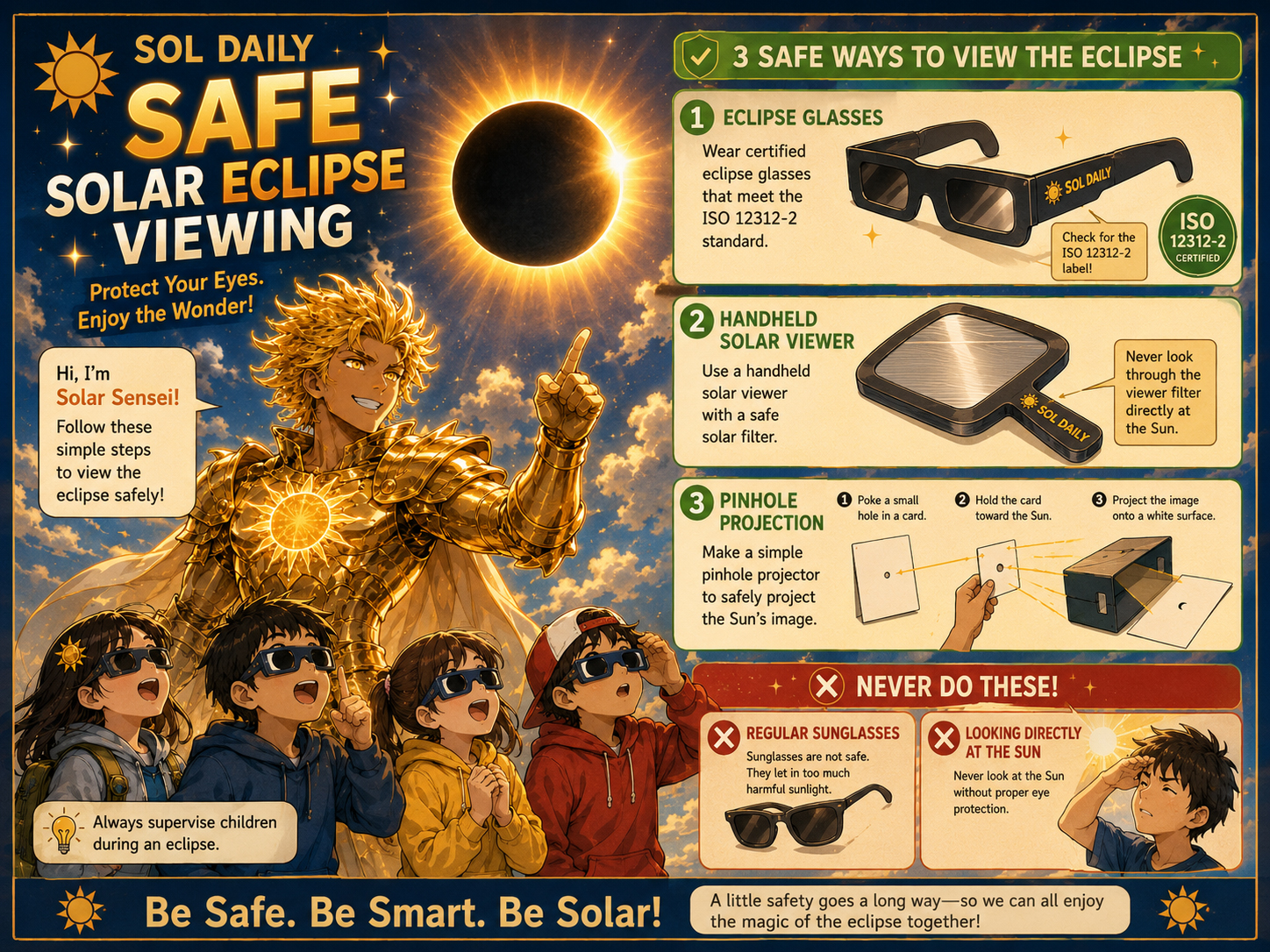
Do not look directly at the Sun without proper solar viewing protection. Ordinary sunglasses, even very dark ones, are not safe for direct solar viewing. Safe solar viewers are thousands of times darker than regular sunglasses and should comply with the ISO 12312-2 standard for direct observation of the Sun. NASA specifically says safe solar viewers should comply with ISO 12312-2 and that NASA does not approve any particular brand of viewer. :contentReference[oaicite:0]{index=0}
Solar Sensei says the rule plainly: if you are not using proper solar viewing equipment, do not look directly at the Sun.
Madame Corona’s warning
Madame Corona is most famous during a total solar eclipse, when the Moon blocks the Sun’s bright disk and the faint outer corona becomes visible. But she gives one royal order before the show begins:
“Admire me responsibly.”
During partial phases, annular eclipses, and ordinary solar viewing, proper solar protection is required. Only during the brief period of totality in a total solar eclipse, when the Moon completely covers the Sun’s bright face, can properly located observers view the eclipse without solar viewers. As soon as the bright Sun begins to reappear, viewers must be used again.
Use proper eclipse glasses or handheld solar viewers
Proper eclipse glasses or handheld solar viewers are made for direct solar viewing. The American Astronomical Society says viewers should meet the requirements of ISO 12312-2 and recommends avoiding solar viewers that do not meet that standard. AAS also maintains guidance and supplier information for safe solar viewers and filters. :contentReference[oaicite:1]{index=1}
Professor Photon does not trust a label by itself. He wants a reputable source, a real standard, and an undamaged viewer.
| Viewing method | Safe or unsafe? | SolDaily note |
|---|---|---|
| ISO 12312-2 compliant eclipse glasses from a reputable source | Safe when used properly and undamaged | Professor Photon approves the standard. |
| Regular sunglasses | Unsafe | Solar Sensei rejects this immediately. |
| Pinhole projector | Safe indirect method when used correctly | Earth Girl Terra watches the projected image, not the Sun. |
| Camera, binoculars, or telescope without proper solar filter | Unsafe | Concentrated sunlight can injure eyes and damage equipment. |
| Damaged eclipse glasses | Unsafe | Scratches, tears, punctures, or loose filters mean stop. |
Inspect your eclipse glasses
Before using eclipse glasses or handheld viewers, inspect them. Do not use viewers that are scratched, punctured, torn, coming loose from the frame, or otherwise damaged. AAS says older viewers may be reused if they are ISO 12312-2 compliant, less than 10 years old, and the filters are not damaged. :contentReference[oaicite:2]{index=2}
PV Boy treats eclipse glasses like safety equipment, not souvenirs. If there is doubt, do not use them.
When in doubt, do not look.
If your glasses are damaged, questionable, counterfeit, unlabeled, or from an unknown source, use an indirect viewing method instead of looking directly at the Sun.
Beware counterfeit or questionable glasses
The AAS warns that some products may claim ISO certification or cite the standard without reliable testing or complete certification information. A safe plan is to obtain viewers from reputable sources and verify supplier guidance before the event. :contentReference[oaicite:3]{index=3}
The Permit Goblin loves fake paperwork. Solar Sensei does not. A printed claim is not the same as trustworthy protection.
Do not use ordinary sunglasses
Ordinary sunglasses are not safe for direct solar viewing, even if they are very dark. The American Academy of Ophthalmology says sunglasses are not enough to protect eyes during eclipse viewing, and NASA makes the same safety point through its eclipse guidance. :contentReference[oaicite:4]{index=4}
Captain Flare tries to put on three pairs of sunglasses. Solar Sensei confiscates them.
Do not look through cameras, binoculars, or telescopes without proper solar filters
Cameras, binoculars, telescopes, and other optical devices can concentrate sunlight and create serious eye or equipment hazards if they are not fitted with proper solar filters. Eclipse glasses alone are not a safe substitute for correct solar filters on optical devices.
Professor Photon says this is where “I will just look quickly” becomes a terrible plan.
Pinhole projection is a safe indirect method
If you do not have proper solar viewers, use indirect viewing. A pinhole projector lets sunlight pass through a small opening and project an image of the Sun onto another surface. You look at the projected image, not at the Sun.
Earth Girl Terra likes pinhole projection because it turns safety into a simple classroom experiment.
Simple pinhole method
A simple pinhole viewing setup can be made with a small hole in cardboard and a white projection surface. Stand with your back to the Sun, let sunlight pass through the pinhole, and watch the projected image on the surface. Do not look through the pinhole at the Sun.
“Project the Sun. Do not stare at it.” — Solar Sensei
Colanders, tree shadows, and projection patterns
During partial eclipse phases, small gaps can project crescent-shaped images of the Sun. A kitchen colander, small holes in paper, or gaps between leaves can create repeated projected images. Again, the safe method is to look at the projection on the ground or a surface, not directly at the Sun.
Professor Photon calls this “many tiny safe Sun pictures.” Captain Flare calls it “not explosive enough,” which is why he is ignored.
Children need supervision
Children should be closely supervised during eclipse viewing. They may remove glasses, look around viewers, use damaged viewers, or misunderstand indirect projection. Adults should demonstrate the correct method and watch continuously.
Earth Girl Terra says eclipse safety is not a one-time instruction. It is active supervision.
Driving and crowd safety
Eclipses can create traffic, crowd, and distraction risks. Plan where to view, where to park, how to avoid sudden roadside stops, and how to keep children, pets, and groups safe.
The Permit Goblin requests a parking plan. For once, Solar Sensei does not object.
Totality is brief and location-specific
Totality occurs only inside the path of totality during a total solar eclipse, and it lasts only a short time. Outside that path, observers see a partial eclipse and must use proper solar viewing protection the entire time.
Madame Corona may reveal her crown during totality, but only the people in the correct path at the correct time experience that phase.
Annular eclipses still require protection
In an annular eclipse, the Moon does not fully cover the Sun’s bright disk. A bright ring remains visible, so proper solar viewing protection is required throughout the event.
Solar Sensei says annular means “no naked-eye totality break.”
If your eyes feel wrong afterward
If someone looked at the Sun without proper protection and later experiences blurred vision, distorted vision, blind spots, color changes, eye discomfort, or other vision concerns, they should seek evaluation from an eye-care professional.
SolDaily.com does not diagnose eye injuries. The safety advice is simple: prevent the exposure before it happens.
SolDaily safety checklist
- Use eclipse glasses or handheld solar viewers that meet ISO 12312-2 and come from a reputable source.
- Inspect viewers before use; do not use scratched, torn, punctured, loose, or damaged filters.
- Do not use regular sunglasses for direct Sun viewing.
- Do not look through cameras, binoculars, or telescopes without proper solar filters on the device.
- Use pinhole projection or other indirect viewing if proper solar viewers are not available.
- Supervise children continuously.
- During total eclipses, remove viewers only during actual totality and put them back on before the bright Sun returns.
- During partial or annular eclipses, use proper protection the entire time.
Why this lesson matters
Solar eclipses are unforgettable because they reveal how precisely the Sun, Moon, and Earth can align. They can show Madame Corona’s crown, shift daylight, and turn an ordinary sky into a once-in-a-lifetime memory.
But the Sun remains powerful. The Solar Man closes the lesson:
“Respect the star before you admire the shadow.”
Madame Corona
Meet the radiant character who represents the Sun’s outer atmosphere, visible during totality when viewed safely.
Meet Madame CoronaSolar Radiation
Learn why sunlight includes visible, infrared, ultraviolet, and other radiation that must be treated with respect.
Study solar radiation