The Sun lifts water into the sky, and Earth writes the rest of the journey.
The simple answer
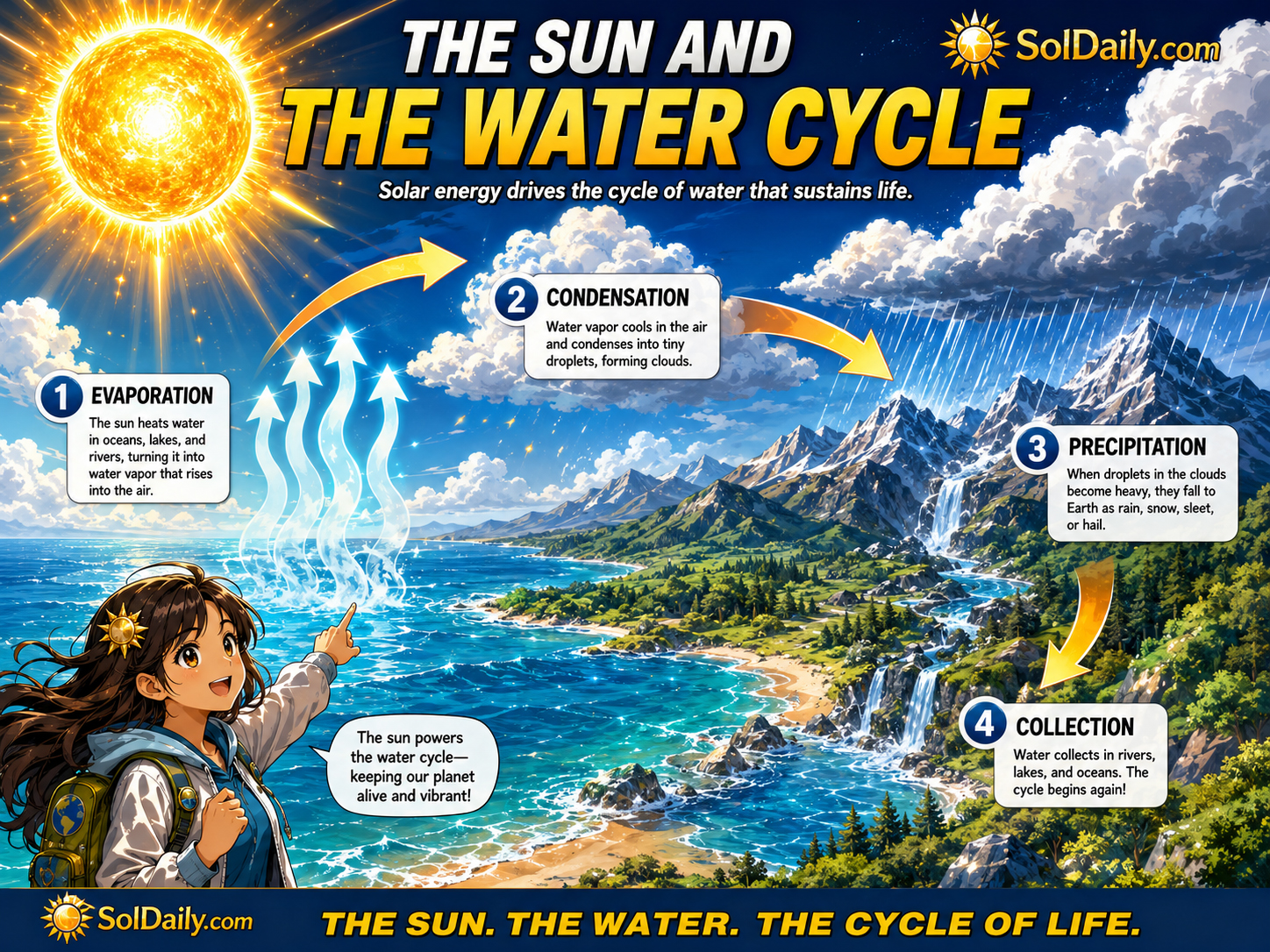
The water cycle is the continuous movement of water through Earth’s oceans, atmosphere, land, rivers, ice, soil, plants, and groundwater. The Sun provides energy that helps water evaporate from surfaces and move into the atmosphere. From there, water can form clouds and eventually return as precipitation.
Earth Girl Terra calls the water cycle a solar-powered circulation story. The Solar Man calls it sunlight becoming cloud, rain, river, root, and life.
Evaporation: sunlight lifts water
Evaporation happens when liquid water becomes water vapor and enters the air. Solar energy warms water on oceans, lakes, rivers, soil, and wet surfaces, helping some water molecules escape into the atmosphere.
Professor Photon loves evaporation because it shows sunlight doing invisible work. You may not see each molecule leave the ocean, but the sky remembers.
Transpiration: plants release water vapor
Plants also release water vapor through a process called transpiration. Water moves from roots through the plant and exits through tiny openings in leaves. Together, evaporation and transpiration are often discussed as evapotranspiration.
Earth Girl Terra likes this because it connects the water cycle to farming, forests, gardens, shade, heat, and plant health.
| Water-cycle step | Plain-language meaning | SolDaily character angle |
|---|---|---|
| Evaporation | Water changes from liquid to vapor and rises into the atmosphere. | Professor Photon helps lift water from the surface. |
| Transpiration | Plants release water vapor through their leaves. | Earth Girl Terra checks the leaf laboratory. |
| Condensation | Water vapor cools and forms tiny droplets or ice crystals. | Solar Sensei draws the cloud assembly line. |
| Precipitation | Water falls back to Earth as rain, snow, sleet, or hail. | Captain Flare complains that rain stole his thunder. |
| Runoff and infiltration | Water flows over land or soaks into soil and groundwater. | The Solar Man follows water from mountain to river to root. |
Condensation: clouds form
As water vapor rises and cools, it can condense into tiny droplets or ice crystals. These droplets and crystals gather into clouds. Clouds are not just sky decoration; they are part of Earth’s water storage and transport system.
Solar Sensei says every cloud is a temporary water warehouse. Captain Flare says that sounds boring until thunder enters the scene.
Precipitation: water returns
When droplets or ice crystals in clouds grow heavy enough, water returns to Earth as precipitation. This can be rain, snow, sleet, hail, or other forms depending on temperature and atmospheric conditions.
The Solar Man sees precipitation as the return trip: the Sun helped lift the water, and gravity helps bring it back down.
Sunlight starts the lift. Gravity completes the fall.
The water cycle is not one force. It is sunlight, air, temperature, clouds, land, plants, oceans, and gravity working together.
Runoff: water moves across land
Some precipitation flows across land into streams, rivers, lakes, reservoirs, and oceans. This is runoff. Runoff depends on terrain, soil, vegetation, rainfall intensity, pavement, land use, and how much water the ground can absorb.
Earth Girl Terra points out that land design matters. Forests, farms, cities, roofs, roads, and drainage systems all change where water goes after it falls.
Infiltration and groundwater
Some water soaks into the ground. This process is called infiltration. Water can move through soil and rock, recharge groundwater, feed springs, and support plants.
Solar Sensei says the water cycle is not only overhead. A major part of the story happens underground, slowly and quietly.
Snowpack and stored water
In some regions, winter snowpack stores water until warmer seasons. As snow melts, water can feed streams, rivers, reservoirs, agriculture, ecosystems, and communities.
The Solar Man calls snowpack a frozen savings account. Earth Girl Terra reminds him that changing snowpack timing can be a serious water management issue.
The Sun and drought
Drought happens when water shortages develop over time. Low precipitation, high heat, evaporation, soil moisture loss, reservoir levels, groundwater use, vegetation stress, and human demand can all contribute.
Solar energy can increase evaporation and water demand when conditions are hot and dry. That is why farmers, cities, water managers, and ecosystems all pay attention to both precipitation and heat.
The water cycle and farming
Farming depends on water at the right time, in the right amount, and in the right place. Rainfall, irrigation, soil moisture, evaporation, transpiration, groundwater, reservoirs, and snowmelt can all affect crop success.
Earth Girl Terra connects this page back to farming: sunlight helps plants grow, but sunlight also helps move the water those plants need.
The water cycle and weather
Water vapor is a key part of weather. It affects humidity, clouds, rainfall, storms, snow, and heat transfer in the atmosphere. Solar heating helps drive evaporation and atmospheric motion, which help create weather patterns.
Captain Flare says storms are Earth’s way of making panels dramatic. Solar Sensei says that is not a scientific definition, but it is memorable.
The water cycle and climate
Climate affects the long-term patterns of precipitation, evaporation, snowpack, drought, storms, and water availability. As climate patterns change, water cycle behavior can also change, affecting ecosystems, agriculture, infrastructure, and human planning.
The Solar Man treats the water cycle as one of the great links between energy and life. When sunlight and climate patterns change the movement of water, everything downstream matters.
Solar panels and water
Solar panels use sunlight to make electricity and usually require very little water during operation compared with many traditional power generation methods. However, water may be used for cleaning panels in some locations, and solar projects still require thoughtful site design to manage drainage, runoff, soil, vegetation, and local conditions.
PV Boy keeps the lesson practical: solar panels catch light, not water, but real solar installations still live in the water cycle. Rain, dust, drainage, roof slope, gutters, soil, and site design all matter.
Roofs, rain, and solar design
On rooftops, water management matters. Roof condition, drainage, flashing, penetrations, gutters, slope, and installation workmanship can affect long-term performance. Solar design should respect the roof as a water-shedding system.
Solar Sensei says this is where cosmic solar science meets practical roofing reality. The Sun may power the panel, but rain tests the roof.
Why this lesson matters
The Sun and water cycle matter because water is life, and solar energy helps move water through Earth’s systems. Evaporation, clouds, rain, rivers, groundwater, snowpack, drought, farming, weather, and solar site design all connect back to sunlight.
Earth Girl Terra closes the lesson with this: when sunlight touches water, Earth begins to move.
Solstice and Equinox
Learn the calendar markers that show how Earth’s tilt changes daylight, shadows, seasons, and solar production through the year.
Study the solar calendarThe Sun and Farming
Return to the field and see how sunlight supports crops, soil temperature, farm water, and agricultural solar energy.
Back to farming