The Sun does not burn like a campfire. It shines because its core is a fusion engine.
The simple answer
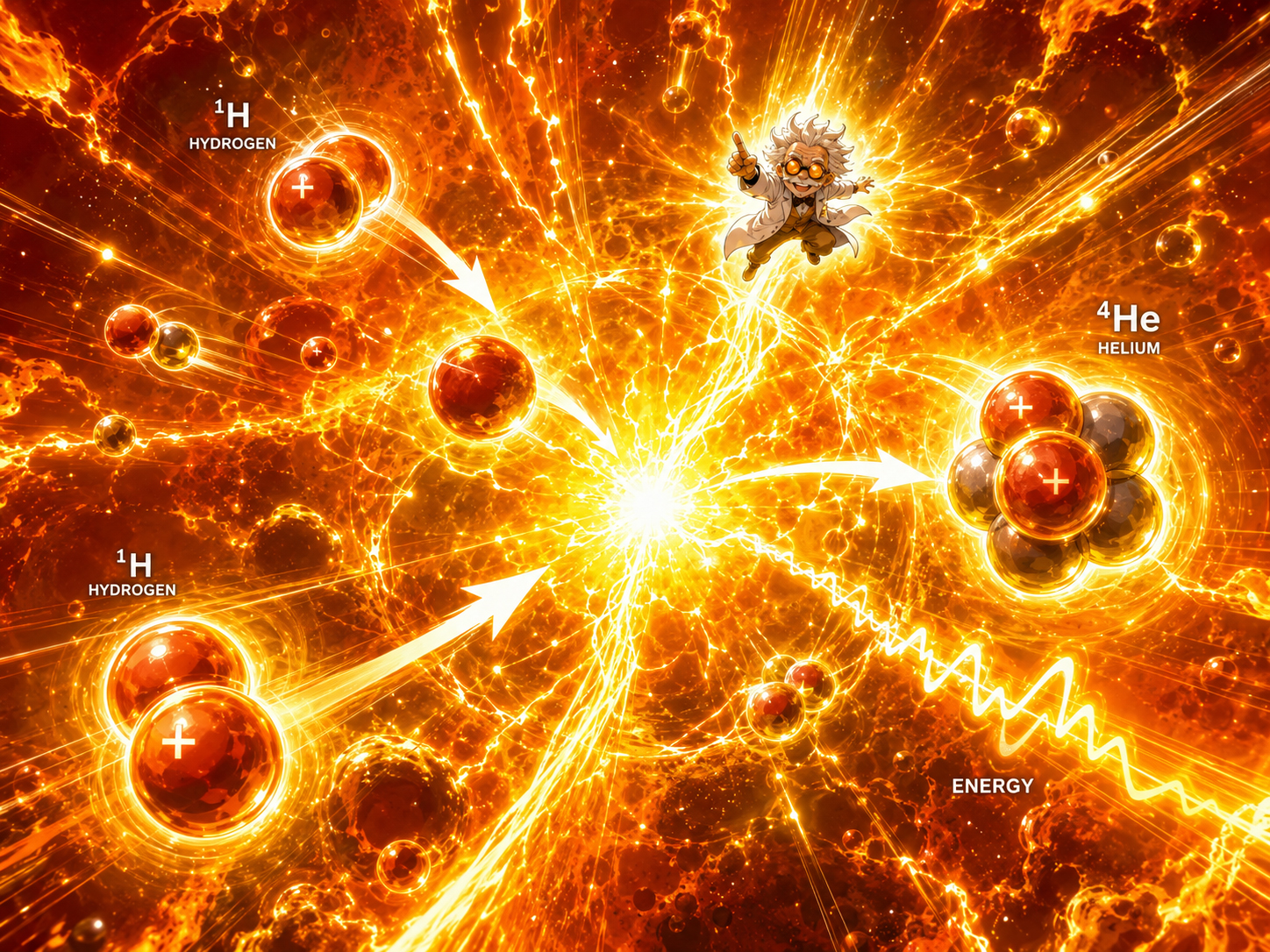
Nuclear fusion is when small atomic nuclei combine to form a larger nucleus. In the Sun, the main story begins with hydrogen. Under extreme conditions in the core, hydrogen nuclei are forced close enough to fuse through a chain of reactions. The final result is helium plus released energy.
Solar Sensei would stop the class here and say: this is the first principle. The Sun is not a burning object in the ordinary sense. It is a gravitationally held fusion reactor on an astronomical scale.
Why fusion happens in the Sun
Hydrogen nuclei naturally repel each other because they have positive electric charge. To make fusion happen, the Sun needs enormous temperature and pressure. The Sun’s gravity provides the pressure by squeezing material inward toward the core.
In the core, the conditions are extreme enough that some hydrogen nuclei can overcome their repulsion and fuse. That is where the story changes from matter under pressure into energy on the move.
The core is the Sun’s power plant
The solar core is the central engine room. It is where fusion releases the energy that eventually becomes sunlight. The rest of the Sun is the long path that energy travels before escaping into space.
| Fusion concept | Plain-language meaning | SolDaily character |
|---|---|---|
| Hydrogen nuclei | The starting fuel of the Sun’s main fusion process. | Professor Photon calls them the beginning of the light story. |
| Extreme pressure | Gravity squeezes the Sun’s core so fusion can occur. | Solar Sensei explains gravity as the great compressor. |
| Extreme temperature | The core is hot enough for particles to move violently. | Captain Flare wants to shout, but Solar Sensei keeps it orderly. |
| Helium | The main product after hydrogen fusion chains complete. | The Solar Man points to helium as proof that matter changed form. |
| Released energy | A small amount of mass becomes energy that moves outward. | Professor Photon begins the long journey outward. |
The proton-proton chain
In stars like the Sun, the main fusion pathway is commonly described as the proton-proton chain. A proton is the nucleus of ordinary hydrogen. Through several steps, protons combine and transform until helium is produced.
The details can get technical, but the big idea is simple enough for the SolDaily newsroom: hydrogen goes into the solar core’s reaction chain, helium comes out, and energy is released.
A tiny mass difference becomes enormous energy.
The helium produced by fusion has slightly less mass than the original hydrogen nuclei. That missing mass is converted into energy. This is why a star can shine for billions of years.
Why fusion releases energy
Fusion releases energy because the final nucleus can be more tightly bound than the starting nuclei. In the Sun’s fusion process, the final helium nucleus has less mass than the separate hydrogen nuclei that began the reaction chain. The difference is released as energy.
The Solar Man would say this is where the Sun becomes poetry and physics at the same time: a tiny difference in mass becomes the light that crosses space, warms Earth, grows food, drives weather, and strikes solar panels.
Energy does not instantly leave the Sun
A common mistake is imagining that energy made in the core immediately becomes sunlight at the surface. The path is much more complicated. Energy created in the core interacts with the dense solar interior. It moves outward through layers before it finally escapes from the visible surface.
Professor Photon gets impatient here because people think light is always simple. Inside the Sun, energy can scatter, be absorbed, be re-emitted, and slowly work outward before becoming the sunlight Earth receives.
From fusion to sunlight
The path from fusion to sunlight can be imagined in stages:
- Fusion releases energy in the solar core.
- Energy moves outward through the dense interior.
- Convection helps carry energy closer to the visible surface.
- Light escapes from the photosphere into space.
- A small fraction of that light reaches Earth.
- Some of that sunlight warms land, water, plants, people, buildings, and solar panels.
The Sun is stable because forces balance
The Sun does not simply explode apart because gravity pulls inward. It does not simply collapse because energy and pressure push outward. The Sun exists in a long-running balance between inward gravity and outward pressure from hot plasma and radiation.
Solar Sensei calls this balance the quiet discipline of the star. Captain Flare finds it boring until he remembers that without this balance, there would be no steady daylight for Earth.
Fusion and solar power
Rooftop solar power begins far away from the roof. It begins in the Sun’s core. A solar panel does not care about the entire fusion chain directly, but it depends on the final result: photons arriving at Earth with usable energy.
PV Boy would explain it in one sentence: fusion makes sunlight, sunlight carries photons, photons strike solar cells, and solar cells help produce electricity.
Why this lesson matters
Nuclear fusion matters because it is the source chapter of the solar story. Without fusion, there is no sunlight. Without sunlight, there is no solar power, no photosynthesis, no normal weather cycle, and no daylight rhythm for life on Earth.
That is why SolDaily.com starts here. If you understand fusion, you begin to understand why The Solar Man treats the Sun with respect.
Photons and Sunlight
Follow Professor Photon as the story moves from fusion energy to light traveling through space toward Earth.
Follow the photonWhat Is the Sun?
Return to the big-picture introduction to the star that powers life, weather, seasons, and solar energy.
Back to the Sun