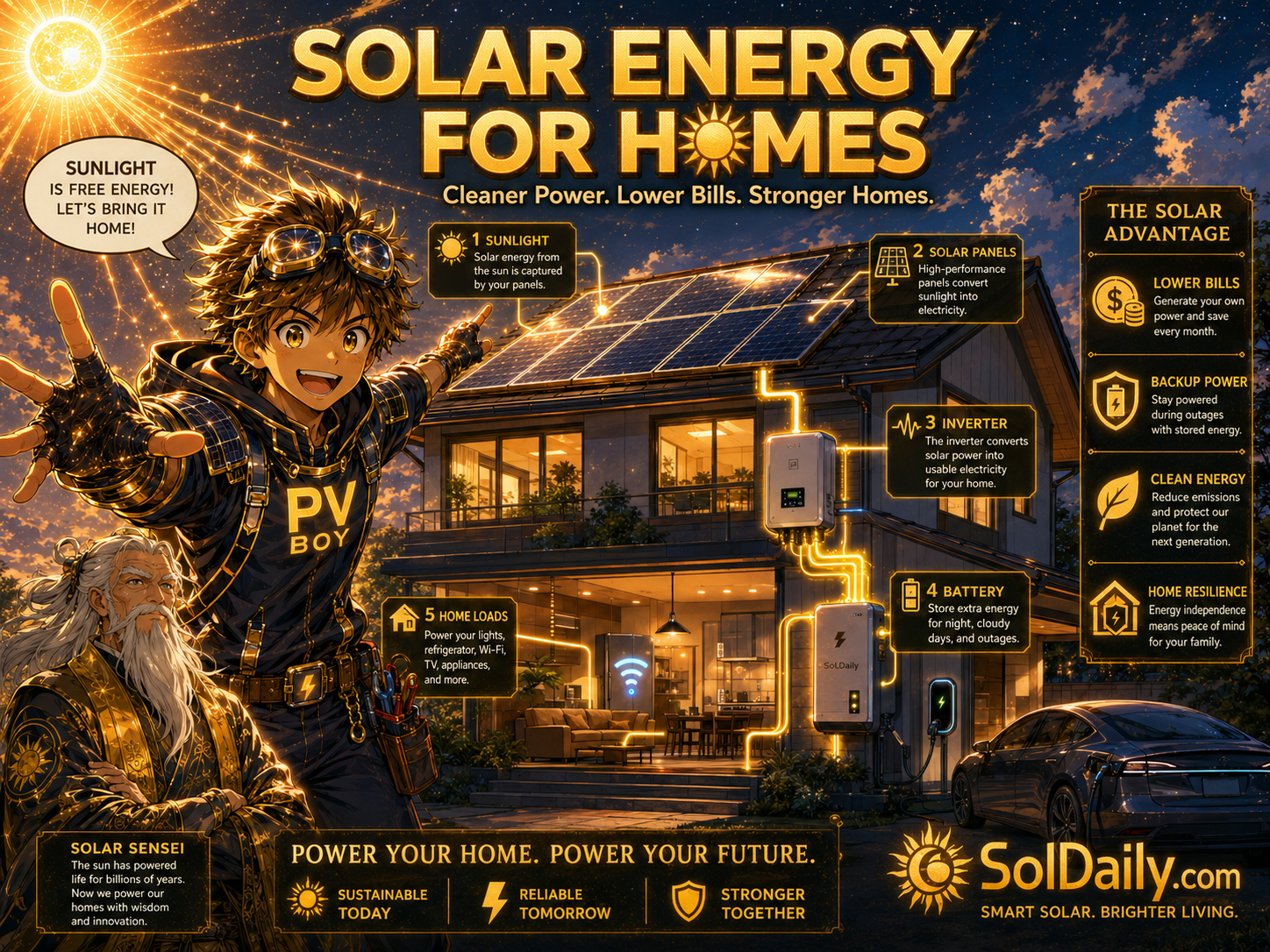
Home solar is not just panels on a roof. It is the Sun meeting the way a household actually lives.
The simple answer
A home solar system uses rooftop or ground-mounted panels to convert sunlight into electricity. That electricity can serve household loads, reduce grid purchases, charge batteries, or export to the grid depending on the system design, utility rules, rate plan, and timing of household use.
PV Boy says the homeowner question is not only “How many panels?” It is “What does the house need, when does it need it, and what can the roof produce?”
Start with household usage
A home uses electricity in patterns. Some loads run all day, such as refrigeration or internet equipment. Some run occasionally, such as laundry, cooking, pumps, or tools. Large loads like air conditioning, electric heat, EV charging, pool pumps, and water heating can dominate the energy story.
Earth Girl Terra asks the practical question:
“What is the home actually doing while the Sun is producing?”
The daily production curve
Solar production usually ramps up after sunrise, becomes stronger as the Sun rises, may peak around midday or early afternoon depending on roof orientation and system design, and then declines toward sunset.
A household’s usage curve may not match the solar curve. That timing gap is where batteries, EV charging schedules, load shifting, and utility rates become important.
| Home solar factor | Plain-language meaning | SolDaily character angle |
|---|---|---|
| Usage pattern | When the home actually uses electricity. | Earth Girl Terra compares the family schedule to the solar curve. |
| Roof condition | The roof must be suitable before panels are installed. | Solar Sensei checks the roof before the hero pose. |
| Shade | Trees, chimneys, buildings, and roof features can reduce production. | PV Boy scans for missing photons. |
| Battery goals | Storage may support backup, evening use, or rate strategy. | The Solar Man calls it stored daylight with a schedule. |
| Utility rate | Bills depend on rates, timing, exports, fixed charges, and usage. | The Permit Goblin waves the rate schedule like a scroll. |
Roof condition comes first
Solar panels can last a long time, so the roof should be reviewed before installation. A worn or failing roof may need repair or replacement before solar is installed. Roof type, age, structure, waterproofing, access, and mounting method all matter.
Solar Sensei says the Sun may be cosmic, but leaks are local.
Shade matters on homes
Residential roofs often have shade from trees, chimneys, vents, neighboring buildings, dormers, antennas, parapets, and seasonal Sun-path changes. Shade at the wrong time or in the wrong location can reduce production.
PV Boy calls shade the homeowner’s invisible production thief. Earth Girl Terra says it is only invisible until the monitoring graph shows the dip.
Electrical service matters
A home’s main service panel, breakers, bus rating, available capacity, backup load panel, grounding, conduit routes, and code requirements can all affect solar design. Some homes may need electrical upgrades or careful interconnection planning.
The Permit Goblin enters here because electrical approvals, utility rules, and inspections are real, even when the Goblin is ridiculous.
Solar design is roof plus electrical plus usage.
A strong home solar plan looks at what the roof can produce, what the electrical system can safely accept, and what the household actually needs.
Batteries for homes
Home batteries can store solar energy for later use, support selected backup loads during outages, or help manage time-of-use rates when configured for that goal. The right size depends on the loads, desired backup duration, available solar recharge, inverter limits, safety rules, and budget.
The Solar Man calls batteries stored daylight. Solar Sensei adds: stored daylight still has capacity limits.
Backup loads
Many home battery systems use a protected loads panel. Instead of trying to power everything, the system powers selected circuits such as refrigerator, lights, internet, garage door, medical equipment, security, or selected outlets.
Earth Girl Terra asks the right homeowner question:
“What must stay on, and what can wait?”
Whole-home backup is different
Whole-home backup can be more complex and expensive than backing up selected loads. Large loads such as air conditioning, electric dryers, ovens, electric heat, pool pumps, and EV chargers can quickly exceed battery power or drain capacity.
PV Boy says whole-home backup should be engineered, not assumed.
EV charging and home solar
EV charging can be one of the largest home electrical loads. Solar can help offset EV charging energy, especially when charging is scheduled during solar production hours. But vehicle availability, charger size, utility rates, battery strategy, and household loads all matter.
Earth Girl Terra asks: is the car home when the Sun is producing?
Pool pumps and home equipment
Pool pumps, well pumps, heat pumps, air conditioning, electric water heaters, and other equipment can affect solar sizing and battery planning. Some loads can be scheduled to run during solar production hours, depending on comfort, equipment, utility rates, and household needs.
Solar Sensei says load scheduling is often cheaper than oversizing everything without a plan.
Utility rates and bills
Solar savings depend on how the home uses energy and how the utility bills energy. Time-of-use rates, export rules, fixed charges, minimum charges, net billing, seasonal rates, and customer behavior can all affect the bill.
PV Boy warns that a solar system is physical equipment, but a utility bill is math, rules, timing, and behavior.
Solar exports
When a home produces more solar electricity than it uses at that moment, extra energy may be exported to the grid if the system is grid-connected and allowed to export. The value of exported energy depends on local utility rules and rate structures.
Batteries may help store some energy instead of exporting it, depending on the design and goals.
Monitoring for homeowners
Monitoring helps homeowners see daily production, battery state of charge, grid imports, exports, load behavior, and equipment status when the system supports those features. Monitoring can also reveal shade patterns, cloud dips, inverter issues, or communication problems.
Earth Girl Terra calls monitoring the home’s solar diary. Solar Sensei calls it evidence.
Maintenance and service
Solar systems need periodic attention. Monitoring should be reviewed. Roof and electrical equipment should remain accessible and safe. Vegetation should be managed. Panels may need cleaning in some conditions. Inverters and batteries should be serviced according to manufacturer and installer guidance.
PV Boy says solar is low-fuel, not no-responsibility.
Home solar myths
Homeowners should avoid common myths:
- Solar panels are powered by heat. They are not; they use light.
- Grid-tied solar automatically works during outages. Many systems shut down unless designed for backup.
- A battery powers everything forever. It does not; capacity and power are limited.
- Every roof is equally good for solar. Roof condition, shade, orientation, and electrical constraints matter.
- The bill is only about kWh. Rates, timing, fixed charges, exports, and usage behavior matter.
Homeowner questions to ask
A good home solar conversation should ask:
- How much energy does the home use each year and each season?
- When does the home use power during the day?
- Is the roof in good condition?
- Where is the shade in morning, midday, afternoon, summer, and winter?
- Does the electrical panel support the project?
- Is battery backup desired, and which loads matter?
- Is EV charging planned now or later?
- What utility rate and export rules apply?
- How will monitoring and service be handled?
Where ABC Solar fits
ABC Solar’s real-world role is to translate the sunlight story into a safe, permitted, practical system for the home. That means site review, roof reality, electrical design, equipment selection, permits, inspections, utility coordination, installation, monitoring, and support.
SolDaily.com teaches the story. ABC Solar brings it to the roof.
Why this lesson matters
Solar energy for homes matters because a home is personal. It has comfort, family routines, utility bills, outage concerns, roof constraints, daily habits, and future plans. Good solar design respects all of that.
The Solar Man closes the lesson:
“The Sun may power the system, but the home defines the mission.”
Solar Energy for Business
Learn how commercial solar differs from home solar, including demand charges, operating hours, roof area, batteries, and business loads.
Study business solarRooftop Solar and Daily Sun
Return to the daily solar production curve: sunrise, midday, shade, heat, loads, batteries, and monitoring.
Back to daily solar