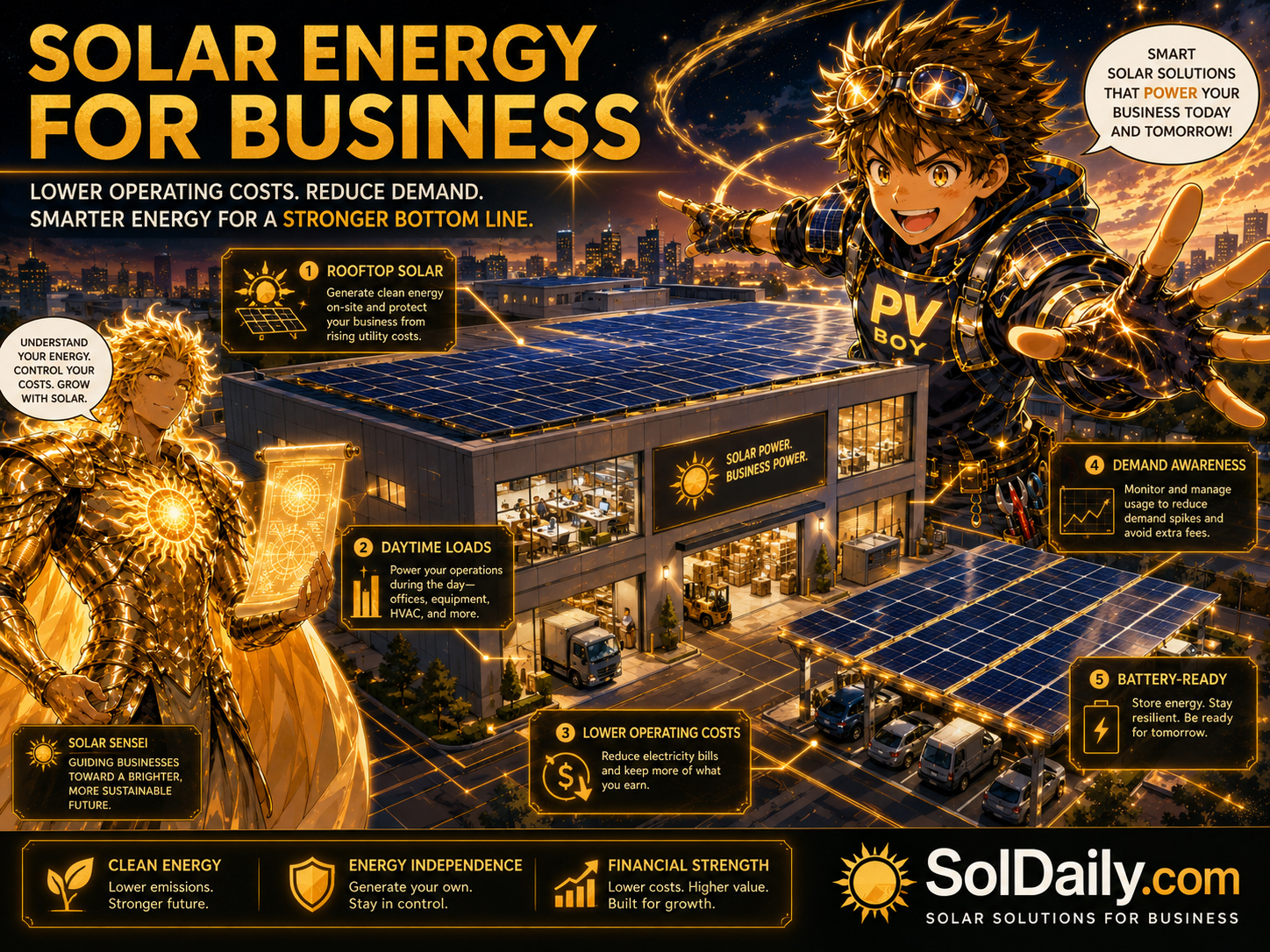
Business solar is not just about sunlight. It is about when the business uses power, how the utility bills it, and what the site can safely build.
The simple answer
A business solar system uses solar panels to convert sunlight into electricity for a commercial property. That electricity may serve daytime loads, reduce grid purchases, support batteries, power EV charging, or export energy depending on the utility rules, interconnection, system design, and rate plan.
PV Boy says commercial solar begins with a different question than residential solar: what does the business do every hour, and how does the utility charge for it?
Commercial loads are different
A business may use electricity for lighting, HVAC, refrigeration, machinery, computers, pumps, elevators, security systems, ovens, compressors, EV chargers, warehouse equipment, medical equipment, or process loads. The load profile depends on the business.
Earth Girl Terra asks the practical question:
“What is the building doing while the Sun is producing?”
Operating hours matter
A business open during the day may use more of its solar production directly. A business that uses most of its power at night may need a different strategy, such as batteries, load shifting, or a smaller solar-only system.
Solar Sensei calls this the commercial timing problem: the solar curve and the business operations curve must be compared.
| Business solar factor | Plain-language meaning | SolDaily character angle |
|---|---|---|
| Operating hours | When the business is actively using electricity. | Earth Girl Terra compares the workday to the solar curve. |
| Demand charges | Charges based on peak power draw, not just total energy. | PV Boy watches the demand spike monster. |
| Roof area | Available space for solar panels, access, setbacks, and equipment. | Solar Sensei checks the flat roof before counting panels. |
| Batteries | Storage may help with backup, timing, or demand management. | The Solar Man calls it scheduled daylight. |
| EV charging | Chargers can create large loads and new revenue or service goals. | PV Boy studies the charger schedule and transformer capacity. |
Demand charges
Many commercial utility bills include demand charges. A demand charge is based on the highest power draw during a billing period or time window, often measured in kilowatts. A short high spike can affect the bill even if total energy use is not extreme.
PV Boy calls demand charges the “peak monster.” Solar panels can reduce demand in some situations, but not always. Batteries or load controls may be needed if demand reduction is a major goal.
Energy and demand are different.
Energy is how much electricity is used over time. Demand is how much power is needed at a moment or interval. Business solar must understand both.
Flat roofs and commercial solar
Many businesses have flat or low-slope roofs. These roofs can be good for solar, but they require careful layout. Designers must consider roof condition, structural capacity, drainage, parapets, HVAC equipment, fire pathways, wind loads, ballast or attachments, access, and maintenance paths.
Solar Sensei says a flat roof is not a blank canvas. It is an occupied working surface.
Roof age and warranties
Commercial roofs can be expensive to repair or replace after solar is installed. Roof age, membrane condition, warranty requirements, penetrations, drainage, and future maintenance should be reviewed before construction.
The Solar Man keeps it direct: do not put a long-life solar system on a roof that is already asking for help.
Parking canopies and carports
Businesses with parking lots may consider solar canopies or carports. These can provide shade, visible sustainability value, EV charging support, and additional solar area, but they require structural design, foundations, drainage, lighting, traffic flow, accessibility, cost review, and permitting.
PV Boy likes canopies because they turn parking areas into solar assets. Solar Sensei reminds him that steel, concrete, trenching, and permits are not manga background effects.
EV charging for businesses
EV charging can change a business energy profile. Fleet charging, employee charging, customer charging, and public charging all have different schedules and power levels. Solar and batteries may help, but charger size, transformer capacity, utility service, demand charges, controls, and pricing strategy matter.
Earth Girl Terra asks: are the vehicles charging when the Sun is producing, or after the business closes?
Batteries for business
Commercial batteries can support backup loads, shift energy timing, reduce peak demand, manage EV charging, or support resilience goals. The right battery strategy depends on load profile, tariff, site constraints, backup objectives, and equipment compatibility.
Solar Sensei warns that a battery without a control strategy is just an expensive box waiting for instructions.
Backup power for business
A business may need backup for refrigeration, computers, security, phones, pumps, medical equipment, lights, doors, payment systems, or critical operations. Backup design should separate critical loads from optional loads and define how long those loads must run.
PV Boy asks the key question: what stops the business if it turns off?
Solar and refrigeration
Refrigeration can be a major commercial load for restaurants, grocery stores, warehouses, labs, or cold storage. Solar may help offset daytime energy, while batteries or backup systems may help protect critical refrigeration during outages if designed for that goal.
Earth Girl Terra calls refrigeration a real-world load, not a theoretical kilowatt-hour.
Solar and HVAC
Air conditioning and heating loads can dominate business electricity use. Solar production may align with daytime cooling loads in many cases, but heat, seasonal patterns, occupancy, building envelope, equipment efficiency, and controls all affect the result.
Solar Sensei says the best solar conversation often includes efficiency and load review, not just panel count.
Monitoring for businesses
Commercial monitoring can track system production, inverter status, battery behavior, demand peaks, EV charging loads, and possible issues. Monitoring is essential for verifying performance and supporting operations.
PV Boy calls monitoring the business dashboard for sunlight.
Utility interconnection
Commercial solar projects may involve more complex utility review than small residential systems. Interconnection studies, transformer capacity, service size, export limits, protection equipment, metering, and utility timelines can affect project design and schedule.
The Permit Goblin appears with a binder labeled “Interconnection.” This time, Solar Sensei does not fully dismiss him.
Permits, inspections, and engineering
Business solar can involve structural engineering, electrical engineering, fire access, building permits, utility approvals, equipment specifications, safety labeling, disconnects, and inspections. Commercial sites may also involve tenant, landlord, lender, insurance, or property-management coordination.
Solar Sensei says real commercial solar lives in the details.
Tax incentives and finance caution
Business solar may involve tax credits, depreciation, grants, financing, leases, PPAs, or other structures depending on law, ownership, site type, and project details. These topics should be reviewed with qualified tax, legal, and financial advisors.
PV Boy can explain equipment, but he does not replace a CPA or attorney.
Business solar questions to ask
A good commercial solar review should ask:
- What are the business operating hours?
- What are the largest loads?
- Are there demand charges?
- Is the roof suitable and structurally ready?
- Is there parking area for canopies?
- Will EV charging be added now or later?
- Are batteries needed for backup, demand management, or rate strategy?
- Does the utility allow export, and under what terms?
- What equipment and monitoring strategy will support operations?
- Who owns the building, and who pays the utility bill?
Where ABC Solar fits
ABC Solar’s role is to translate the commercial energy picture into a buildable, permitted, monitored system. That includes site review, load analysis, roof review, system sizing, equipment selection, electrical design, utility coordination, installation planning, inspections, monitoring, and long-term support.
SolDaily.com teaches the story. ABC Solar brings the field reality.
Why this lesson matters
Solar energy for business matters because commercial power is not simple. Bills can include demand charges, operating schedules can vary, roofs are working assets, EV charging can change load profiles, and batteries need controls.
The Solar Man closes the lesson:
“For business, the Sun is an asset — but the design must understand the business.”
Solar Lessons from ABC Solar
Connect the SolDaily manga lessons to field experience, roof reality, project review, workmanship, and practical solar planning.
Read ABC Solar lessonsSolar Energy for Homes
Return to the home solar page on household loads, batteries, backup, EV charging, roof shade, and utility rates.
Back to home solar