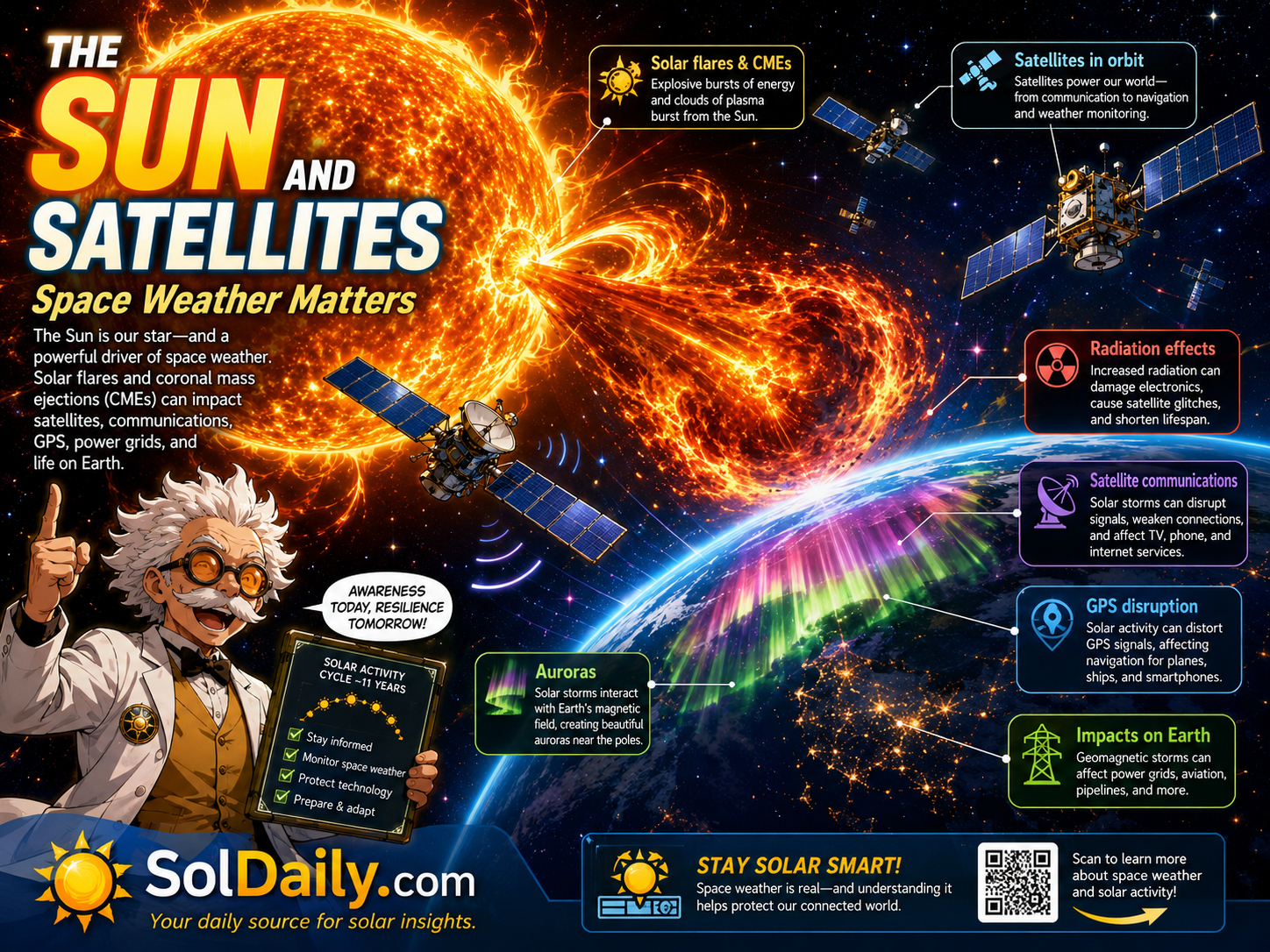
In space, the Sun is both power source and weather maker.
The simple answer
Many satellites use solar panels to convert sunlight into electricity. That electricity helps run instruments, radios, computers, sensors, propulsion systems, and batteries. But satellites also face the Sun’s harsher side: radiation, charged particles, solar storms, and space weather.
Professor Photon loves satellite solar panels because they catch sunlight without clouds or roofs in the way. The Solar Wind Riders remind him that space is not empty peace. Space is a moving solar environment.
Satellites use sunlight for electricity
Satellites commonly use photovoltaic solar panels. These panels convert incoming sunlight into electricity, much like rooftop solar panels do on Earth. In orbit, sunlight can be strong and steady when a satellite is not in Earth’s shadow.
PV Boy calls satellite panels “rooftop solar without the roof.” Solar Sensei immediately corrects him: the engineering environment is very different, but the photon-to-electricity concept is related.
Why satellites need batteries
A satellite may pass into Earth’s shadow during part of its orbit. When that happens, its solar panels cannot receive direct sunlight. Batteries store energy so the satellite can keep operating during eclipse periods or other low-sunlight conditions.
The Solar Man calls satellite batteries “night survival packs.” Professor Photon calls them “temporary photon memory.”
| Satellite solar concept | Plain-language meaning | SolDaily character angle |
|---|---|---|
| Solar array | Panels on a satellite that convert sunlight into electricity. | PV Boy salutes the space panel. |
| Battery | Stores energy for when the satellite is in shadow or needs backup power. | The Solar Man calls it stored daylight. |
| Radiation | Energetic particles and electromagnetic energy that can affect electronics. | Professor Photon puts on serious goggles. |
| Solar flare | A burst of radiation from the Sun that can affect radio and space systems. | Captain Flare interrupts orbit. |
| CME | A large eruption of plasma and magnetic field that can drive geomagnetic storms. | Madame Corona sends the storm cloud. |
The Sun can affect communications
Solar activity can affect radio communication and signals that travel through or near Earth’s ionosphere. Strong solar flares can disturb the upper atmosphere and contribute to radio blackouts. Space weather can also affect communication links involving satellites.
Earth Girl Terra brings this down to daily life: satellites help with phones, television, internet links, weather data, navigation, banking timing, emergency systems, and science. Space weather is not only an astronaut problem.
The Sun can affect GPS and navigation
Navigation systems depend on precise timing and signals from satellites. Disturbances in Earth’s ionosphere can affect how satellite signals travel. During strong space weather, GPS accuracy and reliability can be affected.
Solar Sensei says this is why space weather belongs in a technology classroom. The Sun can disturb the invisible signal paths that modern life depends on.
Radiation can affect electronics
Satellites operate in an environment where radiation can affect electronic components. Energetic particles may cause temporary errors, degrade materials, or damage systems over time. Satellite designers use shielding, hardened components, redundancy, software safeguards, and operational planning to reduce risk.
Professor Photon reminds everyone that not all solar energy is gentle golden light. Some particles and radiation are serious engineering challenges.
Space technology lives without an atmospheric umbrella.
Earth’s atmosphere protects people on the ground from much of the harsh space environment. Satellites operate above that protection, so solar radiation and particles matter more.
Solar storms and satellite drag
Strong solar activity can heat and expand Earth’s upper atmosphere. For satellites in low Earth orbit, this can increase atmospheric drag. More drag can slowly lower a satellite’s orbit and require adjustments.
The Solar Wind Riders love this lesson because it shows that the Sun can reach even into orbital mechanics. Earth’s upper atmosphere responds to solar energy, and satellites feel the consequences.
Solar panels can degrade in space
Satellite solar panels operate in a harsher environment than rooftop panels. Radiation, temperature cycling, micrometeoroids, atomic oxygen in low Earth orbit, and long exposure can reduce performance over time. Engineers account for this when designing missions.
PV Boy respects satellite panels because they keep working while being blasted by space, heated by sunlight, cooled in shadow, and expected to power critical systems.
Space weather forecasting
Agencies and scientists monitor the Sun for flares, CMEs, solar wind changes, radiation storms, and geomagnetic conditions. Space weather forecasting helps satellite operators, aviation, power grid managers, communication systems, and other users prepare for solar disturbances.
Solar Sensei calls forecasting “watching the Sun’s mood before the technology feels it.”
Earth observation satellites
Some satellites watch Earth’s weather, oceans, forests, ice, cities, fires, farms, and atmosphere. These satellites often depend on solar power while also helping humans understand how sunlight interacts with Earth systems.
Earth Girl Terra appreciates the irony: satellites powered by the Sun help us study Earth’s response to the Sun.
Weather satellites and the Sun
Weather satellites help track clouds, storms, temperatures, moisture, and atmospheric motion. Since the Sun helps drive weather, satellites become one of the ways humans observe solar-powered Earth systems in real time.
Captain Flare complains that storms on Earth get more television coverage than solar flares. Solar Sensei tells him to file a media request with the Permit Goblin.
Solar observatories in space
Some satellites and spacecraft are designed specifically to study the Sun. They observe solar radiation, magnetic activity, flares, coronal mass ejections, solar wind, and the corona. These observations help scientists understand the Sun and improve space weather awareness.
The Solar Man sees these observatories as the eyes humanity has placed in the solar wind.
Satellites and solar power on Earth
Satellite data can support solar energy planning by helping track weather, clouds, smoke, atmosphere, and long-term solar resource patterns. The rooftop still matters, but satellite observation helps humans understand larger sunlight patterns.
PV Boy calls this the sky-to-roof connection: satellites watch sunlight from above while panels use sunlight below.
Why this lesson matters
The Sun and satellites matter because modern life depends on space technology. Satellites help with communication, navigation, weather forecasting, Earth observation, science, timing, defense, emergency response, and climate monitoring.
The Solar Man closes the lesson this way: satellites prove the Sun’s double role. It powers the machines, and it tests them.
The Sun and Farming
Come back to Earth and learn how sunlight supports crops, soil temperature, water, seasons, and agricultural solar energy.
Enter the solar fieldThe Sun and Climate
Return to Earth’s energy balance and learn how sunlight, atmosphere, oceans, land, ice, and greenhouse gases shape climate.
Back to climate