Respect the Sun. Watch the data. Do not turn every solar headline into panic.
The simple answer
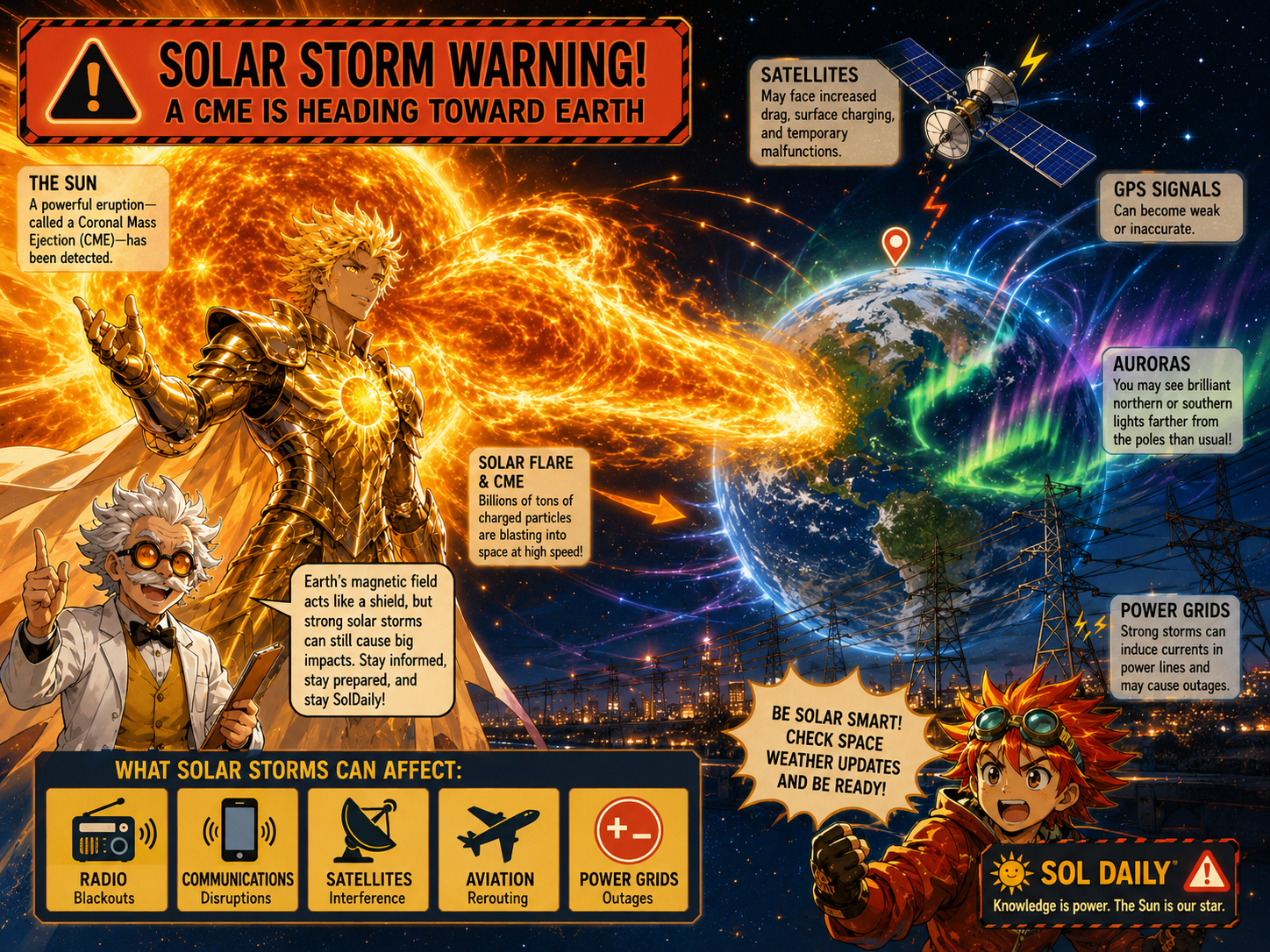
A space weather warning means solar activity may affect conditions around Earth. The warning may involve solar flares, radiation storms, coronal mass ejections, high-speed solar wind streams, geomagnetic storms, or disturbed conditions in Earth’s ionosphere and magnetosphere.
Solar Sensei’s rule is simple: space weather deserves attention, but serious response should come from official alerts, qualified operators, and appropriate technical guidance.
What can trigger a space weather warning?
Space weather warnings can be connected to different solar events. Captain Flare may cause a burst of radiation. Madame Corona may release a CME. The Solar Wind Riders may bring fast charged-particle streams. Earth’s magnetosphere may respond with a geomagnetic storm.
The important point is that “space weather” is not one single thing. Different solar events can affect different technologies in different ways.
| Space weather event | Plain-language meaning | Possible concern |
|---|---|---|
| Solar flare | A sudden burst of radiation from magnetic energy release. | Radio communication, radiation environment, satellite operations. |
| Coronal mass ejection | A large eruption of plasma and magnetic field into space. | Geomagnetic storms if directed toward Earth. |
| Solar radiation storm | Energetic particles associated with solar activity. | Satellites, astronauts, aviation exposure considerations. |
| Geomagnetic storm | Disturbance in Earth’s magnetic environment. | Power systems, pipelines, satellites, auroras, navigation. |
| Ionospheric disturbance | Changes in Earth’s upper atmosphere that affect signal travel. | Radio, GPS, timing, communication reliability. |
Most people on the ground are protected
Earth’s atmosphere and magnetic field provide major protection for people on the surface. Most space weather warnings are not warnings that ordinary people will be directly struck by solar particles on the ground.
Earth Girl Terra asks the practical question: if people are protected, why monitor it? The answer is modern technology. Satellites, signals, grids, aviation, and communications can be more exposed than people standing at ground level.
The concern is usually technology, not sunlight on your skin.
Space weather monitoring matters because modern systems depend on satellites, radio, navigation, timing, aviation routes, and electrical infrastructure.
Satellites may be affected
Satellites operate above much of Earth’s protective atmosphere. Space weather can affect satellite electronics, drag in low Earth orbit, orientation, communications, solar panels, sensors, and operational planning.
Professor Photon says satellites live closer to the wild side of Sol. PV Boy adds that even satellite solar panels must survive a harsher environment than rooftop panels.
GPS and timing can be affected
GPS and other satellite navigation systems depend on precise timing and signals passing through Earth’s upper atmosphere. Space weather can disturb the ionosphere, which may affect accuracy, reliability, and signal behavior.
Earth Girl Terra calls this the invisible problem: nothing looks broken, but timing and signal paths can change.
Radio communication can be affected
Solar flares and ionospheric disturbances can affect radio communication, especially certain high-frequency paths. The impact depends on location, time, frequency, event strength, and the systems involved.
Captain Flare calls this “educational interference.” Solar Sensei calls it a reason to monitor official space weather alerts.
Aviation can be affected
Aviation operators may pay attention to space weather for communication, navigation, and radiation considerations, especially for high-altitude and high-latitude routes. Airlines, dispatchers, and aviation authorities use professional procedures and official information.
SolDaily.com does not provide aviation guidance. It explains why the Sun belongs in the technology conversation.
Power systems can be affected
Strong geomagnetic storms can induce currents in long conductors, which can affect power transmission systems and some infrastructure. Grid operators monitor space weather because severe events may require operational precautions.
The Solar Man keeps this serious: the Sun is not attacking the grid, but large connected systems must respect geomagnetic effects.
Auroras may expand
During geomagnetic storms, auroras can become brighter or visible farther from the poles than usual. This is one of the most beautiful visible signs of space weather.
Earth Girl Terra says the same event can be both a sky show and a technology alert. Solar Sensei says that is why the response must be informed, not emotional.
What should ordinary readers do?
Most ordinary readers do not need to take dramatic personal action for routine space weather warnings. The best general steps are to stay informed, use official sources, avoid spreading panic, and understand that affected industries have operational procedures.
If you depend on sensitive communications, satellite navigation, aviation, off-grid systems, critical electronics, medical devices, or emergency equipment, follow the guidance of the relevant provider, agency, operator, or qualified professional.
What should solar owners know?
For most rooftop solar owners, daily production is shaped far more by local sunlight, clouds, shade, heat, inverter behavior, panel condition, and monitoring than by routine space weather. Do not blame every production dip on the Sunspot Twins, Captain Flare, or a CME.
PV Boy’s rule:
“Check shade, clouds, monitoring, and equipment before blaming space weather.”
What should battery owners know?
Battery owners should understand their normal system operation, backup loads, outage mode, monitoring, and service contacts. Space weather is not the usual reason a battery behaves unexpectedly, but resilient energy planning should always include good monitoring and clear operating instructions.
Solar Sensei says preparedness starts with knowing your own system.
Official sources matter
Space weather can be technical and fast-changing. For real-time alerts, operational decisions, aviation planning, satellite operations, emergency response, or power-grid management, use official space weather centers, utilities, agencies, and qualified experts.
SolDaily.com is educational. It is not an official alerting service.
This page is not an official warning system.
SolDaily explains the concepts. It does not replace NOAA, NASA, space weather centers, utilities, aviation authorities, emergency managers, satellite operators, or qualified technical professionals.
Do not confuse space weather with local weather
Space weather is not rain, clouds, wind, or temperature at your house. Local weather affects your solar panels directly through sunlight, clouds, shade, storms, temperature, soiling, and wind. Space weather affects the near-Earth space environment and technology systems.
Earth Girl Terra writes this in large letters:
“Clouds are local weather. Geomagnetic storms are space weather.”
SolDaily space weather checklist
- Do not panic from a solar headline.
- Check official space weather sources for real-time alerts.
- Understand whether the warning relates to flares, CMEs, radiation, geomagnetic storms, or ionospheric disturbance.
- Remember that most people on the ground are protected by Earth’s atmosphere and magnetic field.
- Recognize that satellites, GPS, radio, aviation, and power systems may be more relevant than ordinary ground exposure.
- Do not blame normal rooftop solar production changes on space weather without checking local and equipment causes first.
- Use qualified professionals for operational, safety, engineering, aviation, grid, or emergency decisions.
Why this warning page matters
Space weather warning pages matter because the Sun is both beautiful and powerful. A solar storm can create auroras, disturb technology, and remind modern civilization that it lives inside a solar environment.
The Solar Man closes the warning:
“The warning and the wonder come from the same star. Respect both.”
Space Weather
Study the broader SolDaily explanation of solar storms, Earth’s magnetosphere, satellites, GPS, radio, power systems, and auroras.
Study space weatherEpisode 9: Space Weather Strikes Earth
Read the manga episode where Earth Girl Terra asks what solar storms mean for modern technology and everyday life.
Read Episode 9