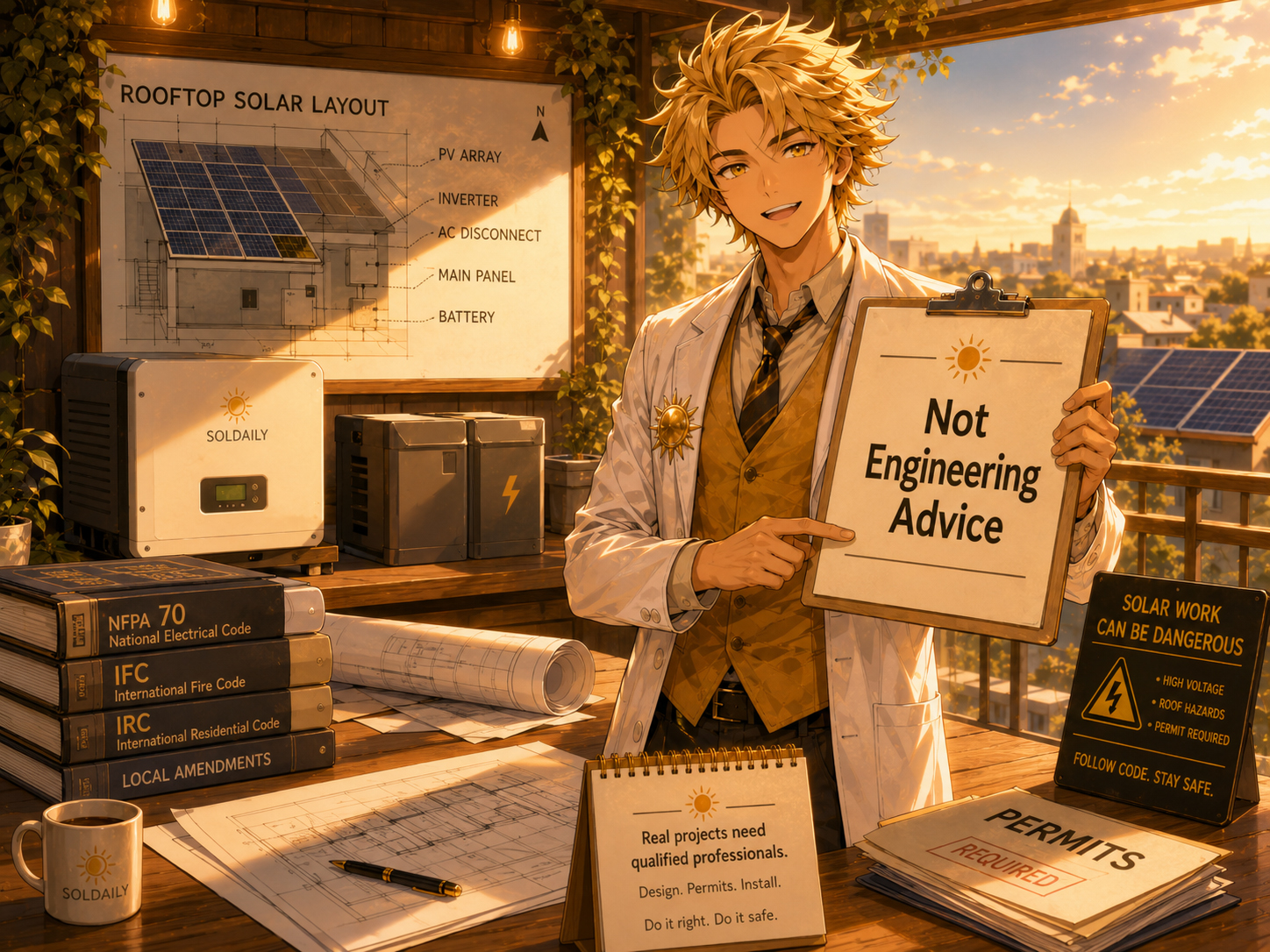
Solar education can explain the parts. Engineering decides what is safe to build.
The simple answer
SolDaily.com is a manga science and solar education site. It helps readers understand the Sun, sunlight, solar panels, inverters, batteries, shade, monitoring, and practical solar concepts. It does not replace licensed engineers, qualified contractors, building officials, utility engineers, fire officials, product manuals, site-specific plans, or code-compliant design documents.
Solar Sensei says the boundary plainly: learning what an inverter does is not the same as designing an electrical system.
What SolDaily may explain
SolDaily may explain broad concepts such as:
- How sunlight reaches solar panels.
- How photovoltaic cells convert light into electricity.
- Why inverters convert DC to AC power.
- Why batteries store energy for later use.
- Why shade, heat, roof direction, and season affect production.
- Why monitoring data matters.
- Why permits, inspections, and utility rules exist.
Those explanations are educational. They are not site-specific engineering.
What SolDaily does not provide
| Project topic | SolDaily may explain | SolDaily does not provide |
|---|---|---|
| Electrical design | Basic roles of panels, inverters, batteries, and wiring. | Conductor sizing, breaker sizing, protection settings, fault calculations, or stamped electrical plans. |
| Structural review | Why roofs and mounting matter. | Load calculations, rafter review, wind uplift design, seismic review, or structural engineering approval. |
| Battery systems | Capacity, power, backup-load concepts, and storage goals. | Battery placement approval, fire-code compliance, thermal analysis, disconnect design, or emergency procedures. |
| Permits | Why permits and inspections exist. | Permit-ready plan sets, jurisdiction-specific code interpretation, or approval guarantees. |
| Utility interconnection | Why utility rules and metering matter. | Utility engineering studies, protection design, transformer approval, or interconnection authorization. |
Electrical design must be site-specific
A safe solar electrical design depends on the actual equipment, voltage, current, service size, panel ratings, wire routes, disconnects, overcurrent protection, grounding, rapid shutdown requirements, inverter architecture, battery equipment, utility rules, and local code requirements.
PV Boy can show the concept. A qualified designer or engineer must produce the buildable design.
A diagram is not a permit plan.
SolDaily diagrams are for education. Real solar projects need equipment-specific, code-compliant, site-specific design and approval.
Structural review is not optional
Solar panels, racking, ballast, attachments, conduit, batteries, and equipment all add physical realities to a building. Roof condition, framing, wind uplift, seismic forces, waterproofing, drainage, access, and maintenance must be reviewed for the actual site.
Solar Sensei says the Sun may be weightless light, but the equipment is not weightless.
Roof waterproofing requires real workmanship
SolDaily may explain why mounting and waterproofing matter, but it does not teach a reader how to flash a roof, penetrate a roof, install a tile mount, repair a membrane, or guarantee leak prevention.
Roof work should be handled by qualified professionals using appropriate methods for the roof type, mounting system, local conditions, and permit requirements.
Battery systems require serious design
Batteries store energy and can introduce fire, electrical, thermal, ventilation, access, emergency-response, communication, and control concerns. Battery placement, clearances, disconnects, wiring, overcurrent protection, monitoring, and code compliance must be handled properly.
The Solar Man calls batteries stored daylight. Solar Sensei adds: stored energy must be respected.
Inverters and controls are not plug-and-guess equipment
Inverters may manage DC-to-AC conversion, battery charging, backup operation, grid synchronization, rapid shutdown, monitoring, and communication. Settings and wiring can affect safety, utility compliance, and system behavior.
PV Boy says inverter programming is not a place for casual guessing.
Backup power needs load calculations
Backup power design requires knowing which loads must operate, how much power they draw, how long they must run, whether they have startup surge, and what the battery and inverter can actually support.
Earth Girl Terra asks the correct field question: what must stay on, and for how long?
Utility interconnection requires approval
Grid-connected solar systems must meet utility interconnection rules. Utilities may review system size, inverter type, export settings, meter configuration, transformer capacity, protection requirements, and operational limits.
The Permit Goblin may make interconnection paperwork funny, but the utility approval is real.
Codes and standards change
Electrical codes, building codes, fire codes, utility rules, product listings, equipment instructions, and local enforcement practices can change. SolDaily pages may become outdated or may not match a specific jurisdiction.
Do not use a general education page as a code book.
Product manuals control product installation
Solar panels, inverters, batteries, racking, disconnects, optimizers, microinverters, and monitoring equipment have manufacturer instructions. Those instructions matter for safety, warranty, listing, and code compliance.
Solar Sensei says the manga panel is not the manual.
Do not use SolDaily for emergency procedures
SolDaily is not an emergency operations guide for battery fires, electrical faults, arc faults, roof hazards, outage response, wildfire, flooding, storm damage, or downed utility lines.
If there is an emergency, contact emergency services and follow instructions from qualified responders, utilities, and authorities.
Do not use SolDaily for worker training
Solar construction involves fall hazards, electrical hazards, lifting, roofing, ladders, battery hazards, arc flash concerns, tools, traffic, heat, and site safety. SolDaily does not train workers or replace OSHA, employer safety programs, manufacturer training, or qualified supervision.
Captain Flare is not allowed on the jobsite. That should tell you something.
Do not use SolDaily for plan check responses
SolDaily pages may help explain a concept, but they are not plan-check responses, engineering letters, correction letters, stamped calculations, structural notes, electrical one-lines, battery layout approvals, or fire-department submittals.
A real plan check deserves project-specific documents.
When to call a qualified professional
Contact a qualified professional when the question involves:
- Electrical design or panel interconnection.
- Breaker, conductor, conduit, grounding, or protection sizing.
- Structural loads, roof framing, or wind uplift.
- Roof penetrations, flashing, waterproofing, or repairs.
- Battery placement, fire clearance, disconnects, or backup design.
- Utility interconnection or export limits.
- Permit drawings, inspections, or code corrections.
- Worker safety, emergency procedures, or hazardous conditions.
What readers can safely take from SolDaily
Readers can use SolDaily to understand vocabulary and general concepts. It is useful for learning the difference between DC and AC, panels and inverters, batteries and generators, shade and production, grid-tied and backup systems, and solar science and solar construction.
That understanding can help readers ask better questions. It should not replace professional design.
SolDaily engineering-boundary checklist
- Use SolDaily for education, not construction.
- Do not build from SolDaily diagrams.
- Do not size wires, breakers, batteries, inverters, or racking from SolDaily pages.
- Do not treat SolDaily as a code book or permit set.
- Do not treat SolDaily as utility approval.
- Do not treat SolDaily as manufacturer instructions.
- Use licensed contractors, engineers, building officials, utility representatives, and product manuals for real projects.
Why this page matters
Solar education should make people smarter, not overconfident. The Sun is inspiring, and solar technology is powerful, but buildings, roofs, electrical systems, batteries, and utility grids require professional care.
Solar Sensei closes the lesson:
“Understand the system. Then let qualified people design what must be built.”
Solar Lessons from ABC Solar
Read the field-reality bridge page on roofs, shade, electrical review, batteries, permits, monitoring, and honest solar expectations.
Read field lessonsSolDaily Disclaimer
Review the broader SolDaily educational limits for engineering, medical, astronomy, legal, financial, and emergency topics.
Read disclaimer